 How-to
What Roadside Assistance Do Delivery Vans Actually Need?
Last Updated: October 25, 2026
Quick Summary
Roadside assistance delivery vans provide 24/7 emergency response, heavy-duty towing for loaded vehicles weighing 10,000-15,000 pounds, on-site mobile repair, and cargo management, services designed to minimize downtime and protect business continuity beyond what standard personal roadside plans offer.
- Delivery van breakdowns require heavy-duty tow trucks rated for commercial weight, not standard 7,000-pound capacity trucks.
- On-site mobile repair for flat tires, batteries, and lockouts can get vans back on the road in 15-30 minutes.
- Many personal roadside plans explicitly exclude commercial use, making commercial coverage essential for delivery operators.
- Response time for commercial roadside assistance aims faster than personal plans' 30-60 minute standard.
- Preventive maintenance including tire pressure checks, battery testing, and brake inspections prevents most common roadside emergencies.
Table of Contents
- Why Roadside Assistance for Delivery Vans Differs From Standard Coverage
- Core Services: What Roadside Assistance for Delivery Vans Includes
- Commercial Roadside Assistance Coverage: What Delivery Operators Need to Know
- Delivery Van Flat Tire Assistance: Handling Loaded Vehicles
- Commercial Vehicle Towing: What Happens After a Breakdown
- Building a Fleet Breakdown Response Plan
- Choosing the Right Provider for Your Delivery Fleet
- Getting Your Delivery Fleet Ready for Roadside Emergencies
- Frequently Asked Questions
Why Roadside Assistance for Delivery Vans Differs From Standard Coverage
Roadside assistance delivery vans aren't a scaled-up version of personal coverage. A breakdown doesn't just strand a driver, it disrupts deliveries, damages your reputation, and costs money every idle hour.
Personal plans assume one driver and one vehicle, built around getting someone home or to a mechanic. Delivery operations run tight schedules with loaded cargo and time-sensitive commitments.
The vehicle itself differs too. Delivery vans carry weight differently, sit lower, work harder, and face unique failure points, tires, suspensions, brakes. Standard plans cover the basics but miss these challenges.
That's where roadside assistance delivery vans become essential: faster response, equipment for loaded vehicles, and coverage protecting business continuity, not just the vehicle.
Core Services: What Roadside Assistance for Delivery Vans Includes
24/7 Dispatch and Emergency Response
Real roadside assistance for delivery vans runs around the clock, a 10 p.m. Sunday breakdown costs as much as one at 2 p.m. Tuesday.
Dispatch must locate the vehicle, understand the problem, and send help fast. Commercial providers often maintain a network trained for commercial vehicles, logging location, cargo type, and urgency, a van stuck on a highway at rush hour may get different priority than one at a distribution center.
Response time is a key differentiator. Personal plans often promise 30-60 minutes; commercial roadside assistance for delivery vans aims for faster response times. The faster you move again, the fewer deliveries you miss.
Towing and Vehicle Recovery
When roadside repair isn't possible, the van must move. A loaded delivery van can weigh 10,000-15,000 pounds; standard tow trucks handle about 7,000. Overloading damages the truck and risks the load.
Commercial roadside assistance for delivery vans includes heavy-duty tow trucks rated for commercial weight. A provider can coordinate with your dispatch to repair on-site, tow to your preferred mechanic, or tow to a service center, usually to get the van back in service fast, not to the nearest shop.
Recovery covers accidents too: winch-out services extract a collision- or rollover-disabled van safely without compounding damage, using specialized equipment and trained operators.
On-Site Mobile Repair
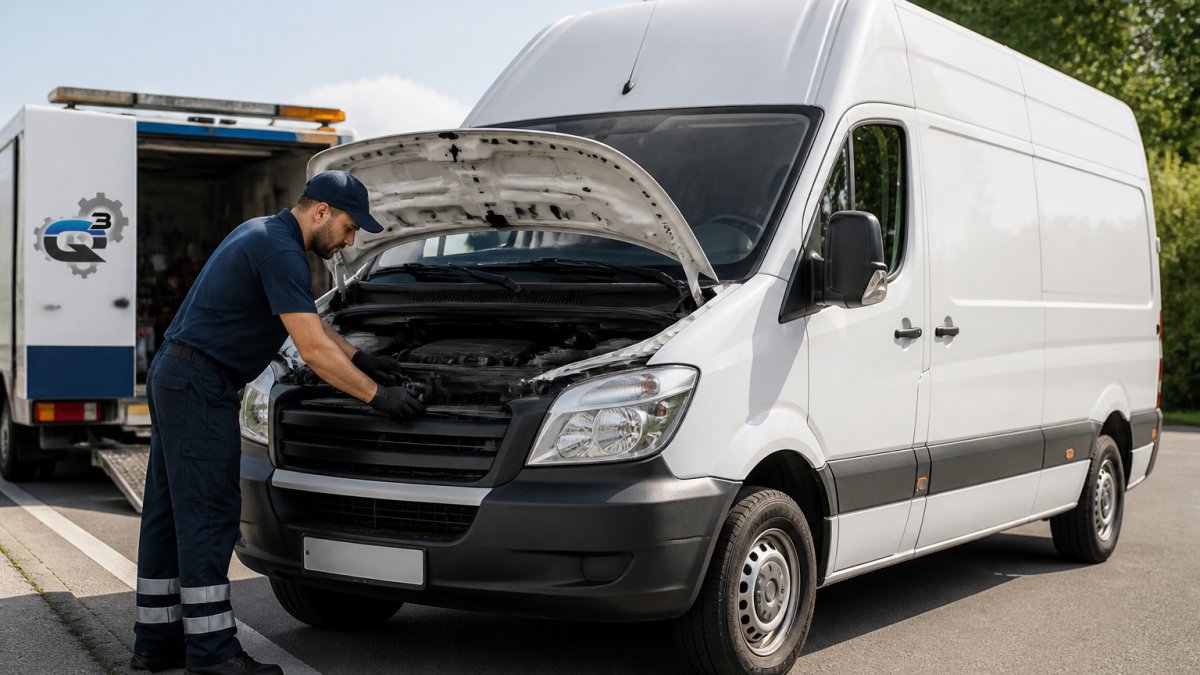
Not every breakdown needs a tow. Dead batteries, flat tires, lockouts, and fuel delivery can be fixed roadside in 15-30 minutes. Mobile units carry tire plugs, jumper packs, basic tools, and fuel cans, 20 minutes back on the road beats two hours waiting for a tow.
A technician assesses the problem, determines if roadside repair is safe and practical, then fixes it or arranges towing, flexibility that saves hours and keeps the route moving.
Commercial Roadside Assistance Coverage: What Delivery Operators Need to Know
Commercial Vehicle Eligibility and Exclusions
Many personal plans explicitly exclude business use, fine print like "personal use only" or "excludes commercial operation" is a deal-breaker for delivery operators.
Commercial roadside assistance for delivery vans is built for business use, but eligibility varies: some plans require commercial registration, others cap weight, and some exclude certain vehicle types.
Before signing up, ask directly: Does it cover your vehicle type? What's the weight limit? Are there cargo exclusions (hazmat, high-value goods) or restrictions on towing distance and service area?
Coverage Limits and Service Area
Coverage limits define what the plan pays for. Coverage limits define what a plan pays for. Limits vary, some cap towing at a certain mileage or charge per mile after. Service area matters too: a network may exclude rural areas or limit certain states.
Match service area to your routes: three-state delivery needs coverage in all three, urban work needs strong metro coverage, and rural routes need different coverage.
Delivery Van Flat Tire Assistance: Handling Loaded Vehicles
Flat tires are the most common roadside emergency, and more complicated on a loaded van.
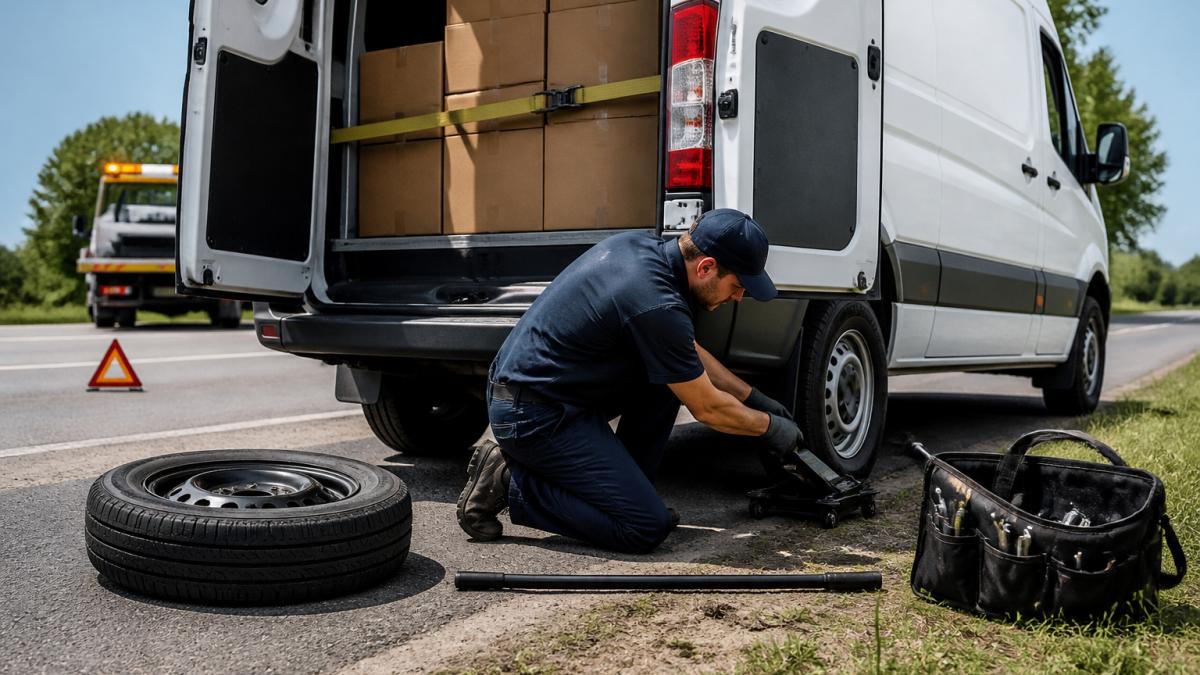
When a rear tire fails on a loaded van, the technician must stabilize the vehicle with the load aboard, often requiring heavy-duty jacks, wheel blocks, and sometimes a second vehicle.
Standard roadside assistance often sends a passenger-car tire kit, which doesn't work for commercial vans. Learn fleet tire management best practices for handling flat tires on loaded delivery vehicles.
A spare isn't always practical, many modern vans use run-flats or lack a full-size spare, so roadside assistance repairs on-site or tows to a shop.
Commercial Vehicle Towing: What Happens After a Breakdown
Winch-Out and Accident Recovery
Not all breakdowns happen on flat ground. A van can slide off a slippery road, get stuck in mud, or land in a ditch, situations where standard towing fails and winch-out services are necessary.
Winch-out requires a heavy-duty recovery vehicle with a winch rated for the van's weight plus cargo. The operator secures cables to the frame (not the bumper, which will tear off) and pulls the vehicle to solid ground, specialized work that takes longer and costs more, but is essential when a van is truly stuck.
Accident recovery is similar: a collision-damaged van may not be drivable, so recovery vehicles extract it safely, often with air bags or spreaders to manage damage and protect cargo.
Cargo and Route Continuity
Here's where commercial roadside assistance for delivery vans differs most: cargo management. A personal vehicle's belongings stay with the car; a delivery van's cargo is the business and must reach the customer on time.
Some commercial plans include cargo transfer: if a van can't be repaired quickly, a backup vehicle may pick up the cargo and continue the route, helping to keep deliveries on schedule.
Even without cargo transfer, a good plan coordinates with dispatch to minimize disruption, prioritizing fast repair or towing to a shop that can turn the van around quickly.
Building a Fleet Breakdown Response Plan
Preventive Maintenance and Downtime Reduction
The best roadside assistance is the one you never use. Prevent commercial vehicle breakdowns with a step-by-step approach to reducing roadside emergencies. Preventive maintenance, regular inspections of tires, brakes, batteries, and fluid levels, prevents most common breakdowns.
For a delivery fleet, preventive maintenance pays back directly: an under-inflated tire, a dying battery, or a failing brake system could all have been caught and serviced before becoming a roadside emergency.
Many operators use a simple pre-shift checklist, tire pressure and condition, battery voltage, brake fluid, coolant, oil, that takes 10 minutes and catches most problems early.
A documented maintenance history also helps: it proves the vehicle was well-maintained for insurance or warranty claims and informs the roadside technician.
Driver Training and Emergency Procedures
Good training covers where to pull over safely, activating hazard lights, calling dispatch with accurate location information, and what to do while waiting.
Emergency procedures: stay in or near the vehicle with hazards on, stay visible and safe, don't attempt untrained repairs, and keep the line open with dispatch, on highways, stay off the shoulder and away from traffic.
Choosing the Right Provider for Your Delivery Fleet
Response Time and Local Coverage
When evaluating roadside assistance for delivery vans, response time is important. Ask: What's the average response time in your service area? Is it guaranteed or an estimate? What happens if they miss it?
Local coverage matters as much as speed, a nationwide network is useless if the nearest technician is 90 minutes away. Ask where their partners are located in your operating areas and whether urban-versus-rural coverage matches your routes.
Ask about service guarantees too: some plans promise response within a timeframe or offer credit if they miss it.
Transparent Pricing and Fleet Agreements
Pricing for roadside assistance for delivery vans varies widely. Some plans charge per vehicle per month, others charge per incident, and some offer tiered coverage with different limits and costs.
Transparent pricing means understanding exactly what you're paying for and what's included. Ask: What services are included? Are there limits on towing distance, repair costs, or number of calls per year? What's not covered?
Fleet agreements often offer better rates than individual plans. If you have multiple vans, ask about fleet pricing. Some providers may offer dedicated dispatch lines, priority response, or customized coverage for your specific needs.
Avoid plans with hidden fees. Some charge extra for certain services (winch-out, fuel delivery, locksmith) or add surcharges for rural areas.
Getting Your Delivery Fleet Ready for Roadside Emergencies
Roadside assistance is your safety net, but preparation is your first line of defense. Start by documenting your fleet: vehicle make, model, year, VIN, current mileage, and maintenance history.
Set up a maintenance schedule and stick to it. Regular tire rotations, brake inspections, battery testing, and fluid checks prevent most breakdowns. Reduce fleet maintenance costs while implementing preventive strategies that minimize downtime.
Establish a clear breakdown protocol. Drivers should know: call dispatch immediately, provide accurate location and vehicle information, stay safe while waiting for help, and document what happened.
Finally, choose roadside assistance that aligns with your operation. If you run a small fleet of 3-5 vans in urban areas, a local provider with strong metro coverage might be ideal.
The right roadside assistance for delivery vans keeps your operation moving. It protects your business continuity, reduces downtime costs, and gives your drivers confidence that help is available when they need it.
Breakdowns happen, and when they do, your response determines whether your customers get their deliveries on time. Q3 Car & Truck Repair helps delivery operators build preventive maintenance plans that reduce emergencies in the first place. Request Appointment to discuss a maintenance strategy that keeps your fleet running and your routes on schedule.
| Service | Coverage | Best For |
|---|---|---|
| 24/7 Dispatch | Emergency response, nationwide network | All delivery operations |
| Roadside Repair | Flat tires, battery, lockout, fuel | Quick fixes, minimal downtime |
| Towing | Heavy-duty tow trucks, up to 100 miles | Major breakdowns, engine failure |
| Winch-Out Recovery | Off-road extraction, accident recovery | Difficult terrain, collision damage |
| Mobile Technicians | On-site diagnosis and repair | Immediate problem-solving |
Frequently Asked Questions
What roadside assistance services do delivery vans need?
Delivery vans need 24/7 emergency response, flat tire assistance for loaded vehicles, battery jump-starts, fuel delivery, towing and vehicle recovery, and mobile roadside repairs. Unlike personal vehicles, commercial delivery vans also require coverage that accounts for cargo, route continuity, and faster response times to minimize lost revenue. Confirm with your provider that commercial vehicles are eligible and that service calls include dispatch coordination for fleet logistics.
Does standard roadside assistance cover commercial delivery vans?
Most standard personal roadside assistance plans exclude or limit coverage for commercial vehicles. Many providers classify delivery vans as commercial vehicles and either deny coverage or charge higher premiums. When selecting commercial roadside assistance coverage, verify that your provider explicitly covers commercial vehicles, specifies response times, defines service area boundaries, and clarifies any exclusions related to vehicle weight, cargo type, or business use. Read the policy carefully before signing.
How can a delivery fleet reduce downtime after a breakdown?
Build a fleet breakdown response plan that includes preventive maintenance schedules to catch issues before they strand a vehicle, driver training on basic emergency procedures, and a relationship with a roadside assistance provider offering fast local response. Keep spare parts on hand for high-failure items. When a breakdown occurs, contact your provider immediately with your vehicle location, cargo details, and destination. Coordinate with dispatch to reassign loads or arrange backup delivery capacity while the vehicle is being recovered or repaired.
Can roadside assistance help with a flat tire on a loaded delivery van?
Yes, but delivery van flat tire assistance is more complex than standard tire changes.
Supporting Keyword Coverage:
- FMCSA Commercial Vehicle Safety Standards
- Commercial Fleet Maintenance Best Practices Guide
- Vehicle Breakdown Response Protocols