 ultimate-guide
Fleet Tire Management: Best Practices Guide
Table of Contents
- Why Fleet Tire Management Matters
- Establishing a Tire Performance Baseline
- Building a Preventative Maintenance Schedule for Fleet Tires
- Fleet Tire Inspection Checklist and Driver Reporting
- Tire Pressure Monitoring and Inflation Management
- Fleet Tire Cost Per Mile Calculation and Tracking
- Tire Retread Management Programs
- Digital Tools and Telematics Integration
- Frequently Asked Questions
Last Updated: October 2, 2026
Why Fleet Tire Management Matters
Tire failures don't announce themselves. They happen on the highway at 65 mph, in the middle of a delivery route, or when you can least afford downtime.
Fleets with structured tire management programs pay half as much per mile as those treating it as an afterthought. Poor fleet tire management extends beyond replacement expenses into fuel efficiency, vehicle downtime, and liability exposure.
Establishing a Tire Performance Baseline
A baseline answers fundamental questions: How long do your tires actually last? What causes most failures? Where are you bleeding money?
Start by collecting data on your current tire inventory.
Without baseline data, you're making maintenance decisions in the dark.
Document your baseline in a spreadsheet or fleet management system. Include vehicle ID, tire specifications, purchase date, replacement date, mileage at replacement, and failure reason.
Building a Preventative Maintenance Schedule for Fleet Tires
A structured preventative maintenance schedule prevents most tire failures before they happen, extends tire life, and reduces emergency repairs.
Setting PM Triggers and Inspection Intervals
PM triggers are conditions that signal inspection or service needs. Mileage-based triggers (every 10,000 miles) are more reliable than time-based triggers because they account for actual vehicle use.
Establish clear inspection intervals based on operating environment. High-mileage routes need more frequent checks than local, low-speed routes.
Document PM triggers in writing and communicate them to drivers and maintenance staff. Make inspections automatic, not something that gets skipped when schedules get tight.
Tire Rotation and Alignment Best Practices
Tire rotation moves tires to different positions, evening out wear patterns and extending tire life.
Rotate tires every 10,000 to 15,000 miles. Consistency is key; vehicles that skip rotations see significantly shorter tire life.
Wheel alignment directly impacts tire wear. Misaligned wheels cause uneven wear and premature failure. Check alignment annually or when uneven wear appears. Poor alignment can reduce tire life by 25% or more.
Worn shocks, struts, or bushings throw alignment off and accelerate tire wear. Include suspension checks in preventive maintenance.
Fleet Tire Inspection Checklist and Driver Reporting
What to Check During Routine Inspections
Use a tread depth gauge to measure depth at multiple points.
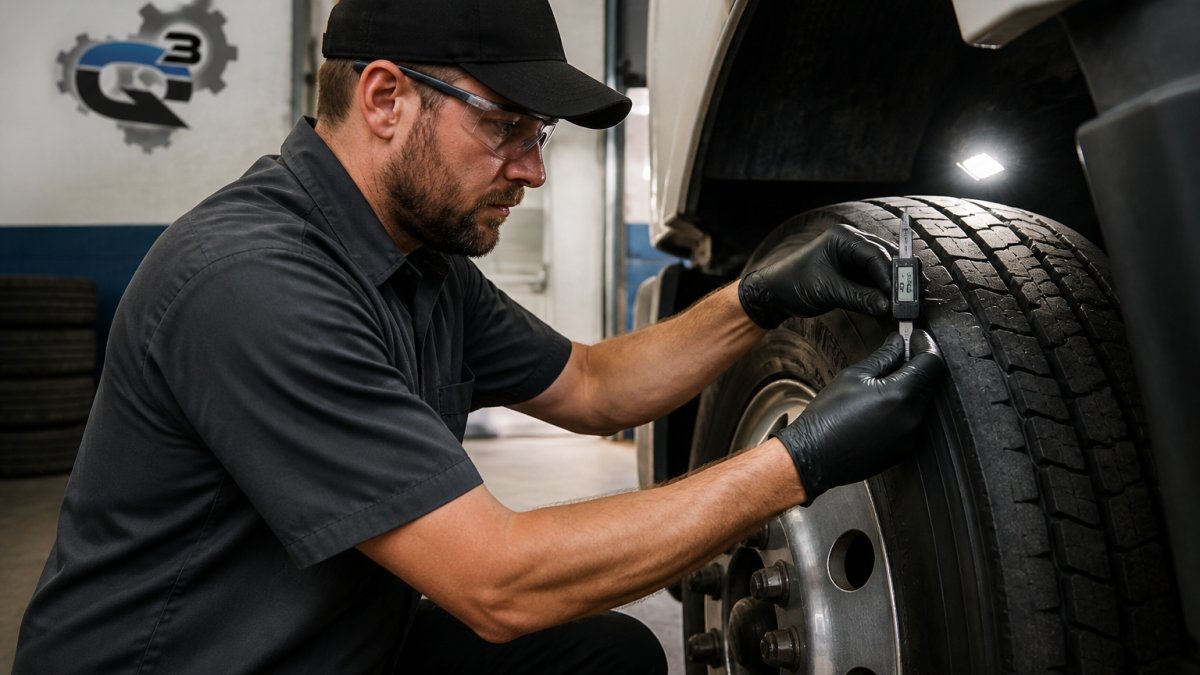
Inspect sidewalls for cuts, bulges, cracks, or blistering. Any sidewall damage requires replacement; sidewalls cannot be repaired.
Inspect the valve stem. A leaking or damaged valve stem causes slow pressure loss.
Document every inspection. Record the date, vehicle, tire position, tread depth, condition notes, and any action taken.
Helping Drivers to Report Tire Issues
Create a simple driver reporting system (form or mobile app) for tire observations: vibration, pulling, unusual noise, visible damage, or pressure warning lights.
Respond to driver reports quickly. Quick response builds trust and turns drivers into your early warning system.
Train drivers to recognize tire problems. A brief training session on tire safety pays for itself in prevented failures.
Tire Pressure Monitoring and Inflation Management
Tire pressure is the most controllable factor affecting tire life and fuel efficiency.
Check tire pressure monthly at minimum using a calibrated gauge. A tire can look properly inflated when it's actually 10% low.
Track pressure over time to identify slow leaks.
Adjust pressure based on load and temperature. Tire pressure increases with heat; account for this when setting target pressure.
Fleet Tire Cost Per Mile Calculation and Tracking
Cost per mile (CPM) combines tire cost, labor, and longevity into a single metric that drives tire management decisions.
How to Calculate Cost Per Mile
Calculate CPM for each tire model: (Tire Cost + Rotation Labor + Alignment Labor) ÷ Tire Life in Miles = Cost Per Mile. Example: ($150 + $20 + $30) ÷ 50,000 = $0.004 per mile. Track this for every tire model; a tire costing $20 more but lasting 10,000 additional miles often delivers lower CPM.
Using CPM Data to Optimize Tire Spending
CPM data reveals which tire models deliver the best value and exposes the cost of poor maintenance practices.
Use CPM to justify maintenance investments. Better alignment reducing tire wear by 15% translates directly to lower CPM.
Compare CPM across vehicle types and routes to identify where special tire specifications might reduce costs.
Tire Retread Management Programs
Retreading extends tire life significantly. A retread takes a worn casing and applies new tread material, creating a tire that performs nearly as well as a new tire at a fraction of the cost. For fleets, retread programs are often the single biggest opportunity for cost reduction.
When Retreading Makes Financial Sense
Retreading works when the casing is still structurally sound. The casing is the internal structure of the tire, the sidewalls, belts, and fabric layers that give the tire its strength.
A tire is a candidate for retreading when tread is worn but the casing is intact. Inspect the sidewalls and internal structure carefully.
Retread economics are compelling. A new tire might cost $150 and last 50,000 miles. A retread might cost $60 and last 40,000 miles.
Casing Management and Retreadability Standards
Casing management means treating casings as assets to be preserved and reused rather than as disposable components.
Establish casing standards. Document which casings are retreatable and which are damaged beyond repair.
Track casings through their lifecycle. A casing might be retreaded three or four times before it finally fails.
Work with a quality retread shop. Not all retreaders deliver the same quality.
Digital Tools and Telematics Integration
Modern fleet management software and telematics systems transform tire management from manual tracking to automated, data-driven processes. These tools catch problems early and provide visibility into tire performance across your entire fleet.
Fleet Management Software for Tire Tracking
Fleet management software centralizes tire data. Instead of spreadsheets scattered across your operation, all tire information lives in one system.
Automated alerts notify maintenance staff when PM is due. A vehicle hits 10,000 miles, the system flags it for rotation.
Digital inspection forms replace paper checklists. Technicians enter data directly into the system during inspections.
Tools like Fleetio, FleetRabbit, and Simply Fleet offer tire-specific tracking modules.
Real-Time Tire Pressure Monitoring Systems
TPMS hardware sends real-time pressure and temperature data from each tire to a central system.
Real-time monitoring catches slow leaks before they become failures.
Temperature monitoring reveals tire stress. A tire running hotter than normal might be under-inflated, overloaded, or experiencing alignment issues.
Integration with fleet management software means tire data flows into maintenance planning automatically.
Effective fleet tire management combines structured processes, consistent execution, and modern tools.
At Q3 Car & Truck Repair, we understand that fleet maintenance is about reliability. Our team works with fleet operators to deliver measurable results through transparent communication, skilled technicians, and genuine focus on your vehicle's performance. Whether you're managing a small fleet or scaling operations, proper tire management starts with the right foundation and the right partner. Request an appointment to discuss how we can help optimize your fleet's tire program.
| Maintenance Task | Frequency | Purpose |
|---|---|---|
| Tire pressure check | Monthly minimum | Prevent underinflation and fuel loss |
| Tread depth measurement | Monthly minimum | Track wear and plan replacement |
| Tire rotation | Every 10,000-15,000 miles | Even out wear patterns |
| Wheel alignment check | Annually or when wear is uneven | Prevent premature wear and fuel loss |
| Sidewall inspection | Monthly | Catch damage before failure |
| Casing evaluation | At replacement | Determine retread candidacy |
EXTERNAL SOURCES FOR FURTHER READING:
For regulations on tire safety standards, consult National Highway Traffic Safety Administration tire safety guidance. The Tire Industry Association best practices for fleet tire management provides detailed technical standards for preventive maintenance. Fleet operators seeking cost optimization frameworks should review American Trucking Association guidance on fleet operational efficiency.
Frequently Asked Questions
What are the key performance indicators (KPIs) for fleet tire management?
The most important KPIs include cost per mile (total tire spending divided by miles driven), tire lifespan in months or miles, tread depth at retirement, uneven wear patterns, and downtime caused by tire failures. Track inflation pressure compliance, rotation frequency, and the percentage of casings suitable for retreading. These metrics help identify inefficiencies and justify investment in preventative maintenance. Monitor them monthly to spot trends early and adjust your fleet tire management program before costs spike.
How does a tire management program reduce total cost of ownership?
A structured fleet tire management program reduces costs by extending tire life through proper inflation and rotation, preventing premature failures that cause roadside breakdowns and downtime. Regular inspections catch wear patterns early, allowing corrective alignment adjustments before tires fail. Retreading programs recover value from serviceable casings. Preventative maintenance eliminates emergency repairs, which cost far more than scheduled service. Tracking cost per mile reveals which vehicles or driving behaviors drive tire wear, enabling targeted driver training or vehicle adjustments that lower overall fleet tire spending.
When should a fleet manager consider tire retreading?
Retreading is cost-effective when casings are structurally sound with no sidewall damage, belt separation, or repairs. Inspect the casing for retreadability before retirement. Retreads typically cost 40-60% less than new tires and extend casing life by one or more additional cycles. Retreading works best for tires on long-haul or highway vehicles where steady speeds and predictable wear patterns preserve casing integrity. Urban delivery or severe-duty vehicles with aggressive wear may not yield retreadable casings. Establish a casing management program to identify and segregate retreadable tires immediately after removal.
How often should fleet tires be inspected for safety and wear?
Conduct visual inspections at every fuel stop or weekly at minimum. Use a formal digital fleet tire inspection checklist monthly to document tread depth, pressure, and wear patterns. Heavy-duty fleet vehicles should undergo detailed inspections every 10,000-15,000 miles or quarterly, whichever comes first. Align inspection intervals with your preventative maintenance schedule and vehicle duty cycle. More frequent inspections catch alignment issues, underinflation, and uneven wear early, preventing catastrophic failures and extending tire life significantly.
What role does tire pressure monitoring play in fleet maintenance?
Tire pressure monitoring systems (TPMS) and regular manual checks prevent underinflation, which increases rolling resistance, reduces fuel efficiency, and accelerates tire wear. Underinflated tires generate excess heat and fail prematurely, causing costly roadside breakdowns. Real-time TPMS alerts fleet managers to pressure drops from punctures or temperature changes before they become safety hazards. Maintaining correct inflation pressure extends tire life by 10-15% and improves fuel economy. Integrate TPMS data with your fleet management software to track pressure trends and identify vehicles with chronic underinflation.
What is the role of driver training in fleet tire management?
Drivers directly influence tire longevity through acceleration, braking, cornering, and load awareness. Aggressive driving, speeding, and hard braking accelerate wear and cause uneven wear patterns. Train drivers to recognize tire issues (bulges, unusual vibration, pressure warning lights) and report them immediately using your fleet tire inspection checklist. Provide feedback on fuel efficiency and smooth driving, which also protects tires. Driver accountability programs tied to tire performance metrics encourage ownership and reduce preventable wear. Regular training reinforces the connection between driver behavior and fleet tire costs.
How do I choose the right fleet management software for tire tracking?
Look for software that automates preventative maintenance scheduling, tracks tire rotations and replacements, calculates cost per mile, and integrates with telematics or TPMS data. The platform should support mobile inspections so technicians and drivers can log tire conditions in real-time. Ensure it generates reports on tire performance metrics, uneven wear patterns, and casing retreadability. Consider whether you need full fleet management (fuel, maintenance, repairs) or a specialized tire-focused tool. Evaluate ease of use for your team, integration with existing systems, and whether the vendor offers training or support for implementation.
What should I include in a tire disposal and sustainability plan?
Establish relationships with certified tire recyclers or retreaders to manage end-of-life tires responsibly. Segregate retreadable casings from scrap tires immediately after removal. Track where tires go and ensure compliance with state regulations on tire disposal (many states restrict landfill dumping). Partner with recyclers that process tires into rubberized asphalt, playground surfaces, or other products. Document your sustainability efforts; many customers and regulators increasingly value environmental responsibility. Proper disposal also reduces liability and demonstrates corporate stewardship to stakeholders.