 How-to
How to Reduce Fleet Maintenance Costs: 7-Step Plan
Last Updated: October 23, 2026
Quick Summary
To reduce fleet maintenance costs, build a baseline of cost per mile and cost per vehicle per month, then make preventive fleet maintenance the default so scheduled service replaces costly reactive repairs. Track every unit, control repair approvals and parts sourcing, and use total cost of ownership to decide when to replace a vehicle.
- Pull twelve months of repair invoices and sort them into scheduled service, unscheduled repairs, tires, and everything else.
- Set a rule that no vehicle goes past its service interval, and assign one person to own the schedule.
- Require a written estimate before approving any repair, then audit each invoice against it line by line.
- Use driver-level approval under $250-$500 per event and manager approval above that.
- Compare the next major repair to the vehicle's current market value before approving it.
Table of Contents
- Step 1: Build a Baseline Before You Cut Anything
- Step 2: Make Preventive Fleet Maintenance the Default
- Step 3: Set a Fleet Maintenance Schedule by Vehicle Type
- Step 4: Use a Fleet Maintenance Checklist on Every Unit
- Step 5: Put Fleet Maintenance Tracking Software to Work
- Step 6: Control Repair Approvals, Parts, and Vendors
- Step 7: Calculate Total Cost of Ownership and Plan Replacements
- Conclusion: Track Results and Protect Uptime
- Frequently Asked Questions
Step 1: Build a Baseline Before You Cut Anything
You cannot lower fleet maintenance costs without knowing where they stand today.
Start by pulling every repair invoice, parts receipt, and service record from the past twelve months.
Then calculate two figures:
- Cost per mile for each vehicle
- Cost per vehicle per month across the whole fleet
Most fleets never do this. They pay invoices as they arrive and never look at the trend line.
Owners know something feels expensive, but they cannot point to which truck is eating the budget.
Step 2: Make Preventive Fleet Maintenance the Default
Reactive repair almost always costs more than planned service. A skipped oil change becomes a worn engine (Why Skipping an Oil Change Could Cost You Big).
Preventive fleet maintenance means servicing vehicles on a schedule before parts fail.
The shift requires a policy, not good intentions. Set a rule: no vehicle goes past its service interval, period. Assign one person to own the schedule.
If you need a shop that can handle scheduled service for multiple vehicles without drama, preventive maintenance in Capitol Heights is where we start most fleet relationships.
What Preventive Maintenance Actually Prevents
- Engine damage from overdue oil and filter changes
- Cooling system failures from neglected coolant and hoses
- Brake problems caught at inspection instead of on the road
Early Fault Detection and Predictive Maintenance
Predictive maintenance goes one step further. It uses data to catch faults before they become failures.
Telematics and GPS tracking now flag trouble codes, odd vibration patterns, and fluid temperature spikes in real time.
You do not need a huge budget for this. Even basic telematics paired with a monthly review of fault codes moves you from reactive to proactive maintenance.
Step 3: Set a Fleet Maintenance Schedule by Vehicle Type
A fleet maintenance schedule should match how each vehicle is used, not a generic sticker on the windshield.
Use this starting framework and adjust with your shop:
| Vehicle Type | Oil and Filter | Full Inspection | Tire Rotation |
|---|---|---|---|
| Light-duty pickup | 5,000-7,500 miles | Every 15,000 miles | Every 6,000 miles |
| Cargo van | 5,000-7,500 miles | Every 12,000 miles | Every 6,000 miles |
| Heavy commercial truck | Per manufacturer spec | Every 10,000 miles | Every 8,000 miles |
| Passenger car | 7,500-10,000 miles | Every 15,000 miles | Every 7,500 miles |
Hard-working vehicles in stop-and-go conditions should follow the shorter end of each range. Highway miles stretch it out.
If you want the reasoning behind scheduled care before you build your own plan, this breakdown of the benefits of a vehicle maintenance schedule covers the long-term payoff.
Step 4: Use a Fleet Maintenance Checklist on Every Unit
A fleet maintenance checklist is a fixed list of items a technician inspects on every vehicle, every time. It removes guesswork and catches small problems before they grow.
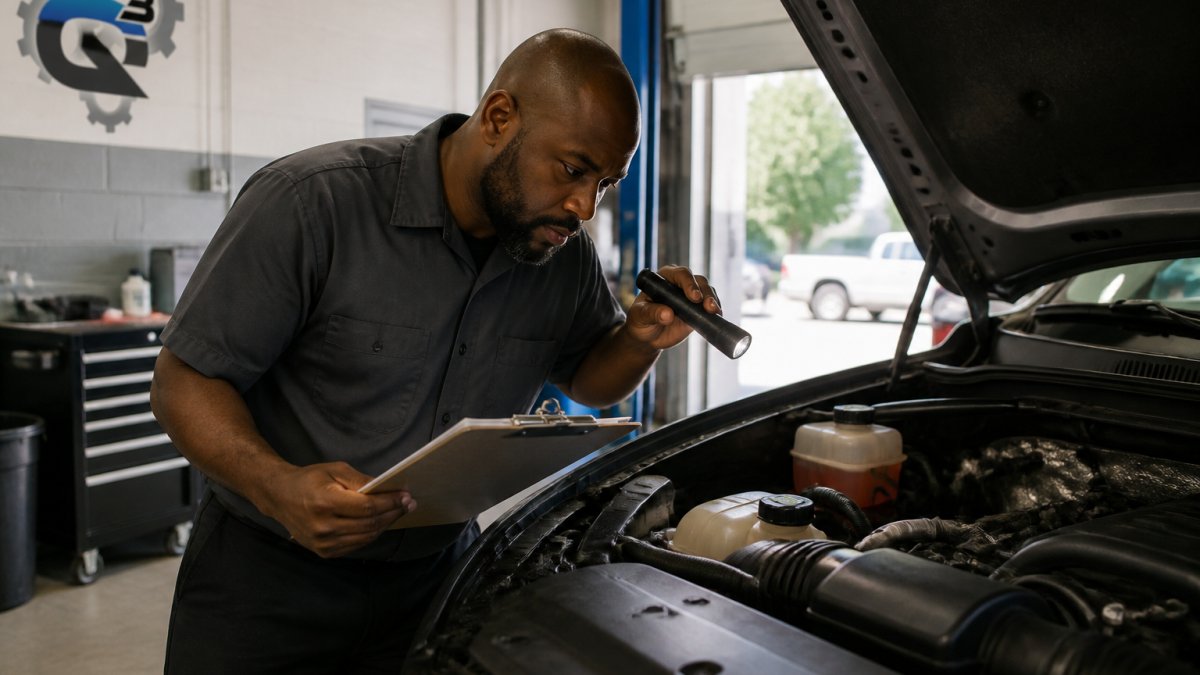
Run this on each unit at every service visit:
- Engine oil level and condition
- Coolant level and hose condition
- Brake pads, rotors, and fluid
A written checklist does two things. It keeps quality consistent across drivers and technicians. It also creates a paper trail you can review when a cost spike appears.
Step 5: Put Fleet Maintenance Tracking Software to Work
Fleet maintenance tracking software logs every service, repair, and cost against each vehicle. It turns scattered invoices into maintenance data you can actually analyze.
What to look for:
- Automatic service reminders by mileage or date
- Cost tracking per vehicle and per mile
- Repair history in one place
The payoff is visibility. When one truck's repair frequency climbs, the software shows it before the budget does.
If you want the financial case before picking a tool, this guide to automated fleet maintenance tracking lays out the benefits and return.
Step 6: Control Repair Approvals, Parts, and Vendors
Repair expenses climb fastest when nobody approves them. A clear repair approval process puts a gate in front of every job above a set dollar amount, and it is the cheapest control you can install.
Set two thresholds, not one:
- Driver-level approval for routine items under a set dollar amount (many fleets use $250-$500 per event)
- Manager or owner approval for anything above that, plus any repair that is not on the vehicle's scheduled service list
Require a written estimate before approval. The estimate should list parts, labor hours, labor rate, and any diagnostic fee. If a shop will not put it in writing, that is a signal about how the invoice will look later.
Auditing Invoices Against the Estimate
Approval is only half the control. The other half is comparing the final invoice to the approved estimate line by line. A common pattern is a job approved at one labor rate that gets billed at a higher rate, or parts billed at list price when a fleet-account discount was agreed. Build a simple invoice audit into your monthly routine:
- Match every invoice to its approved estimate
- Flag any line item that grew without a phone call or written change order
- Track labor rate per shop over time so you notice increases
A five-minute audit per invoice catches the leaks that a monthly total never shows.
Parts Sourcing: OEM, Aftermarket, and Remanufactured
The OEM versus aftermarket question is not one decision for the whole fleet. It is a decision per part category.
- OEM parts cost more up front but carry the manufacturer's warranty and fit exactly. For safety-critical and warranty-sensitive components, OEM is usually the lower-risk choice.
- Aftermarket parts save money now but quality varies widely by brand and category. Use them where the part is non-critical and the failure mode is cheap.
- Remanufactured parts (alternators, starters, brake calipers) can cut parts cost substantially when a reputable rebuilder stands behind the unit.
Set a written parts policy by category so drivers and shops are not making the call job by job. Weigh both sides with this comparison of OEM versus aftermarket parts before you finalize it.
Labor Rates and Service-Level Agreements
Labor is the other big lever, and it is negotiable. Ask every shop you use for:
- Their posted hourly labor rate and any fleet-account rate
- Diagnostic fees and whether they are waived when the repair is approved
- Turnaround expectations, in writing
Put the important terms in a short service-level agreement (SLA). It does not need to be a legal document. A one-page letter of understanding covering rates, approval thresholds, turnaround, and invoicing expectations is enough to make the relationship predictable.
Managing Problem Units and Repair Approvals
Every fleet has a problem unit. The truck that keeps coming back. Track repair frequency per vehicle and review it monthly.
When one unit crosses a set number of repairs in a quarter, make a decision: fix it properly or plan its replacement. Throwing small repairs at a failing vehicle is the most expensive habit in fleet management. Use the TCO math in the next section to make that call on numbers, not on frustration.
Step 7: Calculate Total Cost of Ownership and Plan Replacements
Total cost of ownership, or TCO, is the full cost of a vehicle over its life: purchase, fuel, maintenance, repairs, insurance, and downtime. TCO tells you when to replace a unit instead of repairing it.
Here is the formula, and then a worked example so you can see how it behaves.
TCO = Purchase price + Fuel + Maintenance + Repairs + Insurance + Downtime cost - Resale value
A Worked Example
Take a cargo van bought used for $28,000. Over four years it burns $24,000 in fuel, takes $9,000 in scheduled maintenance, $7,500 in unscheduled repairs, and $6,000 in insurance.
- Purchase: $28,000
- Fuel: $24,000
- Maintenance: $9,000
Divide by the miles driven over those four years, say 120,000, and the van costs about $0.57 per mile all-in. That number is what you compare against a replacement candidate, not the sticker price.
Setting a Repair-versus-Replace Threshold
The decision rule most practitioners use is a ratio, not a dollar figure. Compare the cost of the next major repair to the vehicle's current market value:
- If a single repair approaches a meaningful share of the unit's value, get a second opinion before approving it
- If annual repair spend climbs past a set share of the vehicle's value, start replacement planning
- If a unit is down more than a set number of days per quarter, downtime cost alone may justify replacement
Run TCO per vehicle, not for the fleet as a whole. A fleet average hides the one truck that is quietly eating the budget.
Why Fuel and Downtime Belong in the Math
Older units burn more fuel, and that cost hides inside operating expenses until you separate it out. A truck that loses two miles per gallon costs real money over a year of route miles. Downtime is the same story: a breakdown is not just a repair bill, it is a route not run and a customer not served. Put a dollar figure on a lost vehicle-day and the replacement math changes fast.
Replacement Planning Is About Timing
Replacement planning is not about buying new trucks. It is about timing. Replacing a unit on your schedule, during a slow month, costs far less than an emergency replacement after a breakdown. Build a rolling replacement calendar: list every unit, its age, its miles, its TCO per mile, and its next major service milestone. Review it quarterly and move units up or down based on the numbers.
Conclusion: Track Results and Protect Uptime
Cutting fleet maintenance costs is a discipline, not a one-time purge. Build the baseline, protect preventive service, track every unit, and review the numbers monthly.
Uptime is the real prize. Every avoided breakdown is a route completed and a customer kept.
When you are ready to hand fleet repair to a shop that protects your uptime, our fleet repair services cover everything from engine work to transmission rebuilding.
Frequently Asked Questions
What is preventive fleet maintenance and how does it work?
Preventive fleet maintenance is a scheduled program of inspections, fluid changes, tire rotations, brake checks, and component replacements done before failure. It works by catching wear at predictable intervals instead of waiting for a breakdown. A typical program ties each vehicle to mileage or time-based service intervals, logs every inspection, and flags overdue items. Because small problems get fixed early, repair expenses stay lower and vehicles spend less time out of service. It also gives you documentation that supports warranty claims and resale value.
How can fleet managers track maintenance costs?
Start by recording every repair, part, and labor hour against a specific vehicle, then group those records by month and by mile driven. Fleet maintenance tracking software automates this: it stores service history, sends reminders for upcoming work, and produces cost-per-mile and cost-per-vehicle reports. Pair that with a simple baseline of your current spend so you can measure whether changes actually help. Review the reports monthly, watch for repeat repairs on the same unit, and compare cost per mile across vehicle types to spot outliers before they become expensive.
When should a fleet vehicle be repaired or replaced?
Compare the annual cost of keeping a vehicle against its replacement cost and remaining useful life. A common rule is to flag a unit when yearly maintenance and repair spending climbs well above the fleet average for that vehicle class, or when downtime starts affecting routes. Also weigh safety and compliance: repeated failures in brakes, steering, or cooling systems raise risk. Use total cost of ownership, not just repair bills, since fuel consumption and downtime count too. Plan replacements in cycles rather than reacting to a single breakdown.
How do driver habits affect fleet maintenance costs?
Driver behavior shows up directly in repair expenses. Hard braking wears pads and rotors faster, aggressive acceleration raises fuel consumption, and skipping pre-trip inspections lets small issues grow into engine damage or tire failures. Idling adds hours to engine life without adding miles. Telematics and GPS tracking give you real data on speeding, braking, and idling, which makes coaching concrete. Pair that data with route optimization to cut mileage. Many fleets find that combining driver coaching with a solid preventive maintenance schedule delivers more savings than either alone.