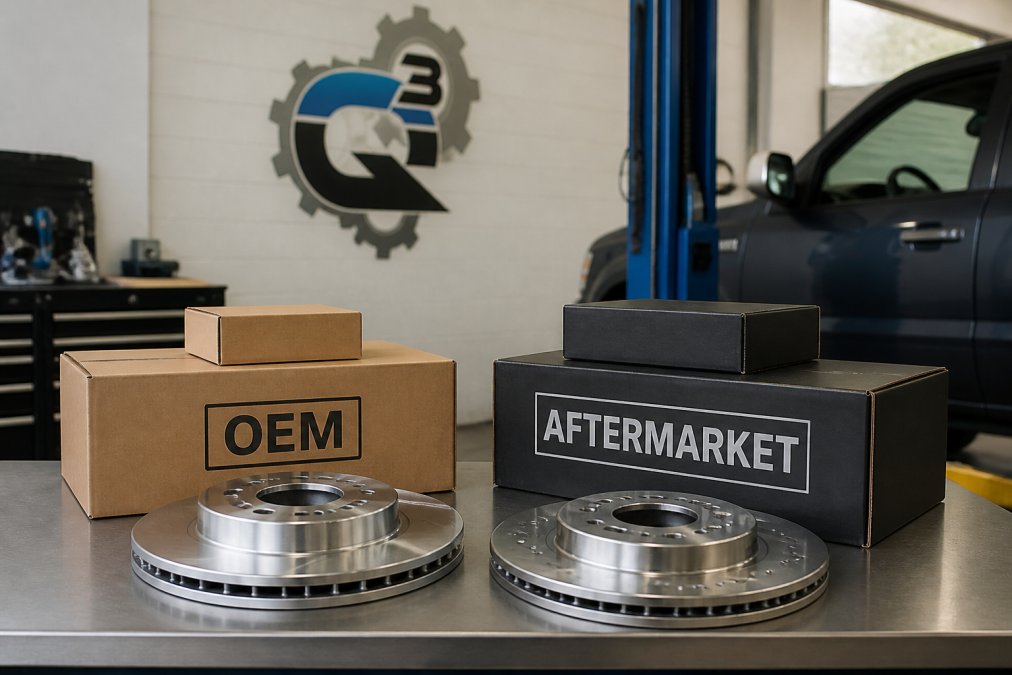
 comparison
Is It Cheaper to Buy OEM or Aftermarket Parts?
Table of Contents
- OEM vs Aftermarket Parts: Cost, Quality, and Warranty at a Glance
- Why Aftermarket Parts Usually Cost Less Than OEM
- Pros and Cons of Aftermarket Car Parts
- Does Aftermarket Parts Void Warranty Coverage?
- When to Choose OEM for Car Repairs
- How Insurance and Counterfeit Parts Change the Math
- Conclusion: Making the Call on OEM or Aftermarket Parts
- Frequently Asked Questions
Last Updated: September 13, 2026
OEM vs Aftermarket Parts: Cost, Quality, and Warranty at a Glance
OEM parts are components manufactured by or for the original vehicle maker to factory specifications. Aftermarket parts are produced by independent companies and sold as replacement or upgrade options. The short answer to whether it's cheaper to buy OEM or aftermarket parts: aftermarket is almost always less expensive upfront, while OEM pricing reflects tighter manufacturing tolerances and manufacturer backing. This guide from Q3 Car & Truck Repair breaks down where the savings are real, where they backfire, and how to decide for your specific vehicle.
The core trade-off is simple. Aftermarket sellers compete on price and availability, so a comparable component often costs noticeably less than the dealership version. OEM sellers compete on exact fitment and warranty alignment, so you pay for certainty.
| Factor | OEM Parts | Aftermarket Parts |
|---|---|---|
| Upfront cost | Higher | Lower |
| Fitment | Exact factory match | Varies by brand and tier |
| Warranty impact | Preserves coverage | Can affect claims |
| Availability | Dealer-dependent | Wide retail network |
| Best for | Newer or safety-critical vehicles | Older or high-mileage vehicles |
Why Aftermarket Parts Usually Cost Less Than OEM
Aftermarket parts cost less because independent manufacturers skip the dealer markup, amortize tooling across many brands, and compete directly on price. A single OEM part number often has several aftermarket equivalents, and that competition pushes prices down. Edmunds maintenance and repair guides explain that this price gap reflects real differences in testing and tooling investment, not just branding.

What most guides miss is that the gap narrows fast at the top of the aftermarket market. Premium aftermarket brands invest in their own quality control, and the price difference shrinks accordingly. You are not choosing between "good" and "cheap." You are choosing between two supply chains with different cost structures.
Pros and Cons of Aftermarket Car Parts
The pros and cons of aftermarket car parts come down to price versus predictability. You gain savings, selection, and availability. You give up some guarantee of exact fitment and factory-backed consistency.
Pros
- Lower upfront cost for the same function
- Broader selection, including upgraded performance options
- Easier availability for older vehicles
- Multiple quality tiers to match your budget
Cons
- Fitment and durability vary by brand
- Cheap tiers can fail early and cost more in labor
- Some warranties restrict non-OEM components
- Counterfeit parts exist in this market
A common mistake is buying the cheapest version of a safety-critical part. Brake and suspension components are not the place to chase the lowest price.
The Three Tiers of Aftermarket Quality
Aftermarket parts are not one category. They split into three tiers, and knowing which one you are buying changes the entire cost calculation.
- Budget tier: Lowest price, basic materials, shortest lifespan. Fine for cosmetic or low-stress parts.
- Standard tier: Meets common industry specifications and works well for most routine maintenance. This is where most everyday repairs land.
- Premium or OE-equivalent tier: Built to match or exceed factory specs, often by the same suppliers that make OEM parts. Price sits closer to OEM, but quality does too.
Does Aftermarket Parts Void Warranty Coverage?
Aftermarket parts do not automatically void your warranty. Under the Magnuson-Moss Warranty Act, a manufacturer generally cannot void coverage simply because a non-OEM part was installed. The Federal Trade Commission guidance on the Magnuson-Moss Warranty Act confirms that a dealer must show the aftermarket part caused the failure before denying a related claim.
The mechanism matters more than the headline. Magnuson-Moss does not ban warranty denials, it shifts the burden of proof onto the manufacturer. In practice, that means three things:
- The warranty is not "voided." Only the specific claim tied to the failed aftermarket part can be denied. The rest of your coverage stays intact.
- The manufacturer must connect the dots. A dealer cannot point at a non-OEM oil filter and refuse to fix a failed power window. They have to show causation between the part and the failure.
- You still have to prove your side. Keep the receipt, the part number, and the brand. If a shop installed it, keep the work order. Without documentation, you are arguing from memory.
A common pattern is a denied claim on a related system. Install a budget aftermarket water pump, and if the timing chain later fails because the pump seized, the manufacturer can deny the timing chain claim, not because the pump was aftermarket, but because it caused the damage. That is a causation denial, and it is allowed.
The practical rule: aftermarket parts are safe for warranty purposes when they are correctly specified and installed. They become a problem when they cause the failure being claimed. The National Highway Traffic Safety Administration maintains recall information by VIN, which is worth checking before any repair on a covered vehicle, a recall repair is free at a dealer regardless of what aftermarket parts are already on the car.
When to Choose OEM for Car Repairs
Choose OEM for car repairs when the vehicle is new, still under warranty, or the part is safety-critical. Exact fitment matters most on engine internals, transmission components, airbags, and electronic sensors tied to the vehicle's computer.
OEM also makes sense when resale value is a priority. A documented history of factory parts signals careful ownership, and that can matter at trade-in.
For fleet operators, consistency is the real argument. Running multiple vehicles on the same OEM part numbers simplifies inventory and reduces the odds of a mismatched component causing a breakdown. That is the kind of decision Q3 Car & Truck Repair walks fleet owners through before any work begins, so the choice fits the vehicle and the budget.
How Insurance and Counterfeit Parts Change the Math
Insurance and counterfeits are the two factors most cost comparisons ignore, and both can flip the answer. This is where the OEM-versus-aftermarket decision stops being about the parts counter and starts being about your policy and your supply chain.
How insurers actually specify parts
When you file a collision claim, the insurer, not you, usually controls the parts specification. Most policies include language allowing "like kind and quality" replacement parts, which in practice means aftermarket, recycled (salvage), or refurbished components rather than new OEM. That is legal in most states, and it is one of the biggest reasons repair estimates come in lower than a dealership quote.
What most drivers do not know:
- You can usually request OEM parts and pay the difference. The insurer owes you the cost of the aftermarket or recycled part; the gap to OEM is typically your out-of-pocket expense.
- State rules vary. Some states require insurers to disclose when aftermarket parts are specified, and some restrict aftermarket use on vehicles under a certain age or mileage. Ask your adjuster which rule applies to your claim.
- Recycled is not the same as aftermarket. A salvage OEM part is a factory component pulled from another vehicle. It can be a better match than a cheap new aftermarket part, or a worse one, depending on condition.
- Your policy language is the contract. Read the parts clause before you need it. If OEM coverage matters to you, some insurers offer an endorsement that guarantees it.
How to spot a counterfeit "OEM" part
Counterfeits are the bigger risk because they hide behind the OEM label. Fake parts often carry brand-name packaging and sell at prices that look like a great deal. The Federal Trade Commission consumer guidance on counterfeit goods notes that counterfeits increasingly show up in automotive supply chains, not just in handbags and electronics.
Warning signs include:
- Packaging with misspellings, blurry logos, or fonts that do not match the brand's official materials
- Prices far below every other seller, including other aftermarket sellers
- No traceable part number, no certification mark, and no country-of-origin labeling
- Sellers on marketplaces with no return policy, no business address, and no brand authorization
- A part that arrives without the anti-counterfeit hologram or scratch-off code the manufacturer uses
A counterfeit brake pad or airbag is a safety problem, not a savings. Buying from established retailers and asking your shop to verify part numbers closes most of that gap.
Conclusion: Making the Call on OEM or Aftermarket Parts
The cheapest option is rarely the best one, and the most expensive is not automatically the safest. Match the part to the vehicle, the warranty, and the consequence of failure. For routine maintenance on an older vehicle, quality aftermarket parts usually win on value. For a newer vehicle or a safety-critical system, OEM is worth the premium.
This is exactly the judgment call Q3 Car & Truck Repair makes with every customer. Our technicians explain why a repair is necessary, walk you through the part options and their trade-offs, and give you a straightforward estimate before any work starts. No pressure, no surprises, just clear answers so you can decide with confidence.
Frequently Asked Questions
Is it better to buy OEM or aftermarket parts?
It depends on the part and your vehicle. OEM parts guarantee exact fitment and come with manufacturer-backed warranty coverage, which matters for safety systems, engine internals, and newer vehicles still under factory warranty. Aftermarket parts from reputable brands can deliver comparable durability for brakes, filters, and suspension at 20% to 50% less. For older vehicles past warranty, quality aftermarket is often the smarter financial call.
Does aftermarket parts void warranty coverage?
Not automatically. Under the Magnuson-Moss Warranty Act, a manufacturer cannot void your entire warranty just because you installed an aftermarket part. They can only deny coverage for a specific failure if they prove the aftermarket component caused it. If a modified exhaust is linked to an engine sensor failure, that repair might not be covered, but unrelated issues like a failed window motor remain protected.
Why are aftermarket parts generally cheaper than OEM?
OEM parts carry the automaker's brand, dealer markup, and distribution costs built into the price. Aftermarket manufacturers skip the dealer network, produce at higher volumes across multiple vehicle platforms, and compete directly on price. That competition drives costs down 20% to 50% for many common replacement parts. The trade-off is that quality varies widely, so sticking with established aftermarket brands matters more than the lowest sticker price.
How can I tell if an aftermarket part is counterfeit?
Counterfeit parts often show mismatched fonts on packaging, missing certification marks, unusually low prices, and loose or ill-fitting components. Buy from authorized retailers or trusted repair shops rather than unfamiliar online sellers. Ask for the part's country of origin and manufacturer name. A professional shop can verify fitment and cross-reference part numbers before installation, which catches most fakes before they cause mechanical failure.
If you are weighing OEM or aftermarket parts for your next repair, get an honest assessment first. Q3 Car & Truck Repair offers transparent estimates, skilled technicians who explain every recommendation, and a process built on clear communication from the first phone call. Request an appointment and get expert guidance on the right parts for your vehicle.