 how-to
Why Is My Truck Repair Estimate High? A 2026 Guide
Table of Contents
- The Real Reasons Your Truck Repair Estimate Is High
- How to Read a Mechanic's Estimate Line by Line
- Hidden Damage, Supplemental Estimates, and Why the First Number Changes
- When to Get a Second Opinion on Car Repairs
- Negotiating Auto Repair Costs Without Getting Played
- The Total Loss Math: When a High Estimate Means a Different Conversation
- Frequently Asked Questions
Last Updated: September 12, 2026
The Real Reasons Your Truck Repair Estimate Is High
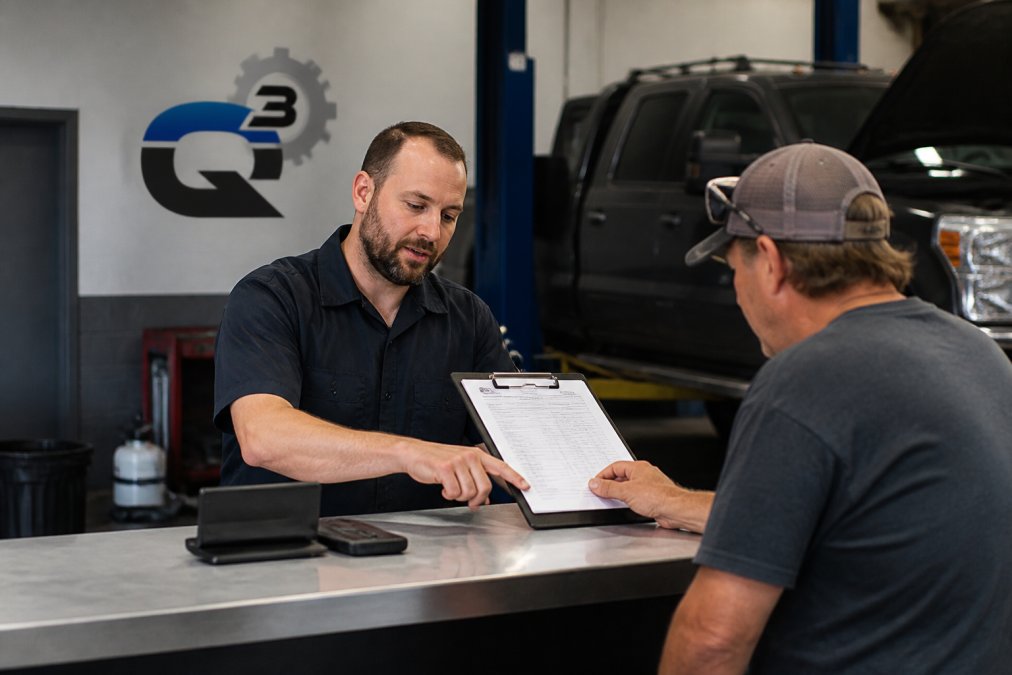
A high truck repair estimate is not automatically a sign of a dishonest shop. It usually means the technician found more damage than the initial inspection could see, the job requires more labor hours than expected, or the parts are expensive by nature. This guide from Q3 Car & Truck Repair walks through the line items and when to push back.
Trucks carry heavier loads and take more punishment than passenger cars, so repair bills run higher as a rule. But "higher as a rule" and "higher than it should be" are different things. Here's how to tell them apart before you authorize a repair.
How to Read a Mechanic's Estimate Line by Line
An estimate is a contract in draft form. Every line should state the part, the labor hours, and the rate. If a line item is vague, ask for it in writing before you approve anything.
Most shops use estimating software that produces a standardized document. Once you know the anatomy, you can audit any estimate in about ten minutes:
| Line Item | What It Means | What to Check |
|---|---|---|
| Labor hours | Time billed at the shop's rate | Does the book time match the job? |
| Labor rate | Hourly charge for the technician | Is it posted or stated upfront? |
| Parts | OEM or aftermarket components | Which type, and why? |
| Paint and materials | Supplies for refinishing | Separate from labor hours? |
| Diagnostic fee | Charge for finding the problem | Applied to the repair if you proceed? |
| Sublet | Work sent to a specialist | Marked up, and by how much? |
| Tax and shop supplies | Percentage-based add-ons | Capped, or open-ended? |

The Four Numbers That Drive the Total
Every estimate total is built from four inputs. Understand these and you understand the bill.
1. Labor hours. These come from a published labor time guide, not the technician's stopwatch. A job that pays 3.5 hours pays 3.5 hours whether the tech finishes in two or takes five. If the estimate shows 6 hours for a job the guide lists at 3.5, ask which guide the shop used.
2. Labor rate. This is the shop's hourly charge, and it varies by region, dealership versus independent shop, and mechanical versus collision work. The rate should be posted or stated on the estimate. A rate that appears only after you ask is a red flag.
3. Parts markup. Parts are typically billed above the shop's cost. A modest markup is normal and covers handling, warranty administration, and returns. The estimate should state OEM or aftermarket, with a price consistent with the part type quoted.
4. Sublet and supplies. Sublet lines cover work sent out, such as alignment, machining, or glass. Shop supplies are usually a small percentage of labor. Both are legitimate but should be itemized, not buried in a lump sum.
Labor Hours, Labor Rate, and Paint and Materials
Labor hours are the time a job should take, pulled from a published repair guide. Labor rate is what the shop charges per hour. Multiply one by the other and you have the bulk of your bill.
Paint and materials is a separate line most drivers overlook. It covers refinishing supplies, not the technician's time, and should never be folded silently into labor. On a collision estimate it is often billed as a percentage of paint labor hours, so a higher labor rate inflates this line too.
How to Audit an Estimate in Ten Minutes
You don't need to be a mechanic to spot the patterns that inflate a bill. Work through these checks in order:
- Scan for duplicate labor. The same operation should not be billed twice under two different descriptions. Overlap between a "diagnostic" line and a "teardown" line is a common one.
- Check the labor guide. Ask the shop which published guide it uses. If the hours on the estimate exceed the guide, ask why.
- Confirm part type. Every parts line should say OEM, aftermarket, or remanufactured. "Replacement part" with no qualifier is not enough.
- Look for the diagnostic credit. Many shops apply the diagnostic fee to the repair if you authorize the work. If the estimate charges it separately and does not credit it, ask.
- Verify the sublet markup. Call the sublet vendor directly if the markup looks steep. Alignment and glass prices are easy to check.
- Read the fine print. Some estimates include a storage fee, an administrative fee, or an authorization clause that lets the shop proceed without a second signature. Know what you are signing.
OEM Parts vs. Aftermarket Parts on the Estimate
OEM parts are made by or for the truck's manufacturer. Aftermarket parts come from third-party suppliers. OEM parts usually cost more; aftermarket quality varies widely. Remanufactured parts sit in between: original cores rebuilt to a specification, often with a warranty.
Neither is automatically wrong. What matters is that the estimate states which one is used and that you agreed to it. A shop that quietly substitutes a cheaper aftermarket part after quoting OEM pricing is the problem, not aftermarket parts themselves.
One practical check: ask for the part number on any line over a few hundred dollars. A real part number can be looked up, and it tells you whether the part is OEM, aftermarket, or remanufactured without relying on the shop's description.
Hidden Damage, Supplemental Estimates, and Why the First Number Changes
The first estimate is a prediction, not a promise. Once a shop removes a bumper, fender, or wheel, it often finds damage invisible from the outside. That discovery triggers a supplemental estimate, a revised, documented addition to the original.
This is normal in collision repair and heavy truck work. What is not normal is a supplement with no photos, part numbers, or explanation. Ask to see the damage before you approve the addition.
- Request photos of every newly discovered issue
- Ask for the supplemental estimate in writing
- Confirm whether the added work is safety-critical or cosmetic
- Check whether your insurer needs to approve the supplement first
When to Get a Second Opinion on Car Repairs
Get a second opinion when the estimate far exceeds your expectations, the diagnosis is vague, or the shop pressures you to decide on the spot. A second opinion costs time, not usually money, and is the most effective way to catch an inflated quote.
A reputable shop will not be offended. If a shop reacts badly to you wanting a second look, that reaction tells you something.
Negotiating Auto Repair Costs Without Getting Played
You have more leverage than most drivers realize. Shops compete for repeat business, and a calm, informed customer usually gets a straighter answer than one who argues. The goal is not to grind the price down but to pay only for work that is actually needed.
What works:
- Ask which repairs are safety-critical and which can wait
- Request a breakdown of parts versus labor on any large line
- Ask whether a diagnostic fee is credited toward the repair
- Get the final price in writing before work begins
What backfires: demanding a discount before you understand the estimate, or agreeing to a "package deal" you didn't ask for.
What to Say, Word for Word
Use these scripts when you're on the phone or at the counter:
"Can you walk me through this line by line? I want to understand what's urgent and what can wait."
"Is this an OEM part or aftermarket? Can you show me the difference in price?"
"If I get a second opinion, will that change anything about this estimate?"
"Can you send me the supplemental estimate in writing before you start the extra work?"
These are not confrontational. They are the questions a careful owner asks, and good shops answer them without hesitation.
The Total Loss Math: When a High Estimate Means a Different Conversation
Sometimes a high estimate is not a negotiation problem but a math problem. If the repair cost crosses a threshold relative to the truck's actual cash value, your insurer may declare it a total loss. Actual cash value is what your truck is worth today, not what you paid for it.
The Threshold, Explained Simply
Most insurers use a total loss threshold expressed as a percentage of actual cash value. The two numbers that matter are repair cost and ACV. When repair cost divided by ACV crosses the threshold, the vehicle is typically declared a total loss.
The threshold is not uniform. Some states set it by statute, commonly 70 to 80 percent of ACV (naic.org). Others use a "total loss formula" that adds salvage value back in (insurance.ca.gov). A few leave it to the insurer's guidelines. Because the rule varies, the same repair bill can total one truck and not another depending on where it is registered and which insurer writes the policy.
Here is the math in plain terms:
- Repair cost: the final, supplemented estimate, not the first number.
- ACV: what a willing buyer would pay for your truck in its pre-loss condition, given its mileage, options, and local market.
- Ratio: repair cost divided by ACV. If that ratio crosses the applicable threshold, expect a total loss conversation.
A simple example: a truck with an ACV of $30,000 and a repair estimate of $24,000 produces a ratio of 0.80, or 80 percent. In a state with an 80 percent threshold, that is right at the line. In a state with a 70 percent threshold, it is a total loss. Same truck, same damage, different outcome.
Why the First Estimate Rarely Decides It
Insurers do not declare total loss from the initial estimate. They wait for the supplement, because hidden damage found during teardown usually pushes the ratio over the line. That's why a repair that looked straightforward on day one can become a total loss on day five. If your truck is close to the threshold, ask the adjuster early for the ACV and the applicable threshold.
What Happens If It Is Declared a Total Loss
When the insurer totals the truck, the conversation shifts entirely from labor hours to:
- The ACV settlement. The insurer pays the ACV, minus your deductible, minus any outstanding loan or lease balance.
- Salvage value. If you want to keep the truck, the insurer deducts what it would have recovered at salvage auction. That deduction can be substantial on a heavy truck with valuable components.
- Owner retention. Keeping a totaled truck means it will carry a salvage or rebuilt title, which affects resale and, in some states, future insurance.
- Loan or lease gap. If you owe more than the ACV, the difference is yours unless you purchased gap coverage.
How to Push Back on the ACV
The ACV is not a fixed number handed down from on high. It is an opinion built from comparable sales, mileage adjustments, and condition. If you believe it is too low, challenge it with your own comparables: listings for similar trucks with similar mileage in your region, recent sale prices, and receipts for recent maintenance or upgrades. Document everything in writing. A polite, evidence-backed counter usually moves the number more than an argument does.
Understanding that shift early saves you from arguing about the wrong number. A high estimate on a truck worth less than the repair is not an inflated bill; it is a valuation problem, and it is handled with different tools.
Frequently Asked Questions
How accurate are truck repair estimates?
An estimate is the shop's best guess before teardown, not a final bill. Once a technician opens the truck, hidden damage often appears and the shop files a supplemental estimate with your insurer. A well-written estimate should list labor hours, the labor rate, and parts by name so you can see exactly what is included. If the final invoice jumps far above the original number with no supplement or phone call, ask for an itemized explanation of every added line before you pay.
Is it standard practice to negotiate a truck repair estimate?
Yes, negotiating auto repair costs is normal in the industry. Shops set their own labor rate, and many will price-match a written quote from another licensed shop or split the difference on a large job. What you cannot negotiate is the labor hours a repair actually requires. Ask the shop to walk through the labor guide time for each operation, then discuss the rate and parts choices. A shop that refuses to explain its numbers is a red flag, not a tough negotiator.
When should you get a second opinion on a truck repair quote?
Get a second opinion when the estimate exceeds what you expected by a wide margin, when the diagnosis sounds vague, or when a shop recommends a full replacement without showing you the failed part. Also seek one if you are told the truck is a total loss. A second shop can confirm the diagnosis, check the labor hours, and quote the same job with different parts. Expect a diagnostic fee, which many shops credit toward the repair if you move forward with them.
What is the difference between an estimate and a final invoice?
An estimate is a projection of what the repair should cost based on what is visible and known at drop-off. A final invoice reflects what was actually done: parts installed, labor hours billed, and any supplemental work you approved along the way. In most states, a shop cannot charge more than a set percentage above the written estimate without your authorization. Before you authorize anything, ask what triggers a supplement and how you will be contacted for approval.