 listicle
Diesel Truck Fleet Maintenance Scheduling: A 2026 Guide
Table of Contents
- Why Preventive Maintenance Beats Emergency Repairs
- The Core of Your Diesel Truck Fleet Maintenance Scheduling: Service Intervals
- Build a Preventive Maintenance Schedule for Trucks That Works
- What Fleet Maintenance Software Benefits Your Operation Most?
- Diesel-Specific Engine Health Monitoring: Don't Skip This
- Common Scheduling Mistakes That Cost You Fleet Uptime
- Regulatory Compliance and Documentation for Fleet Managers
- Conclusion: Start Scheduling, Stop Reacting
- Frequently Asked Questions
Last Updated: September 6, 2026
Every hour a diesel truck sits in the shop is revenue lost, and for fleet managers, profitability often comes down to diesel truck fleet maintenance scheduling. Reactive repairs are a tax on your time and bottom line. This guide from Q3 Car & Truck Repair breaks down how to build a maintenance schedule that prioritizes uptime, built on data, not guesswork.
Below, we’ll show you how to structure service intervals, what to track, and which software tools deliver value. The goal: catch small problems before they become expensive breakdowns.
Why Preventive Maintenance Beats Emergency Repairs
Preventive maintenance is the practice of performing scheduled service and inspections on a vehicle to prevent failures before they occur. It operates on a simple principle: it is cheaper and faster to replace a $50 belt during a scheduled stop than it is to replace a $2,000 engine after that belt fails on the highway.
Emergency repairs carry hidden costs that go far beyond the invoice. When a truck breaks down unexpectedly, you lose the revenue from that load, you pay for roadside assistance, and you often pay premium rates for parts and labor because there is no time to shop around. The American Transportation Research Institute's operational costs report consistently identifies vehicle repair and maintenance as one of the largest line items for fleets, and unscheduled downtime is the most expensive type of maintenance there is. A proactive approach shifts your operation from a reactive cycle of firefighting to a controlled process where you decide when a truck is in the shop.
The Core of Your Diesel Truck Fleet Maintenance Scheduling: Service Intervals
The backbone of any fleet maintenance scheduling effort is a set of defined service intervals based on mileage, engine hours, or calendar time. For diesel trucks, relying on mileage alone is a mistake; an idling truck accumulates engine hours that stress components without adding miles.
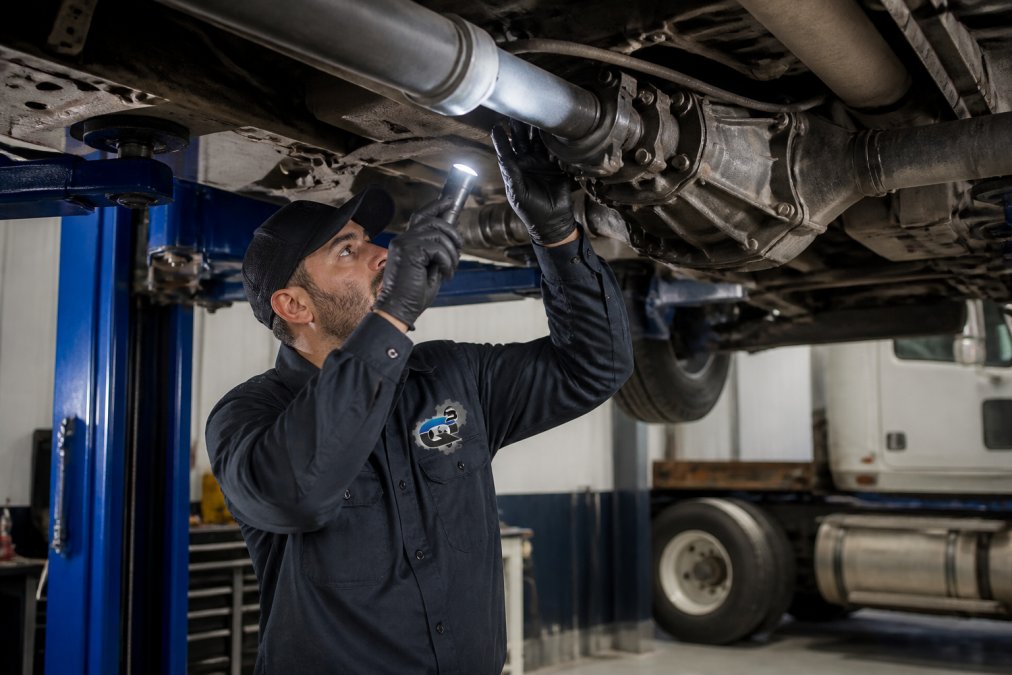
Your schedule should use a combination of mileage and engine hours. While OEM recommendations vary, the structure follows a tiered approach: a basic service (oil, filters, inspection) at regular intervals, and a more comprehensive service (fluids, chassis lube, brake inspection) at longer intervals. The specific numbers depend on your engine manufacturer and application.
Daily Inspections and DVIRs
The most critical interval is the daily one. Every driver should complete a Driver Vehicle Inspection Report (DVIR) before taking a truck on the road. This is not just a paperwork exercise; it is your first line of defense against breakdowns and a legal requirement for commercial vehicles. The DVIR should cover brakes, tires, lights, fluids, and any visible leaks. If a driver notes a fault, that truck should not move until a qualified technician clears it.
Interval-Based Maintenance by Mileage and Hours
Beyond the daily check, your preventive maintenance schedule for trucks should be built around the manufacturer's recommended service points, typically including oil and filter changes, fuel filter replacement, cooling system checks, and driveline lubrication. A common approach is to align basic service with the oil change interval and layer on additional inspections at alternating intervals. The key is consistency; skipping a service today almost always results in a larger repair bill tomorrow.
Build a Preventive Maintenance Schedule for Trucks That Works
Creating a schedule that works requires more than writing dates on a calendar. It requires a baseline of data and a clear understanding of your operational priorities, built from the ground up, vehicle by vehicle.
Step 1: Baseline Every Vehicle
Start by auditing your entire fleet. Document each truck's current mileage, engine hours, VIN, and complete service history, plus any known issues. This baseline gives you a starting point for calculating when the next service is due and ensures no vehicle falls through the cracks. Without this step, you are just guessing.
Step 2: Prioritize Critical Systems
Not all maintenance is created equal. Prioritize the systems that cause the most downtime and damage when they fail. Brakes, steering, and tires are obvious safety priorities. For diesel engines, the fuel system and cooling system demand strict attention. After that, focus on components that strand drivers, like the charging and air systems. Build your schedule so critical safety items are inspected more frequently than cosmetic items.
What Fleet Maintenance Software Benefits Your Operation Most?
Manual scheduling with spreadsheets and paper logs breaks down as your fleet grows. The primary fleet maintenance software benefits are automation, centralization, and visibility, replacing guesswork with automated alerts and a searchable database of every work order and repair.
Comparing Top Platforms: OxMaint, Fleetio, Geotab, and More
Several platforms dominate the market, and the right choice depends on your fleet size and technical needs.
| Platform | Starting Price | Core Focus | Best For |
|---|---|---|---|
| OxMaint | $5/vehicle/month | AI-driven scheduling, modular pricing | Fleets needing scalable, budget-conscious tools |
| Fleetio | Contact for pricing | End-to-end fleet management, predictive modeling | Fleets of all sizes wanting a strong PM program |
| Geotab | Contact for pricing | Telematics hardware, real-time engine diagnostics | Fleets wanting deep data from the vehicle itself |
| WiDrive | $5/vehicle/month | GPS tracking and basic maintenance reminders | Small to mid-sized fleets needing a simple entry point |
OxMaint offers a low entry price point for fleets that want to start with the basics and scale up. Fleetio is more comprehensive, handling everything from work orders to vendor management, though it can feel complex for very small operations. For fleets moving toward predictive maintenance, Geotab's hardware integration provides a clear path but requires installation and commitment.
Telematics Integration for Real-Time Engine Health
The most significant shift in diesel truck fleet maintenance scheduling is telematics integration. Rather than waiting for a mileage milestone, telematics devices read engine data in real time, alerting you to fault codes, high coolant temperatures, or excessive idling before they cause a breakdown. This moves you from a preventive model based on averages to a predictive model based on the actual condition of that specific engine.
Diesel-Specific Engine Health Monitoring: Don't Skip This
General fleet software treats all vehicles the same, but a diesel engine is not a gasoline engine. Diesels operate at higher compression ratios and produce much higher torque, putting unique stress on the bottom end, fuel injection system, and cooling system. A common mistake is applying a generic service schedule without considering diesel-specific failure modes. Here is what a diesel-specific schedule must track.
DPF Regeneration and Ash Service Intervals
The Diesel Particulate Filter (DPF) is a primary source of unscheduled downtime. A DPF traps soot and burns it off through regeneration. Passive regen occurs during highway driving when exhaust temperatures are high enough. Active regen happens when the engine computer injects extra fuel to raise exhaust temperature and burn off soot. If a truck idles too much or runs in stop-and-go traffic, it may not complete active regen cycles, leading to a clogged filter and derated engine.
Your schedule must account for two separate DPF events. First, monitor the soot load percentage through the engine computer or telematics. If the load consistently exceeds 80% without a successful regen, you have a problem with the regen process itself, often a faulty sensor or injector. Second, plan for an off-vehicle DPF cleaning or replacement at the OEM-recommended interval, typically every 150,000 to 250,000 miles. Ash from engine oil is not burned off during regen and accumulates over time. Failing to schedule this service results in a plugged filter costing $3,000 to $8,000 to replace, versus a few hundred dollars for cleaning.
EGR System Maintenance
The Exhaust Gas Recirculation (EGR) system lowers combustion temperatures to reduce NOx emissions by routing exhaust gas back into the intake manifold. The problem is that this gas carries soot and carbon, which coats the EGR valve and intake system. A stuck EGR valve causes rough idling, poor fuel economy, and eventually a check engine light.
Your schedule should include an EGR valve inspection and cleaning at every major service interval, typically every 50,000 to 75,000 miles, along with inspection of the intake manifold and charge air cooler for carbon buildup. Many fleets find that proactive cleaning of the EGR cooler and intake system at 150,000 miles prevents a much more expensive replacement, which can run $1,500 to $2,500 in parts alone. The root cause of most EGR failures is excessive idling and low-load operation.
Fuel Injector and High-Pressure Fuel System Care
Modern diesel engines use high-pressure common rail fuel systems operating at pressures exceeding 30,000 psi. These systems are extremely sensitive to contamination. A clogged fuel filter can starve the injection pump, causing it to fail catastrophically. The pump replacement alone can cost $4,000 to $6,000, not including labor to replace all six injectors, often damaged by metal shavings from the failed pump.
Your schedule must prioritize fuel filter changes at the OEM interval, often every 15,000 to 25,000 miles, but this varies widely by engine. Perform a fuel quality test at every oil change, as water in the fuel is common in regions with high humidity or temperature swings. Drain the water separator at every scheduled service, and change the filter on time, not when the truck runs rough. A return-on-investment analysis almost always favors a $50 fuel filter over a $6,000 injection pump.
Cooling System and Cylinder Head Protection
Diesel engines are more sensitive to cooling system neglect than gasoline engines. Overheating a diesel can warp the cylinder head or crack the block, an engine-ending event. Your schedule should include a coolant analysis at every major service interval, checking for proper freeze point, corrosion inhibitors, and combustion gases, which indicate a head gasket leak.
A common failure point is the coolant-filled EGR cooler. If it develops an internal leak, coolant can enter the intake system and cylinders, causing hydrolock and severe engine damage. A coolant pressure test and visual inspection of the EGR cooler should be part of your comprehensive service. Most practitioners find that a proactive coolant change at the OEM interval, typically every 60,000 to 100,000 miles, is far cheaper than the $15,000 to $20,000 cost of a replacement cylinder head or engine rebuild.
Common Scheduling Mistakes That Cost You Fleet Uptime
Even with good intentions, scheduling errors happen. The most common mistake is treating the maintenance schedule as a suggestion rather than a requirement. Letting a service slide by 5,000 miles "because the truck is running fine" is a gamble with poor odds.
Another frequent error is failing to track the maintenance backlog. When a technician finds an additional issue during a scheduled service, that issue becomes a work order. Without a system to track and prioritize that backlog, it gets lost, and you will deal with it as an emergency breakdown in a few weeks. Finally, many fleets underestimate parts availability. A preventive maintenance schedule is only as good as your ability to execute it; if the oil filters are on backorder, you have wasted your shop time. Managing parts inventory is a core part of effective scheduling.
Regulatory Compliance and Documentation for Fleet Managers
Maintenance scheduling is not just about mechanical reliability; it is also about legal compliance. In the United States, the Federal Motor Carrier Safety Administration (FMCSA) requires carriers to maintain accurate records of all maintenance and inspections. The FMCSA regulations on maintenance records mandate that you keep a record of each vehicle's repairs and inspections, and these records must be retained for a specific period.
Your maintenance software or paper logs must be able to produce these records on demand during a DOT audit. This includes the DVIRs, the work orders, and proof that scheduled maintenance was performed on time. Failing to document a repair is the same as not performing it in the eyes of an auditor. A digital system that timestamps every entry and stores it in a searchable database is the most reliable way to stay compliant and avoid fines. The FMCSA's compliance and enforcement guidance provides clear details on what constitutes a compliant record-keeping system.
Conclusion: Start Scheduling, Stop Reacting
Moving from a reactive maintenance model to a scheduled, preventive one is the single most effective way to improve fleet uptime and control costs. It requires an initial investment of time to baseline your vehicles and set up your intervals, but the payoff is a predictable operation where breakdowns are the exception, not the rule.
At Q3 Car & Truck Repair, we help fleet managers in the Capitol Heights and Waldorf areas implement these strategies. Our focus is on transparent communication and honest estimates, so you understand exactly what your trucks need and why. We have the expertise to handle the diesel-specific demands of your fleet and the commitment to build a long-term relationship that keeps your vehicles on the road.
Request an appointment with Q3 Car & Truck Repair and start building a maintenance schedule that protects your bottom line.
Frequently Asked Questions
What is a good maintenance schedule for trucks?
A good schedule follows the manufacturer's recommended commercial truck service intervals for oil changes, fuel filter replacement, and brake inspections. It also layers in daily driver vehicle inspection reports (DVIRs) and tracks mileage and engine hours. Most fleets run preventive maintenance on a 10,000 to 25,000-mile cycle for oil and filters, with major inspections every 50,000 miles. Your diesel truck fleet maintenance scheduling should be flexible enough to flag issues early based on real-time engine diagnostics.
How often should fleet vehicles be serviced?
Service frequency depends on vehicle age, usage, and manufacturer guidelines. For most commercial trucks, oil and filter changes happen every 15,000 to 25,000 miles. Brake inspections are needed every 25,000 to 50,000 miles. A preventive maintenance schedule for trucks should include daily pre-trip inspections and follow the severe-duty intervals if your trucks idle often or run in stop-and-go traffic. Using fleet maintenance software helps track these intervals accurately across multiple vehicles.
What is the best fleet maintenance software for trucking?
The best platform depends on your fleet size. Fleetio scales well for fleets of all sizes with predictive maintenance modeling. OxMaint offers a cost-effective entry at $5 per vehicle per month. For deep engine data, Geotab provides telematics-based alerts. Start by listing the features you need, like work orders, compliance tracking, and inventory management, then match the tool to your budget.
How does a maintenance schedule reduce fleet downtime?
A maintenance schedule shifts your work from reactive breakdowns to planned service. You control when trucks are in the shop instead of losing revenue to unexpected failures. Tracking service intervals and repair history lets you spot component wear before it causes a breakdown. Fleet maintenance software benefits include automated alerts and work orders, which keep your team on schedule. The result is higher fleet uptime, lower cost per mile, and fewer emergency repairs.