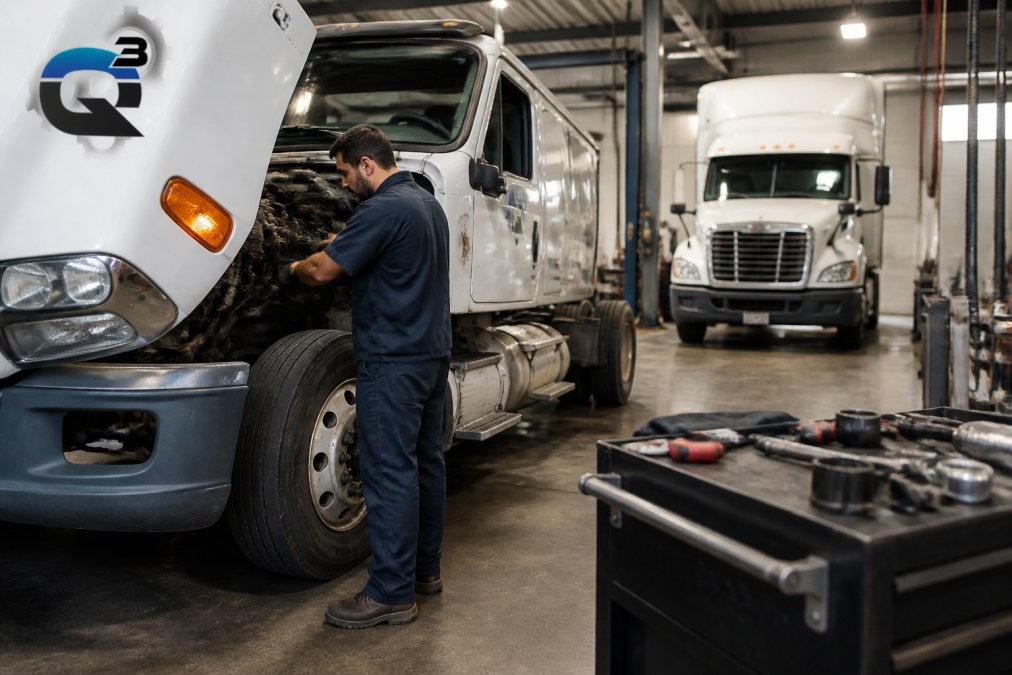
 how-to
Commercial Fleet Maintenance: A How-To Guide
Table of Contents
- Why Commercial Fleet Maintenance Matters
- Building a Preventative Maintenance Schedule for Commercial Fleets
- DOT Inspection Requirements for Commercial Vehicles
- Fleet Vehicle Maintenance in Your Area
- In-House vs. Outsourced Fleet Maintenance: Cost and Efficiency
- Common Fleet Maintenance Mistakes to Avoid
- Fleet Management Software and Maintenance Tracking
- Frequently Asked Questions
Last Updated: September 3, 2026
Why Commercial Fleet Maintenance Matters
A broken-down vehicle doesn't just cost money, it costs time, reputation, and customer trust. For businesses managing commercial fleets, preventative maintenance isn't optional. It's the difference between a fleet that runs smoothly and one that bleeds money through unexpected repairs, downtime, and emergency service calls.
The real problem most fleet managers face isn't knowing maintenance exists. It's understanding which maintenance tasks matter most, when to do them, and whether to handle them in-house or outsource to a specialist. Q3 Car & Truck Repair has worked with local business owners managing commercial fleets, and the pattern is consistent: teams that adopt structured preventative maintenance schedules see fewer breakdowns, lower repair costs, and longer vehicle lifecycles.
Commercial fleet maintenance isn't just about changing oil. It encompasses vehicle diagnostics, brake service, tire management, suspension inspection, and DOT compliance, each with its own timeline and requirements. Without a clear system, critical tasks slip through the cracks. A missed brake inspection becomes an emergency repair. Delayed tire rotation becomes a blowout on the highway.
This guide walks you through building and maintaining a commercial fleet maintenance program that actually works. We'll cover the specific maintenance tasks your fleet needs, how to schedule them effectively, regulatory requirements you must meet, and the strategic decision between in-house and outsourced maintenance.
Building a Preventative Maintenance Schedule for Commercial Fleets
The foundation of any successful commercial fleet maintenance program is a preventative maintenance schedule tailored to your vehicles' needs. A preventative maintenance schedule for commercial fleets outlines which tasks to perform, when to perform them, and how often to repeat them. Without this structure, maintenance becomes reactive, you fix things only after they break.
Most fleet managers start with the manufacturer's recommended service intervals. These provide a baseline, but they're often too generic for commercial use. Commercial vehicles typically accumulate miles faster than personal vehicles, operate under heavier loads, and face more demanding conditions. Your preventative maintenance schedule should account for these factors.
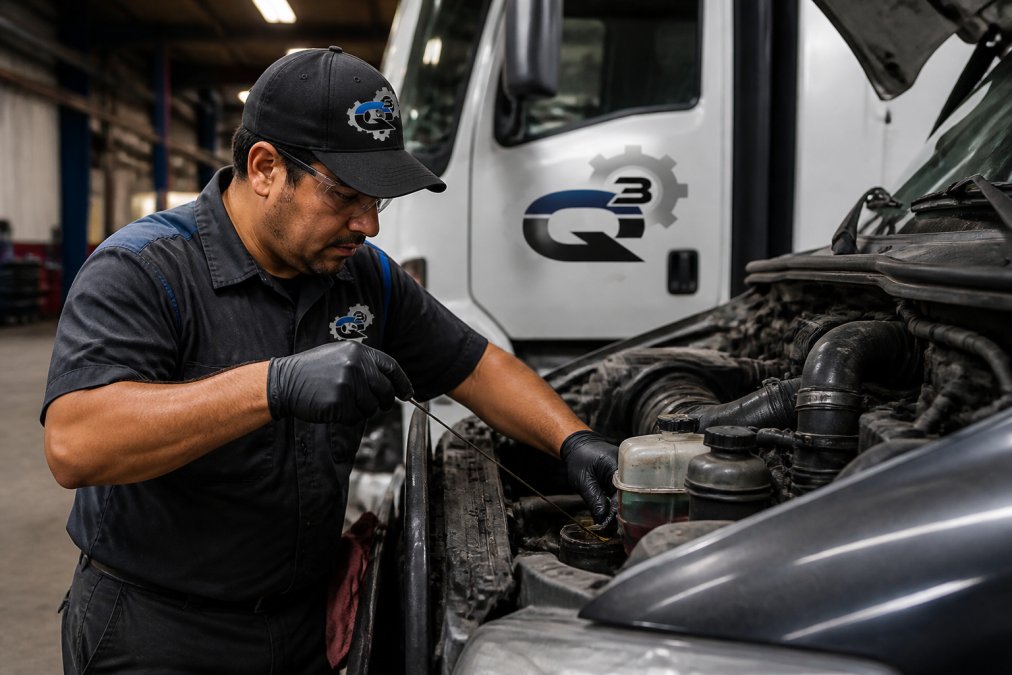
Start by documenting each vehicle's baseline: make, model, year, current mileage, and purchase date. Then map out the major maintenance categories, oil changes, brake service, tire rotation, suspension inspection, fluid checks, and assign intervals based on manufacturer guidance adjusted for your fleet's actual usage patterns. A delivery fleet running 60,000 miles annually needs different intervals than a construction fleet that idles for half the day.
Oil Changes and Fluid Checks
Oil changes are the most visible maintenance task, but they're just one part of a broader fluid management program. Commercial vehicles rely on multiple fluids: engine oil, transmission fluid, coolant, brake fluid, and power steering fluid. Each serves a critical function, and each degrades over time.
Engine oil breaks down from heat, oxidation, and contamination. In commercial vehicles running long hours under load, oil degrades faster than in typical passenger cars. Most manufacturers recommend oil changes every 5,000 to 7,500 miles for conventional oil, though some modern engines with synthetic oil can extend to 10,000 miles (the FDA). The key is checking your vehicle's specifications and adjusting based on actual operating conditions.
Transmission fluid, coolant, and brake fluid follow different schedules but the same principle: degradation requires replacement. Transmission fluid typically needs changing every 50,000 to 100,000 miles depending on the transmission type and usage (the NIH). Coolant usually lasts 30,000 to 50,000 miles. Brake fluid absorbs moisture and should be replaced every 2 to 3 years regardless of mileage, since moisture degrades braking performance.
Many fleet managers overlook fluid checks between service intervals. Monthly visual inspections of oil level, coolant level, and brake fluid level catch small leaks before they become major problems. A slow transmission fluid leak might cost $500 to fix if caught early. If ignored until the transmission fails, you're looking at $3,000 or more in repairs plus vehicle downtime.
Brake Service and Suspension Inspection
Brakes are safety-critical systems that deteriorate predictably. Brake pads wear down as the friction material contacts rotors. In commercial fleets, brake wear depends heavily on driving patterns, stop-and-go delivery routes wear brakes much faster than highway driving.
Inspect brake pads visually every 15,000 to 20,000 miles. Most pads need replacement between 25,000 and 50,000 miles, but commercial vehicles often need service at the lower end of that range. Don't wait for brake warning lights or grinding sounds. By then, you've likely damaged the rotors as well, turning a $300 brake pad job into a $600+ repair that includes rotor replacement.
Suspension components, springs, shocks, struts, and control arms, support the vehicle's weight and absorb road impacts. In commercial vehicles carrying heavy loads, suspension wear accelerates. Worn suspension reduces handling, increases tire wear, and compromises safety. Inspect suspension components every 20,000 miles and replace shocks or struts when they no longer absorb bumps effectively (a simple test: push down hard on the vehicle's corner and release; if it bounces more than once, shocks are worn).
Suspension service is often overlooked because it doesn't cause obvious failures like a dead battery. Instead, it creates a cascade of secondary problems: uneven tire wear, steering issues, and reduced braking effectiveness. A $400 shock replacement prevents $1,500 in premature tire wear and improves safety.
DOT Inspection Requirements for Commercial Vehicles
The Department of Transportation requires commercial vehicles to meet specific safety and maintenance standards. DOT inspection requirements for commercial vehicles vary by vehicle type and weight, but the core principle is consistent: your fleet must maintain equipment that meets federal safety standards.
For vehicles over 10,000 pounds GVWR (Gross Vehicle Weight Rating), the Federal Motor Carrier Safety Administration requires annual inspections (fmcsa.dot.gov). These inspections cover brakes, tires, lights, steering, coupling devices, and other critical systems. Failure to pass inspection means the vehicle cannot legally operate in commercial service.
Many fleet managers treat DOT inspections as a compliance checkbox rather than a maintenance tool. This is a mistake. A DOT inspection identifies problems before they cause accidents or fines. Brake violations, lighting issues, and tire defects are common findings, and each represents a safety hazard and a potential liability exposure.
Schedule DOT inspections with a qualified facility at least 30 days before your current inspection expires. This gives you time to address any findings before the deadline. Don't wait until the last week, if major repairs are needed, you risk vehicle downtime during a critical business period.
Fleet Vehicle Maintenance in Your Area
Local commercial fleet maintenance options range from independent shops to national chains to specialized heavy-duty repair facilities. The choice depends on your fleet size, vehicle types, and service frequency.
Independent shops like Q3 Car & Truck Repair offer personalized service and direct relationships with ownership. You work with the same technicians over time, they understand your fleet's specific needs, and communication is straightforward. For small to mid-sized fleets, this approach often delivers better results than national chains because decisions are made locally.
National chains offer standardized processes and wider availability, but service quality varies by location and technicians rotate frequently. You lose the continuity of having specialists who know your vehicles.
Heavy-duty diesel specialists are essential if your fleet includes diesel trucks. Diesel engines require different diagnostic tools, parts, and expertise than gasoline engines. A general mechanic can handle basic maintenance, but complex diesel work, fuel system issues, turbocharger problems, emissions system repairs, requires specialists.
The decision between in-house maintenance and outsourced service is addressed in detail below, but your location matters. If you're in an area with limited commercial repair options, outsourcing to a reliable facility becomes more critical. If multiple options exist, you can be more selective.
In-House vs. Outsourced Fleet Maintenance: Cost and Efficiency
This decision shapes your entire maintenance operation and deserves careful analysis. In-house maintenance means hiring technicians, maintaining a facility, stocking parts, and managing equipment. Outsourced maintenance means contracting with external repair shops.
In-house maintenance makes sense if your fleet is large enough to keep technicians fully used. A fleet of 15+ vehicles running consistent schedules can support dedicated staff. You gain control over scheduling, direct oversight of work quality, and the ability to respond quickly to emergencies. Technicians become familiar with your specific vehicles and can anticipate problems.
The hidden costs of in-house maintenance are significant: facility rent, equipment purchases and maintenance, tool inventory, parts storage, employee benefits, training, and payroll taxes. A single technician costs $50,000+ annually when you factor in benefits and overhead. That technician needs to generate enough billable hours to justify their cost.
Outsourced maintenance offers flexibility. You pay only for work performed, with no fixed overhead. You access specialized expertise without hiring specialists. You reduce liability, the repair facility carries insurance and responsibility for their work. For small fleets (under 10 vehicles) or fleets with unpredictable maintenance needs, outsourcing is usually more cost-effective.
The trade-off is control. You depend on external shops' availability, scheduling, and quality. Communication can be slower. You don't have direct oversight of work being performed.
A hybrid approach works well for many fleets: handle routine maintenance in-house (oil changes, tire rotations, basic inspections) and outsource complex work (transmission repair, diesel diagnostics, major engine work) to specialists. This keeps costs down while ensuring complex problems receive expert attention.
Common Fleet Maintenance Mistakes to Avoid
Most fleet maintenance problems stem from predictable mistakes rather than bad luck.
Ignoring manufacturer intervals. Manufacturers specify service intervals based on engineering data about component lifespan. Ignoring these intervals to save short-term money creates long-term costs. A $100 fluid change done on schedule prevents a $5,000 component failure.
Deferring "non-critical" maintenance. Suspension work, brake inspections, and alignment adjustments don't cause immediate failures, so fleet managers often defer them. This is backwards thinking. These systems prevent accidents and reduce tire wear. Deferring them increases liability and total cost of ownership.
Not tracking maintenance history. Without records, you can't identify patterns (a specific vehicle breaking down repeatedly) or verify that work was actually performed. Maintenance tracking also proves compliance if you're ever audited or involved in litigation.
Mixing repair shops without documentation. When different shops work on the same vehicle, they lack continuity. One shop doesn't know what another did, leading to duplicate work or missed problems. Stick with one primary facility for each vehicle.
Waiting for warning lights. Dashboard warning lights indicate problems that have already developed. By then, damage may be spreading. Proactive inspections catch problems earlier and cheaper.
Skipping pre-trip inspections. Drivers should perform basic checks before operating a vehicle: tire pressure, fluid levels, brake responsiveness, light function. These five-minute checks catch obvious problems before they cause accidents or breakdowns.
Fleet Management Software and Maintenance Tracking
Fleet management software transforms maintenance from a reactive scramble into a structured program. Good software tracks maintenance history, schedules upcoming service, alerts you when vehicles are due for service, and generates reports on fleet health.
The core features to look for are maintenance scheduling (automatic reminders based on mileage or time), work order management (track what was done, who did it, and costs), parts inventory (if you stock parts), and reporting (identify maintenance trends and high-cost vehicles).
For small fleets, simple spreadsheets or basic software can work. For larger fleets, dedicated fleet management platforms provide better visibility and control. The software doesn't need to be expensive, many solutions cost $50 to $200 per vehicle annually, which pays for itself through better maintenance timing and reduced emergency repairs.
The real value of fleet management software isn't the technology itself, it's the discipline it enforces. When maintenance is tracked in software, it becomes visible and accountable. When it's handled informally, tasks slip.
Managing a commercial fleet requires balancing cost, safety, and reliability. The businesses that succeed do so by building a maintenance system, sticking to it, and partnering with technicians who understand commercial vehicles. Q3 Car & Truck Repair works with local fleet managers to develop maintenance schedules tailored to their specific needs, handle complex repairs that demand expertise, and provide the transparent communication that builds trust. If your fleet needs a reliable partner for commercial fleet maintenance, get in touch and we'll walk you through exactly what your vehicles need and why.
Frequently Asked Questions
How often should commercial trucks undergo preventative maintenance?
Commercial fleet maintenance schedules depend on vehicle type, mileage, and operating conditions. Most heavy-duty trucks require regular maintenance. Check your vehicle manufacturer's recommendations and DOT guidelines, then work with a certified technician to create a schedule that matches your fleet's usage patterns and keeps vehicles compliant.
What services are included in a standard commercial fleet maintenance program?
A comprehensive commercial fleet maintenance program covers oil and fluid changes, brake service, tire rotation and replacement, suspension inspection, electrical system diagnostics, transmission checks, and engine diagnostics. Your provider should customize the program based on your fleet's specific needs and vehicle types.
What are the DOT inspection requirements for commercial vehicles?
The Federal Motor Carrier Safety Administration (FMCSA) requires commercial vehicle operators to conduct pre-trip and post-trip inspections daily. Annual DOT inspections cover brakes, lighting, tires, coupling devices, steering, and emergency equipment. Drivers must maintain inspection records for at least one year. Vehicles must pass these inspections to remain legally compliant. Your fleet maintenance provider should ensure all vehicles meet DOT standards and help you maintain documentation for regulatory compliance.
How does regular maintenance reduce fleet downtime?
Preventative maintenance identifies potential problems before they cause breakdowns, keeping vehicles on the road and reducing costly emergency repairs. Scheduled service intervals prevent unexpected failures during critical business operations. Fleet management software helps track maintenance schedules and predict maintenance needs, allowing you to plan service around your operational calendar rather than reacting to failures that disrupt your business.
This article was written using GrandRanker