 how-to
How to Identify Common Car Brake Issues
Table of Contents
- Warning Signs of Common Car Brake Issues
- Signs of Worn Brake Pads You Should Never Ignore
- How to Check Brake Pad Thickness at Home
- Vehicle Pulling, Vibration, and Brake Warning Lights
- Leaks, Burning Smells, and Other Underlying Brake Problems
- The Cost of Brake Repair and When to Stop Driving
- Frequently Asked Questions
Last Updated: September 18, 2026
Warning Signs of Common Car Brake Issues
Learning how to identify common car brake issues early can save you from a costly breakdown or a dangerous drive. At Q3 Car & Truck Repair, we tell drivers that brakes rarely fail without warning. Your car usually gives you clues first. The trick is knowing what to listen for, feel, and watch.
Brake problems fall into a few clear groups. You'll notice strange noises, a change in how the pedal feels, or a warning light on the dash. Each one points to a different part of the system.
Here's the good news: most of these signs show up long before a real failure.
Noises: Squealing, Grinding, and Screeching
Squealing usually means your brake pads are wearing thin. Most pads have a small metal tab called a squeal indicator. When the friction material wears down, that tab touches the rotor and makes a high-pitched sound. It's designed to get your attention.
Pedal Feel: Spongy, Soft, or Pulsing
A spongy or soft brake pedal often points to air or a leak in the hydraulic system. The pedal sinks toward the floor instead of staying firm. This is a serious sign and you should not ignore it.
Signs of Worn Brake Pads You Should Never Ignore
Worn brake pads are the most common brake problem drivers face. Spotting the signs of worn brake pads early keeps small repairs from turning into big ones.
Watch for these clues:
- Squealing or chirping when you press the brake
- Longer stopping distance than usual
- The pedal feels lower or softer
- Visible dust or dark grime on the wheels
- A grinding sound that gets louder over time
How to Check Brake Pad Thickness at Home
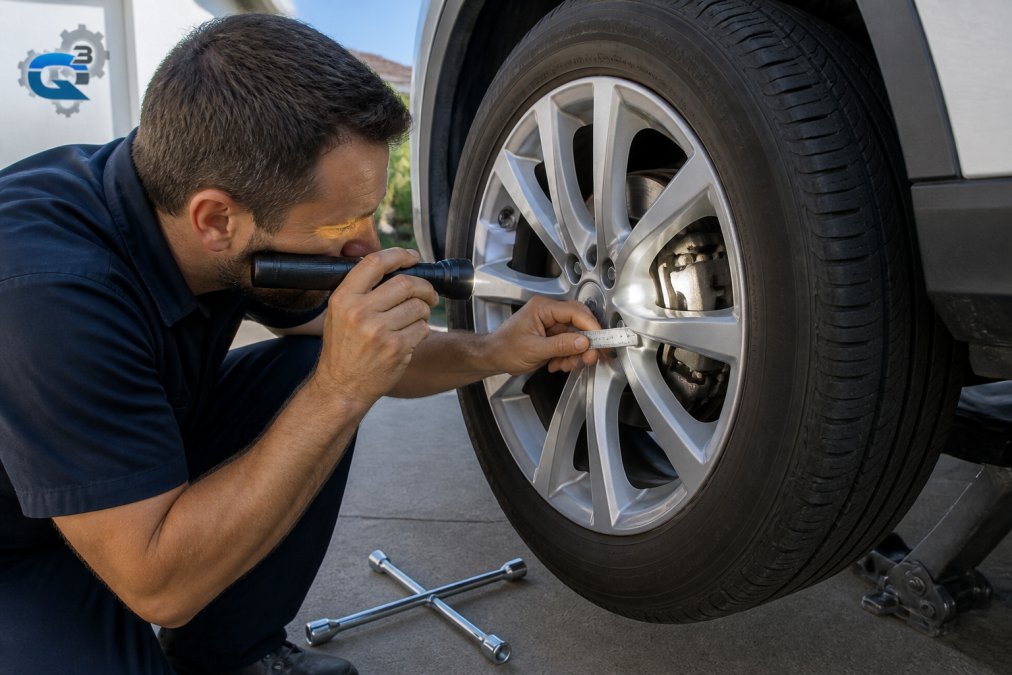
You can check your brake pad thickness in your own driveway with a few basic tools. The method changes depending on whether your vehicle has disc brakes or drum brakes, so confirm which setup you have before you start.
What You'll Need
- A flashlight or headlamp
- A small ruler or a brake pad gauge
- A lug wrench and jack (if you need to remove the wheel)
- A pair of work gloves
- A jack stand for safety
- A tire pressure gauge (to reset TPMS if your vehicle monitors it)
Step 1: Inspect Through the Wheel Spokes (No Jack Required)
On most alloy wheels, you can see the brake caliper and pad edge without removing anything. Park on a flat surface, set the parking brake, and shine a light at a shallow angle across the rotor. Look for the pad's friction material sandwiched between the caliper and the rotor. If you can see at least 3 millimeters of friction material, the pad is still in service range.
Step 2: Remove the Wheel for an Accurate Reading
- Park on a flat surface and set the parking brake.
- Loosen the lug nuts slightly before lifting the car.
- Jack up the car and secure it on a jack stand.
- Remove the wheel to see the caliper and pads clearly.
- Shine your flashlight on the brake pad.
- Measure the thickness of the friction material, not the metal backing.
- Compare your reading to the replacement threshold.
- Check both pads on each wheel, since they can wear unevenly.
Step 3: Watch for ABS and Sensor Differences
If your vehicle has ABS, each wheel may have a wheel-speed sensor and, on many newer cars, a pad-wear sensor wired into the caliper. Do not pull or bend these wires while inspecting. A damaged ABS sensor can trigger a dashboard warning light and disable anti-lock function until it is replaced. On non-ABS vehicles, the caliper and pad are simpler, but you still want to avoid prying on the caliper piston or boot.
Step 4: Know When to Stop and Call a Pro
Stop your inspection and book service if you find any of these:
- Friction material at or below 3 millimeters
- Uneven wear between the inner and outer pad on the same wheel (a sign of a sticking caliper or seized slide pin)
- Deep grooves, scoring, or a visible lip on the rotor edge
- Brake fluid residue or a torn caliper dust boot
- A pad-wear sensor wire that is frayed or disconnected
Vehicle Pulling, Vibration, and Brake Warning Lights
A car that pulls to one side when you brake usually has a stuck caliper or uneven pad wear. One side grabs harder than the other, so the car drifts. This also throws off your alignment and wears tires faster.
Leaks, Burning Smells, and Other Underlying Brake Problems
Brake fluid leaks are easy to miss but serious. Look for clear or yellowish puddles near your wheels or under the master cylinder. Low fluid means air can enter the hydraulic system, and that's when your pedal goes soft.
| Symptom | Likely Cause | What to Do |
|---|---|---|
| Squealing | Worn pad, squeal indicator | Check pad thickness |
| Grinding | Metal-on-metal contact | Stop driving, get service |
| Spongy pedal | Air or fluid leak | Check brake fluid, bleeding |
| Pulsing pedal | Warped rotors | Inspect rotors and pads |
| Pulling to one side | Stuck caliper, uneven wear | Test calipers, check pads |
| Warning light | Low fluid, sensor, ABS fault | Run a diagnostic scan |
| Burning smell | Dragging brake, stuck caliper | Cool down, inspect right away |
The Cost of Brake Repair and When to Stop Driving
The cost of brake repair depends on what's worn and how much needs replacing. Because every vehicle is different, the best move is to ask for a written estimate before any work starts.
Drive vs. Tow: A Decision Rule You Can Use
Most articles list symptoms. Fewer tell you what to do with them. Use this threshold to decide whether you can drive to a shop or need a tow.
Tow immediately, do not drive:
-
The pedal sinks to the floor or nearly to the floor
-
You hear constant metal-on-metal grinding
-
The car pulls hard to one side when braking
-
You see a brake fluid leak under the car or a wet master cylinder
-
The brake warning light stays on and the pedal feels different
-
You smell a sharp burning odor and one wheel is hot to the touch
-
A single squeal on the first stop of the day that fades
-
A soft but still firm pedal with no fluid loss
-
A pulsing pedal with normal stopping distance
-
A dashboard light that came on once and cleared
Monitor and schedule service soon:
- Slight vibration only at highway speed
- Visible pad dust with no noise or pedal change
- A pad-wear indicator that just started chirping
Why the DIY vs. Professional Line Matters
Some brake work is reasonable for a confident home mechanic: pad swaps on a disc-brake axle, brake fluid top-offs after finding a leak, and visual inspections. Other work should go to a shop: bleeding ABS hydraulic units, replacing a master cylinder, servicing drum brakes, and any repair that requires a scan tool to reset the ABS module. If your vehicle has electronic parking brakes, you often need a scan tool to retract the caliper before a pad change, a step most driveway guides skip.
Frequently Asked Questions
What are the most common signs of failing brakes?
The most common signs include squealing or grinding noises when you press the pedal, a spongy or soft brake pedal feel, vibration or pulsing through the pedal, the vehicle pulling to one side during braking, an illuminated dashboard warning light, visible fluid leaks near the wheels, and a burning smell after driving. Any one of these symptoms means you should have the brake system inspected promptly.
How do I know if my brake pads are worn out?
Check the friction material thickness through the wheel spokes. Once the pad is down to 3 millimeters or less, replacement is due. Many pads also have a built-in squeal indicator, a small metal tab that contacts the rotor and produces a high-pitched squeal when the pad is near the end of its life.
Is it safe to drive with a soft or spongy brake pedal?
A soft or spongy pedal usually points to air in the hydraulic system, a failing master cylinder, or a fluid leak. It is not safe to continue driving because stopping distance increases and the pedal could eventually go to the floor. Have the vehicle towed or inspected immediately rather than risk brake failure in traffic.
What causes a car to pull to one side when braking?
Pulling to one side during braking often means a caliper is sticking, a brake hose is restricted, or the pads on one side are more worn than the other. Uneven wear like this reduces stopping power and can lead to rotor damage. A qualified technician can diagnose whether the caliper, hose, or another hydraulic component is the cause.
Brake problems rarely fix themselves, and the warning signs only get louder with time. At Q3 Car & Truck Repair, our skilled technicians inspect your brakes, explain exactly what's worn, and give you a clear estimate before any work begins. We handle everything from pad and rotor service to brake fluid flushes and full diagnostics, so you can drive with confidence. Request an appointment with Q3 Car & Truck Repair and get your brakes checked before a small issue becomes a big one.