 listicle
7 Common Car Diagnostic Warning Lights Explained
Table of Contents
- 1. Check Engine Light: Solid vs. Flashing
- 2. Oil Pressure Warning Light
- 3. Engine Coolant Temperature Warning
- 4. Battery and Charging System Alert
- 5. Tire Pressure Monitoring System (TPMS) Light
- 6. Brake System and ABS Warning Lights
- 7. Airbag and SRS Warning Light
- Color-Coded Urgency: Red, Amber, or Green?
- When to See a Mechanic for Dashboard Lights
- Frequently Asked Questions
Last Updated: September 11, 2026
1. Check Engine Light: Solid vs. Flashing
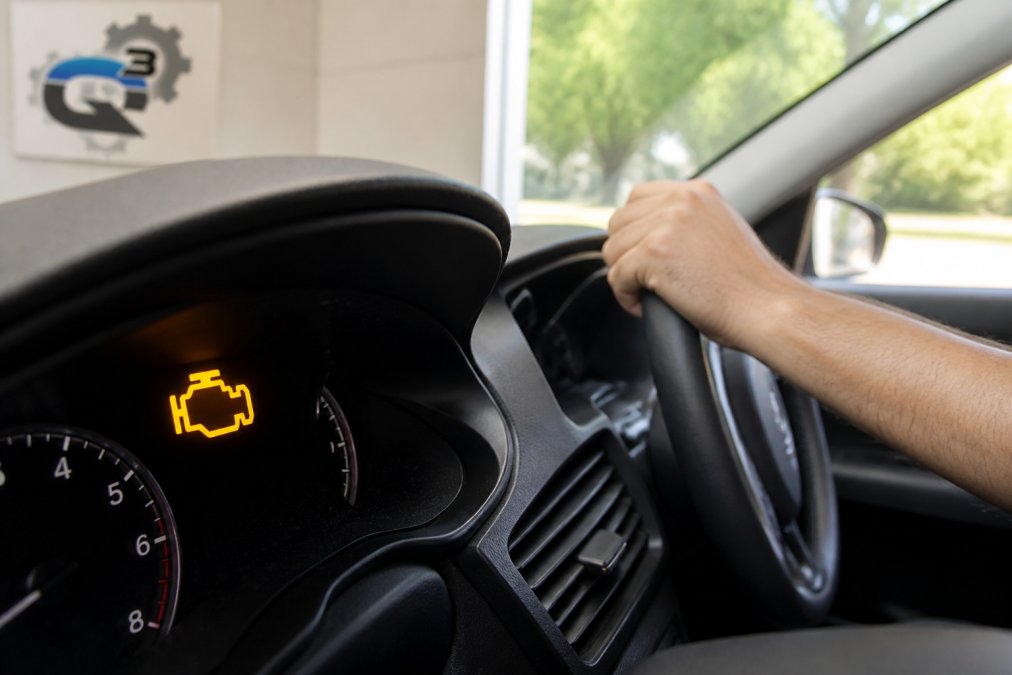
The check engine light is the most misunderstood of all car diagnostic warning lights. A steady light means the engine control unit has logged a fault but the vehicle can typically be driven to a shop. A flashing light means active misfire is dumping raw fuel into the catalytic converter, risking a fast-climbing repair bill (the EPA).
What Does a Flashing Check Engine Light Mean?
What does a flashing check engine light mean in practice? Stop driving. It indicates a live misfire that can destroy the catalytic converter within minutes, so pull over safely and arrange a tow.
Common triggers behind either version include:
- A loose or failed gas cap (the cheapest fix, and the most common)
- A failing oxygen sensor skewing the air-fuel ratio
- Worn spark plugs or ignition coils causing misfire
- A clogged catalytic converter restricting exhaust flow
At Q3 Car & Truck Repair, we pull the stored diagnostic trouble codes before quoting anything.
2. Oil Pressure Warning Light
An oil pressure warning light means the engine has lost oil pressure, the one dashboard alert you should never finish your drive through. Oil pressure keeps metal surfaces separated; when it drops, bearings grind against crankshaft journals and the damage is often permanent.
Pull over, shut the engine off, and check the oil level on the dipstick once the engine cools. If the level is fine, the problem is usually a failing oil pump or a bad pressure sensor. Driving on turns a sensor replacement into an engine rebuild.
3. Engine Coolant Temperature Warning
The coolant temperature warning signals engine overheating, and continuing to drive can warp the cylinder head or crack the block. Steam, a pinned temperature gauge, or a sweet smell usually accompanies it.
Never open a hot coolant reservoir or radiator cap, pressurized coolant can spray and cause serious burns. Wait for the engine to cool, then check the reservoir level and look for leaks. Persistent overheating points to a failed thermostat, a leaking water pump, or a head gasket issue; a warning that returns within a day or two almost always means a component has failed.
4. Battery and Charging System Alert
A battery or charging system light means the alternator has stopped keeping up with electrical demand, and the car is running on stored battery power alone. You may have minutes to an hour before the electrical system shuts down, and the vehicle will not restart.
Turn off the radio, air conditioning, and phone chargers to reduce the load, then head straight to a repair shop. A common mistake is assuming the battery is at fault, when a failed alternator, a worn serpentine belt, or a corroded terminal is the real cause. Testing the charging system, not just the battery, is the only way to know which part needs replacing.
5. Tire Pressure Monitoring System (TPMS) Light
The tire pressure monitoring system light means one or more tires has dropped below the recommended cold inflation pressure, and it is the most common dashboard alert drivers ignore. A tire 25 percent underinflated wears faster, hurts fuel economy, and is far more likely to overheat and fail at highway speed.
Check all four tires with a gauge rather than eyeballing them, since a tire can look fine and still be significantly low. Cold weather routinely drops pressure enough to trigger the light, which is normal. A light that returns within a few days of adding air usually means a slow puncture or a leaking valve stem. Sensor failure can also trigger the light on older vehicles, so a shop that reads the sensors directly can tell you whether you have a pressure problem or a sensor problem.
6. Brake System and ABS Warning Lights
Brake system and anti-lock braking system lights are safety alerts, not maintenance reminders. The two lights look similar but mean very different things, and confusing them can cost you a tow bill or your stopping distance in a panic stop.
Red Brake Light: Hydraulic System Failure
A red brake light usually points to low brake fluid, worn brake pads, or a hydraulic system problem. On most vehicles, the same red light doubles as the parking brake indicator, so first check whether the parking brake is fully released, a partially engaged lever or stuck electronic switch will keep the light on and mimic a real fault.
If the parking brake is not the cause, the red light typically means one of three things:
- Low brake fluid, often the first sign of a leak in a caliper, wheel cylinder, or brake line. Fluid level drops as pads wear, but a sudden drop points to a leak.
- Worn brake pads, many vehicles trigger the red light when pad wear sensors contact the rotor.
- Hydraulic pressure loss, a failing master cylinder or a leaking line. Pedal feel usually goes soft or spongy before the light appears.
A red brake light combined with a soft or sinking pedal is a stop-now condition. Do not drive the vehicle. Have it towed.
Amber ABS Light: Anti-Lock System Disabled
An amber ABS light means the anti-lock braking system is disabled. The base hydraulic brakes still work, but the wheels can lock under hard braking, so you lose steering control during an emergency stop.
The most common triggers are:
- A failed wheel speed sensor at one corner (the single most common cause)
- A damaged or corroded tone ring on the axle or hub
- A wiring fault between the sensor and the ABS control module
- A failing ABS pump motor or control module
A scan tool that reads ABS codes, not just engine codes, is required to pinpoint which wheel or component is at fault. A generic OBD-II reader often cannot read ABS codes; you need a scanner with ABS coverage or a shop-level tool.
When Both Lights Are On Together
If both the red brake light and the amber ABS light are on together, treat it as urgent. This combination usually means the ABS module has detected a fault affecting both the anti-lock function and the base hydraulic system, or that a wheel speed sensor fault has escalated. Low brake fluid often signals a leak, and a leak means braking performance can degrade without warning.
Do not postpone either diagnosis. Brakes are the one system where waiting rarely saves money, a $200 wheel speed sensor job can become a $1,500 ABS module replacement if the fault is ignored long enough for the module to fail.
Color-Coded Triage for Brake Lights
| Light | Color | Meaning | Action |
|---|---|---|---|
| Brake | Red | Hydraulic fault or parking brake engaged | Stop now if pedal is soft; check parking brake first |
| ABS | Amber | Anti-lock disabled, base brakes work | Drive cautiously to a shop soon |
| Both | Red + Amber | Combined hydraulic and ABS fault | Treat as urgent; limit driving |
NHTSA brake safety and defect information
7. Airbag and SRS Warning Light
The airbag and supplemental restraint system light means the airbags may not deploy in a crash, a safety system failure, not a cosmetic annoyance. It typically comes on when a crash sensor, a seat belt pretensioner, or a wiring connector under the seat has failed.
What the SRS System Actually Includes
The SRS is not just the airbags. It is a network of components that must all communicate correctly to fire in a crash:
- Front airbags, driver and passenger, deployed by impact sensors
- Side airbags and curtain airbags, deployed by side-impact sensors
- Seat belt pretensioners, pyrotechnic devices that tighten the belt in a crash
- Seat occupancy sensors, tell the system whether a passenger is present and their weight
- Crash sensors and the SRS control module, the brain that decides whether to deploy
A fault anywhere in this network triggers the same warning light, so the light alone cannot tell you what is wrong.
Common Causes and the Codes Behind Them
The most common SRS fault codes point to specific components:
- B-pillar or seat connector faults, the wiring harness under the driver or passenger seat is the single most common failure point. Moving the seat back and forth can chafe or loosen the connector.
- Seat belt pretensioner codes, the pretensioner has its own circuit and can fail independently.
- Occupancy sensor codes, the passenger seat weight sensor can fail, especially on older vehicles.
- Clock spring faults, the spiral cable in the steering wheel that carries airbag wiring can break after years of turning.
A diagnostic scan reads the specific SRS code and points to the failed component, which is often a connector or sensor rather than the airbag itself. A generic OBD-II reader usually cannot read SRS codes, you need a scanner with SRS/airbag coverage or a shop-level tool.
Resetting the SRS Light Safely
Resetting the light without fixing the underlying fault only hides the problem until it matters most. Legitimate reset procedures after a repair exist, though:
- Fix the fault first. Replace the failed sensor, connector, or pretensioner.
- Clear the code with an SRS-capable scanner. Do not use a generic OBD-II reader, it will not clear SRS codes.
- Perform a drive cycle. Most vehicles require a specific ignition cycle sequence before the SRS module re-tests the system.
- Verify the light stays off. If it returns, the fault is still present or a second fault exists.
Some vehicles require a manufacturer-specific reset procedure, and a few require the SRS module to be re-flashed. A shop with the right tool can do this in minutes; a DIYer with a generic scanner usually cannot.
Why You Should Never Ignore It
A common mistake is ignoring the light because the car drives normally. It will, right up until the moment you need the airbag and it does not fire. The SRS light does not affect drivability, which is exactly why so many drivers let it ride for months, and why it is one of the most dangerous lights to ignore.
NHTSA airbag and recall information
Color-Coded Urgency: Red, Amber, or Green?
Dashboard illumination follows a color code, and reading it correctly tells you how fast to act. Red means stop safely and shut the engine off. Amber means drive cautiously to a shop soon. Green or blue simply means a system is on, such as headlights or high beams.
| Color | Meaning | Action | Examples |
|---|---|---|---|
| Red | Stop now | Pull over, shut off engine | Oil pressure, coolant temp, brakes |
| Amber | Service soon | Drive to a shop promptly | Check engine, TPMS, ABS |
| Green or blue | System active | No action needed | Headlights, turn signals, cruise |
This color framework is the fastest way to triage any of the car diagnostic warning lights on your dash, the one piece of knowledge worth memorizing before you need it.
When to See a Mechanic for Dashboard Lights
See a mechanic immediately for any red light, any flashing amber light, or any warning that returns after you address the obvious cause. For steady amber lights, booking a diagnostic within a few days is reasonable, but do not let it ride for weeks.
A car diagnostic scan is far cheaper than the repair a neglected warning light eventually demands. The scan reads stored diagnostic trouble codes directly from the engine control unit, so the technician diagnoses the actual fault instead of replacing parts on a guess.
A modern OBD-II scanner reads these codes in seconds. Here is how the process works:
- Plug the scanner into the port under the driver's side dash
- Turn the ignition to the run position
- Read the stored and pending trouble codes
- Cross-reference the codes against the vehicle's repair database
- Clear the codes only after the fault is fixed, never before
Some drivers buy a scanner to read codes at home, which is useful for monitoring a recurring light. It is not a substitute for diagnosis. Knowing that code P0301 means a cylinder 1 misfire does not tell you whether the cause is a spark plug, an ignition coil, or a fuel injector.
If you manage a fleet of work vehicles, a recurring amber light on one truck is worth diagnosing early. Catching a small fault before it strands a driver keeps your schedule intact and your repair costs predictable.
Dashboard warning lights are the vehicle's way of telling you something before it becomes a breakdown, and the difference between a cheap fix and an expensive one usually comes down to how quickly you respond. Q3 Car & Truck Repair diagnoses warning lights with transparent communication and straightforward estimates, so you understand exactly why a repair is needed before anyone touches your vehicle. Our highly skilled technicians work on both cars and trucks, from a simple sensor replacement to transmission and diesel service. Request an appointment with Q3 Car & Truck Repair and get a clear answer about what your dashboard is telling you.
Frequently Asked Questions
What are the most common car diagnostic warning lights?
The most frequent alerts include the check engine light, oil pressure warning, coolant temperature alert, battery/charging system light, tire pressure monitoring system (TPMS) indicator, brake system warning, and airbag/SRS light. These cover the core systems that affect engine performance, safety, and vehicle reliability. Recognizing each symbol helps you decide whether to pull over immediately or schedule service soon.
What does a flashing check engine light mean?
A flashing check engine light signals an active misfire that can damage the catalytic converter and other emissions components. Unlike a steady light, which may indicate a minor sensor issue, a flashing light demands immediate attention. Reduce speed, avoid heavy acceleration, and drive directly to a repair shop. Continuing to drive can lead to costly repairs.
When should I see a mechanic for dashboard lights?
See a mechanic immediately for any red warning light, especially oil pressure, coolant temperature, or brake system alerts. Amber lights like check engine or TPMS allow you to drive cautiously but should be diagnosed within a few days. If a light flashes or is accompanied by strange noises, smells, or performance changes, stop driving and call for assistance.
How much does a car diagnostic scan cost?
For an accurate quote, contact a trusted local shop directly.
Is it safe to drive with a dashboard warning light on?
It depends on the light's color and system. Red lights indicate a serious safety or mechanical issue and require immediate attention. Yellow or amber lights mean you should schedule service soon but can typically drive short distances. Green or blue lights are informational. When in doubt, consult a professional to avoid risking further damage or unsafe driving conditions.