 How-to
How to Avoid Overcharges at Auto Repair Shops: A Step-by-Step Guide
Last Updated: November 15, 2026
Quick Summary
To avoid overcharges at auto repair shops, get every quote in writing and itemized, then read each line before approving work. Check labor hours against a published book time and multiply hours by the posted rate yourself. Confirm parts type, the diagnostic fee, and shop supplies, and compare the final invoice to the estimate you approved.
- Never authorize work by phone without a written, itemized estimate you can review.
- Multiply each labor line's hours by the posted hourly rate yourself.
- Ask whether parts are new, remanufactured, or salvaged, and request the old parts back.
- Confirm whether the diagnostic fee is credited toward the repair if you approve it.
- Compare the final invoice to the approved estimate before paying any charge.
Table of Contents
- Why Overcharges Happen and How to Spot the Warning Signs
- How to Read an Auto Repair Estimate Line by Line
- Questions to Ask a Mechanic Before Repairs Begin
- How to Compare Mechanic Quotes Fairly
- Telling Necessary Repairs From Optional Maintenance
- What to Do If a Mechanic Overcharges You
- Booking Your Next Repair With Q3 Car & Truck Repair
- Frequently Asked Questions
Why Overcharges Happen and How to Spot the Warning Signs
Most overcharges are not scams. They happen when a shop adds work nobody asked for, quotes parts at a markup, or bills more labor hours than a job should take. Knowing the common patterns is the first step to avoid overcharges.
A few warning signs show up again and again. Watch for vague descriptions like "engine service" with no detail. Pressure to decide right now is another red flag. So is a repair list that grows after you've already dropped the car off.
- A verbal quote with no written estimate
- Charges for "shop supplies" that are unusually high
- Urgent safety warnings with no test results to back them up
- Refusal to show you the old parts
Watch out: Never authorize work by phone without a written estimate you can review later. That's where many disputed charges begin.
How to Read an Auto Repair Estimate Line by Line
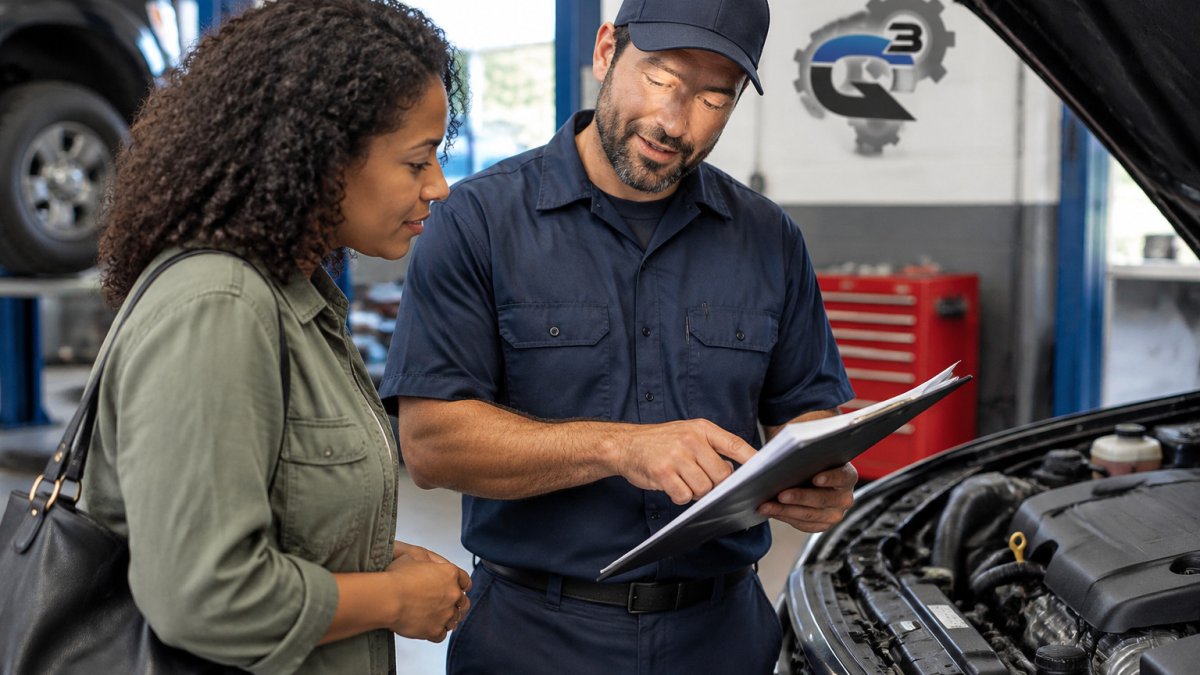
A written estimate should list each part, its price, and the labor hours for each task. Read every line before you approve anything. The goal is not to become a mechanic, it is to catch the handful of line items where overcharges usually hide.

1. Confirm the estimate is written and itemized. A legitimate estimate separates parts, labor, and fees. If you get one lump sum like "$1,200 to fix the front end," ask for it in writing, broken out line by line, before you authorize anything.
2. Check the labor hours against a published book time. Most shops price labor using flat-rate time guides, which assign a standard number of hours to a job (for example, a specific number of hours for a water pump on a given make and model).
3. Multiply hours by the posted labor rate. The estimate should show the hourly labor rate. Do the math yourself on each labor line: hours × rate. This is where padded hours and a high rate compound. If the rate is not shown, ask for it.
4. Scrutinize parts pricing and part type. For each part, note the name, part number, and price, and whether it is new, remanufactured, or salvaged. A common pattern is quoting an OEM (original equipment manufacturer) part at full price while installing an aftermarket equivalent.
5. Pin down the diagnostic fee. Ask whether the diagnostic charge is separate, how much it is, and whether it is credited toward the repair if you approve the work.
6. Question shop supplies and environmental fees. These are usually small percentages or flat fees, but they should be disclosed and calculated on a stated basis. An unusually large "shop supplies" line, or one that appears only at invoice time, is worth challenging.
7. Check tax and the final total. Confirm the estimated tax and the out-the-door total in USD, and make sure the total equals the sum of the lines.
8. Compare the estimate to the final invoice. Before you pay, put the approved estimate next to the invoice. Every charge on the invoice should trace to a line you approved. If the invoice is higher, ask for the authorization for each added item.
- Parts: part name, part number, new vs. remanufactured vs. salvaged, and price
- Labor: book time hours, hourly rate, and hours × rate per line
- Diagnostic fee: amount and whether it is credited if you approve the repair
- Shop supplies and fees: the amount and how it is calculated
- Total: estimated tax and final amount in USD
Watch out: A verbal "we'll take care of it" is not an approval record. Keep the written estimate, and if the shop texts or emails an updated quote, save it, that message is your proof of what you authorized.
Use this summary to check each part of an estimate before you approve the work.
| Check | What to verify | Why it matters |
|---|---|---|
| Written, itemized estimate | Parts, labor and fees listed separately | Lump sums hide charges |
| Labor hours | Compare to a published book time | Padded hours inflate labor |
| Hours × rate | Multiply each labor line yourself | Padding and high rates compound |
| Parts type | New, remanufactured or salvaged | OEM quoted, aftermarket installed |
| Diagnostic fee | Amount and whether it is credited | Common surprise charge |
| Shop supplies | Stated basis for the fee | Unusually large fees are challengeable |
| Tax and total | Total equals the sum of the lines | Catches arithmetic and tax errors |
| Estimate vs. invoice | Every invoice charge traces to an approved line | Unapproved charges can be disputed |
Questions to Ask a Mechanic Before Repairs Begin
Ask a few direct questions before any work starts. A good shop will answer them without fuss. Hesitation is worth noting.
Start with what's broken and how the shop knows. Then ask what happens if you wait. Finally, ask what the repair will cost, and what's optional.
"What exactly failed, how did you confirm it, and what happens if I don't fix it today?"
Also ask whether the shop uses new or remanufactured parts, and whether the work comes with a warranty.
How to Compare Mechanic Quotes Fairly
Getting a second estimate only helps if you compare the same job. Two quotes for "brake work" can differ by hundreds of dollars because one includes rotors and the other does not. Use a repeatable method so price differences reflect real differences in scope, parts, and labor, not confusion.
Build a like-for-like comparison. For each quote, write down the same fields side by side: the diagnosis, the parts (name, part number, new vs. remanufactured vs. salvaged), labor hours and hourly rate, diagnostic fee, shop supplies and fees, tax, warranty terms, and the out-the-door total in USD. If a quote is missing a field, ask the shop to fill it in before you compare.
Separate the diagnosis from the price. The cheapest quote may be cheapest because it addresses a different problem. Ask each shop what failed and how it confirmed the failure, a test result, a measurement, a fault code, or a visual inspection.
Ask each shop to explain the difference. Once you have two itemized quotes, call each shop and read the other quote's line items without naming the shop. Ask: "Another estimate includes X and bills Y hours. Can you tell me why yours differs?" A confident shop will explain part quality, book time, or additional related work.
Weigh parts quality and warranty, not just price. A much lower quote may use lower-grade parts or skip steps like resurfacing or replacing related hardware. A much higher quote may include optional maintenance bundled in. Compare the warranty in months and miles, and ask who honors it, the shop or a third party.
Set authorization limits in writing before anyone starts. This is the step most guides skip. When you choose a shop, give written authorization that names the approved repairs and a dollar ceiling, and state that no additional work may be performed without your explicit approval. Put it in the text or email thread so there is a record.
Use short scripts to hold the line. Concise phrases work better than debate:
- Declining an add-on: "Please do only the approved items on the estimate. I'm declining the additional work today."
- Limiting scope: "You're authorized up to $[amount] for the approved repairs. Anything beyond that needs my written approval first."
- Buying time: "I'm not approving additional work today. Please send me the findings and a written estimate, and I'll respond in writing."
- Requesting evidence: "Can you send me a photo of the worn part or the test result before I decide?"
Keep a clean record. Save every estimate, text, email, and invoice in one place, and note the date and time of each approval. If a dispute arises later, that record is what a consumer protection office or small claims court will look at.
- Confirm both quotes cover the same repair, parts, and labor
- Compare part quality and warranty terms in months and miles
- Check labor hours against book time and the hourly rate
- Ask who will do the work and how long it will take
- Put your approval and dollar limit in writing before work begins
Watch out: Approving work by phone without a written follow-up leaves you with no record of what you authorized. If you must approve remotely, ask the shop to text or email the itemized addition and reply in writing with your approval and limit.
Telling Necessary Repairs From Optional Maintenance
Some recommended work is urgent, like worn brakes or a leaking fluid that threatens other parts. Other work is optional or can wait, like a fluid flush done earlier than the owner's manual suggests.
Ask the mechanic to rank the items: safety now, soon, or later. Check your owner's manual for the recommended service schedule. If a repair isn't on that schedule and isn't a safety issue, you can often delay it.
Many owners find it helpful to write down the list and decide item by item. Use plain questions like "Will the car be unsafe to drive?" to sort the work.
What to Do If a Mechanic Overcharges You
Start by calmly asking the shop to explain the charge and show the original estimate. Many billing mistakes get fixed at this stage. Keep copies of everything, including invoices and any texts or emails.
If the shop won't correct it, you have options. You can file a complaint with your state attorney general's consumer protection office. Many states also let you use small claims court for amounts within the limit. If you paid by credit card, you can ask your card issuer about a dispute.
- Request a written, itemized invoice
- Compare it with the estimate you approved
- File a complaint with your state consumer protection office
- Consider small claims court or a credit-card dispute
Booking Your Next Repair With Q3 Car & Truck Repair
Choosing the right shop is one of the best ways to avoid overcharges. At Q3 Car & Truck Repair, we focus on straightforward estimates and clear communication so you can make informed decisions.
To get started, schedule an appointment with Q3 Car & Truck Repair. You can also review our services for cars and trucks to see what we handle. If you're still choosing a shop, our tips for finding a reliable local mechanic cover what to look for. For the next step after a bad bill, see what to do if a mechanic overcharges you.
Stop guessing at your next repair. Get a clear, written estimate from Q3 Car & Truck Repair and know exactly what you are paying for before we start.
Frequently Asked Questions
How can I tell if an auto repair estimate is fair?
Start by checking that the estimate is written and itemized, with each part, its price, and the labor hours listed separately. Compare the labor hours against the standard times your mechanic uses, which are commonly published in industry guides. Check whether shop supplies and diagnostic fees are listed clearly and whether taxes are included. If a line item is vague, such as a general repair charge with no description, ask for a specific breakdown before you authorize any work.
Can a repair shop charge more than its estimate?
A shop should not exceed a written estimate without contacting you first. Rules on charges above an estimate vary by state, so check with your state attorney general's consumer protection office. Before work begins, ask the shop to call you for approval if the cost is going to rise, and get any revised amount in writing. Keep your original estimate and all approvals so you have a clear record if a dispute arises.
What should I ask a mechanic before approving repairs?
Ask what is broken, how the mechanic confirmed the problem, and what happens if you do not fix it right away. Ask whether each repair is required for safety or drivability or is optional maintenance. Request the replaced parts back so you can verify the work was done. Confirm the labor rate, the parts cost, and the total before you sign. A reputable shop will answer these questions without pressure.