 blog
How to Spot the Signs You Need a Tire Rotation
Last Updated: November 13, 2026
Quick Summary
Uneven tire wear is the clearest sign you need a tire rotation, showing up as bald patches, cupped tread, or one edge wearing faster than the rest. Vibration, pulling to one side, and reduced grip can also point to worn tires that a position swap would have evened out. Check tread depth at three points across each tire to confirm.
- Run your hand across the tread or use a gauge at the inner edge, center, and outer edge.
- A shake that starts around 50 to 70 mph is usually wheel balance, not tire position.
- Many tire manufacturers require documented rotations at the stated interval for treadwear warranty claims.
- Directional tires can only move front to back on the same side, never across.
- Wear on one edge of both front tires points to alignment, not rotation.
Table of Contents
- Why Tire Rotation Matters and the Signs You Should Not Ignore
- Uneven Tire Wear: The Clearest Sign You Need a Rotation
- Vibration, Pulling, and Other Signs You Need a Tire Rotation
- How Often Should Tires Be Rotated?
- Signs Your Tires Need to Be Aligned vs. Rotated
- What Tire Rotation Cost Looks Like and What Affects It
- When Rotation Will Not Solve the Problem
- Book Your Tire Rotation at Q3 Car & Truck Repair
- Frequently Asked Questions
Why Tire Rotation Matters and the Signs You Should Not Ignore
Your tires do not wear evenly, and that is the whole reason rotation exists.
A driver who mentions a slight shimmy at highway speed often has tires that have gone too long without a swap.
Rotation is simple: move each tire to a different position so the wear evens out.
Below, we walk through each symptom in order, from the ones you can spot in your driveway to the ones that need a lift and a trained eye.
Uneven Tire Wear: The Clearest Sign You Need a Rotation
Uneven tire wear is the most reliable sign you need a tire rotation.
Here is what to check. Run your hand across the tread, or use a tread depth gauge at three points across each tire: inner edge, center, and outer edge.
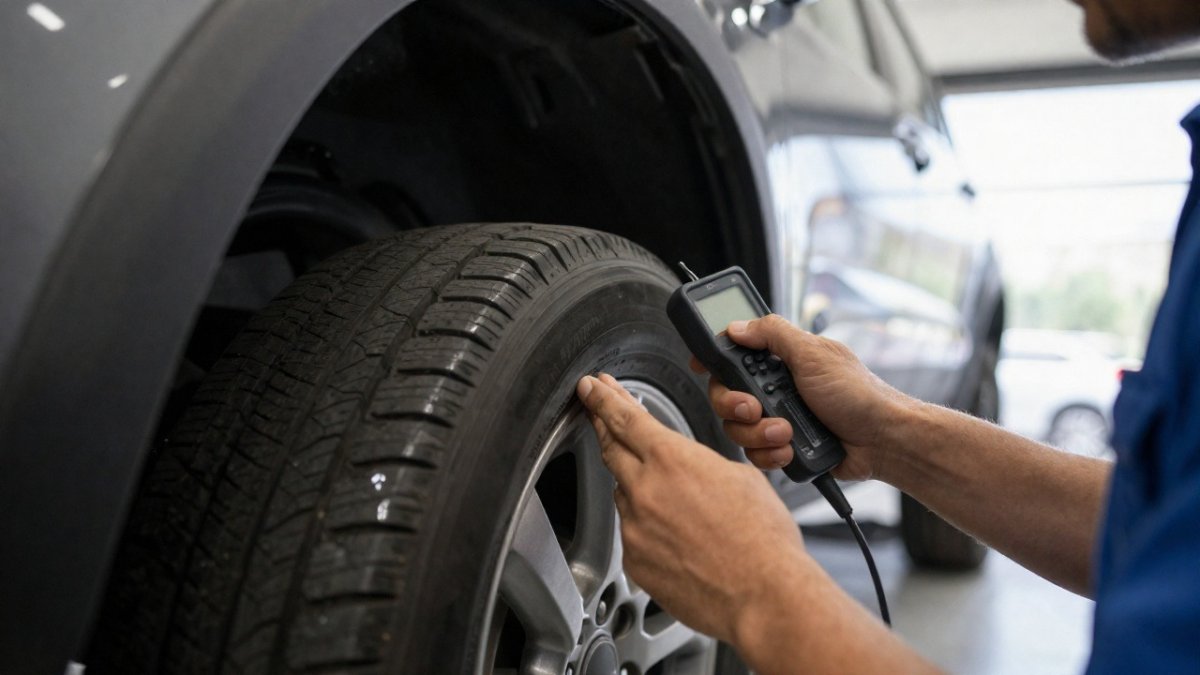
What Patchy and Cupped Wear Look Like
Patchy wear shows up as bald spots or flat patches on one section of the tread. Cupped wear looks like scalloped dips, almost like the tread is scooped out in waves.
Both point to a tire that has been running in the wrong position too long. Front tires often develop shoulder wear on the outer edges from cornering.
If the wear is patchy across the whole tread rather than one spot, that is usually a pressure or suspension issue, not a rotation problem. We cover that distinction further down.
Vibration, Pulling, and Other Signs You Need a Tire Rotation
Vibration and pulling are the symptoms drivers notice first, because you feel them through the wheel and the seat. Both can come from uneven wear that rotation would have prevented, but both can also come from problems a rotation will never fix. The useful skill is telling those apart before you pay for a swap.
Steering Wheel and Cabin Vibration
A shake in the steering wheel usually traces to the front tires. A vibration through the floor or seat points to the rear. That much is simple. The cause is where drivers get stuck.
Work through this order:
- Speed-dependent shake that starts around 50 to 70 mph and fades at other speeds: most often wheel balance. A thrown wheel weight or a bent wheel is the usual culprit. Rotation will not fix it.
- Shake that appears only under braking: warped rotors or a brake issue, not tire position.
- Constant vibration that changes with road surface: often a separated belt or internal tire damage. Inspect the tire before rotating it.
Watch out: rotating a tire with a separated belt or internal damage just moves a failing tire to another corner. Have the tire inspected first.
Pulling to One Side and Reduced Grip
Does the vehicle drift toward one side on a flat, straight road? That is pulling, and the cause matters more than the symptom.
- Pull that follows a pressure difference: check and set all four tires to the door-jamb placard pressure cold. A low tire on one side will pull toward that side.
- Pull that stays after pressures are set: alignment is the likely cause, especially if the steering wheel is off-center while driving straight.
- Pull that appeared after a rotation: a worn tire moved to a new corner can change the pull. Note the direction and tell the technician which tires moved where.
Reduced grip is the safety side of the same coin. Worn shoulders and patchy tread give up traction in rain long before the center tread looks bad. If your stopping distance feels longer than it used to, check the tires first, then check pressures, then look at alignment.
Other signs worth noting:
- A rougher ride over the same roads you drive daily
- Lower fuel efficiency as worn tires struggle for grip
- One tire that keeps losing pressure compared to the others
A Quick Diagnostic Order
When a symptom shows up, check in this sequence before assuming rotation is the answer:
- Set all four cold pressures to the placard spec and recheck the symptom.
- Inspect tread depth at three points across each tire and look for cupping, patchy wear, or a separated belt.
- Note whether the symptom changes with speed, braking, or road surface.
- Compare the symptom to your last rotation date and mileage.
- If the symptom persists after pressures and inspection, get alignment and balance checked before rotating again.
That order keeps you from paying for a rotation that cannot solve a balance, alignment, brake, or suspension problem.
How Often Should Tires Be Rotated?
Many vehicle manufacturers recommend a tire rotation at a set mileage interval. The best source is your owner's manual, which lists the interval and the correct rotation pattern for your drivetrain. Treat the manual as the authority.
If you drive mostly short trips, tow, or carry heavy loads, the manual may call for a shorter interval.
Why the Manual and the Warranty Matter
Many tire manufacturers require documented rotations at the stated interval to honor a treadwear warranty claim. Check your warranty terms for the specific requirements.
Rotation Patterns by Drivetrain
The pattern matters as much as the timing:
- Front-wheel drive: front-to-rear, same side, with the rear tires crossing to the front
- Rear-wheel drive: rear tires move straight forward, front tires cross to the rear
- All-wheel drive: follow the manual closely, since AWD systems are sensitive to tread depth differences between axles
Staggered setups, where the front and rear tires are different sizes, generally cannot be rotated front to rear. The manual will specify which swaps are allowed for your vehicle.
Vehicle-Specific Limitations
- AWD and 4WD: a tread depth difference between front and rear can stress the drivetrain. Check your manual for the maximum allowable difference.
- Electric vehicles: instant torque and regenerative braking change wear patterns, and some models have different front and rear tire sizes. Check the manual before assuming a front-to-back swap is allowed.
- Staggered and directional combinations: if the tires are both staggered and directional, left-to-right swaps may be the only option, and sometimes no rotation is possible.
If you want to handle the swap yourself, our step-by-step tire rotation guide walks through the process, including how to mark tires before you start so the pattern stays correct.
Signs Your Tires Need to Be Aligned vs. Rotated
Alignment and rotation fix different problems, and mixing them up wastes money. Rotation evens out wear. Alignment corrects the angle at which the tires meet the road.
Here is how to tell them apart:
| Symptom | Likely Cause | Fix |
|---|---|---|
| One tire or edge wearing faster | Wrong position, no rotation | Tire rotation |
| Both front tires worn on inner or outer edge | Camber or toe out of spec | Wheel alignment |
| Vehicle pulls on a flat road | Alignment or pressure difference | Alignment check |
| Steering wheel off-center while driving straight | Alignment | Wheel alignment |
| Vibration at highway speed | Wheel balance | Balance and inspect |
| Scalloped or cupped tread | Worn shocks or struts | Suspension inspection |
If the vehicle pulls, the alignment is the place to start. Our team can check whether you need a wheel alignment and compare it against your rotation history before recommending anything.
What Tire Rotation Cost Looks Like and What Affects It
The cost of tire rotation depends on the vehicle, the shop, and whether balancing or an inspection is bundled in. Contact Q3 Car & Truck Repair on our website for current pricing or a quote.
What moves the number:
- Whether the wheels need to come off the vehicle or just be swapped
- Tire size and wheel type, since large truck wheels take more time
- Whether a balance, alignment check, or brake inspection is added
Ask for a written estimate before any work begins, and compare it line by line against what was discussed.
When Rotation Will Not Solve the Problem
Rotation is a maintenance habit, not a repair. If the underlying cause of the wear is mechanical, a swap just moves the problem to another corner.
Skip rotation as the fix and get a diagnosis if you notice:
- Wear on one edge of both front tires, which points to alignment
- Cupped or scalloped tread, which points to worn shocks or struts
- A vibration that stays after a fresh rotation and balance
Also check your tire warranty. Many manufacturers require documented rotations at the stated interval to honor a treadwear claim. Skipping them can void coverage on a set you paid good money for.
Book Your Tire Rotation at Q3 Car & Truck Repair
A five-minute tread check in your driveway tells you more than a dashboard light ever will. If the wear looks uneven, or the wheel shakes on the highway, get it looked at before the damage spreads to all four corners.
Q3 Car & Truck Repair provides straightforward estimates and clear explanations of what your vehicle needs and why.
We also offer tire rotation service you can schedule around a workday, and a short service video if you want to see what the process involves before you come in. If pressure loss is part of your problem, our article on the impact of driving with low tire pressure explains what that is doing to your tread.
Get started with Q3 Car & Truck Repair and keep your tires wearing evenly for the full life of the set.
Uneven tread and a shaking wheel are easy to ignore until they cost you four new tires. Let our team check the wear pattern, confirm whether you need a rotation or an alignment, and give you a written estimate before any work begins. You will know exactly what your vehicle needs and why.
Frequently Asked Questions
Can you tell if tires need rotating just by looking at them?
Often, yes. Compare the tread depth on the front tires against the rear tires using a tread depth gauge or a penny. If the front tires are noticeably more worn, or you see patchy, cupped, or feathered wear across the tread, a tire rotation is overdue. Also check for pressure differences between tires. Visible wear is a strong signal, but a technician can catch early uneven wear you might miss at home.
How often should tires be rotated on an AWD vehicle?
Most vehicle manufacturers recommend rotating tires every 5,000 to 8,000 miles, and all-wheel-drive vehicles often fall at the shorter end of that range. AWD systems send power to all four wheels, so mismatched tire diameters can strain the drivetrain. Check your owner's manual for the exact interval, and follow your tire warranty guidance as well. Consistent rotation protects both the tires and the AWD components.
Is tire rotation the same as wheel alignment or balancing?
No. A tire rotation moves wheels to different positions to even out wear. An alignment adjusts suspension angles so the tires point straight, and balancing corrects weight distribution on the wheel. If your car pulls to one side or the steering wheel is off-center, that points to alignment. If you feel vibration at speed, that points to balancing. Uneven tread wear alone usually means rotation is due. A shop can confirm which service you actually need.
Can unrotated tires cause vibration or noise?
Yes. When tires stay in the same position, wear patterns develop unevenly, and those irregular surfaces can create vibration through the steering wheel, floor, or cabin. You may also hear rhythmic noise that changes with speed. Rotation helps prevent these patterns from forming. If vibration persists after a rotation, have a technician check balancing, alignment, and suspension components before assuming the tires are the only cause.