 blog
blog
Common Causes of Check Engine Lights
Table of Contents
- What a Check Engine Light Actually Means
- Loose or Faulty Gas Cap
- Oxygen Sensor Failure
- Catalytic Converter Problems
- Spark Plugs and Ignition System Issues
- Vacuum Leaks and Mass Airflow Sensor Problems
- Is It Safe to Drive With Check Engine Light On
- Check Engine Light Flashing vs. Steady
- Frequently Asked Questions
Last Updated: October 14, 2026
What a Check Engine Light Actually Means
Your check engine light tells you something needs attention. It's not always an emergency, but it's never something to ignore.
The malfunction indicator lamp illuminates when your onboard diagnostic system detects a problem with the engine, emissions system, or transmission.
The key is knowing what triggered it. Some issues are minor and can wait a few days; others require immediate attention to prevent serious damage.
At Q3 Car & Truck Repair, we help drivers understand what their warning lights mean and what action to take. The difference between a steady and a flashing light matters a lot.
Loose or Faulty Gas Cap
This is the most common cause of a check engine light, and it's also the easiest to fix yourself.
Your fuel cap seals the tank and maintains pressure in the evaporative emissions system.
Check your gas cap first and make sure it's tight.
After tightening or replacing the cap, the light may take a few driving cycles to turn off. If it stays on after a week of normal driving, the problem is something else.
A faulty gas cap won't damage your engine, and you can drive safely with a loose cap, but fixing it prevents other fuel system issues.
Oxygen Sensor Failure
An oxygen sensor measures unburned oxygen in your exhaust stream, and the engine computer uses that reading to trim the air-fuel mixture dozens of times per second.
Most vehicles built after 1996 carry at least two oxygen sensors: an upstream sensor (before the catalytic converter) that drives fuel control, and a downstream sensor (after it) that verifies the converter is working. The two failures behave differently.
Upstream sensor failure usually shows up as:
- Poor fuel economy that creeps in over weeks, not days
- Rough idle or a slight surge at steady cruise
- Hesitation on light acceleration
- A sulfur or fuel smell from the exhaust
- Codes in the P0130-P0167 range, depending on which cylinder bank and position failed
Downstream sensor failure often produces no drivability symptom at all, the light comes on, the code points to catalyst efficiency or a heater circuit fault, and the vehicle feels normal.
A few mechanisms worth knowing:
- Heater circuit faults (often P0135, P0141, and similar) mean the sensor's internal heater has failed. The sensor may still read correctly once warm, but it takes too long to reach operating temperature, so the computer flags it.
- Contamination from coolant, oil, or silicone sealant coats the sensing element and slows its response, common after a head gasket repair or coolant leak into the combustion chamber.
- Age-related drift is the most common cause, sensors degrade gradually, so the light may come on long after performance has slipped.
Cost varies widely. On many four-cylinder cars, an upstream sensor is accessible from the top of the engine bay and the repair is modest. On V-configured engines, transverse drivetrains, or sensors buried behind the exhaust manifold, labor can multiply the bill several times over, sensor position, rust, and seized threads all drive the final number.
One more distinction: an oxygen sensor code is not proof the sensor is bad. Exhaust leaks ahead of the sensor, a misfire dumping unburned fuel, or a wiring fault can all set the same code, so a proper diagnosis confirms the cause before any part is replaced.
Catalytic Converter Problems
Your catalytic converter uses chemical reactions to convert harmful exhaust pollutants into less harmful substances before they leave your vehicle.
When it fails, the emissions system can't process exhaust properly, triggering a check engine light and usually a converter efficiency code.
Signs of a failing catalytic converter include:
- Reduced engine power and sluggish acceleration
- Rattling noises from underneath the vehicle
- Rotten egg smell in the exhaust
- Overheating in the catalytic converter area
A damaged catalytic converter is expensive to replace. This is why catching other problems early matters, a failing oxygen sensor can damage your converter if you don't fix it.
Never ignore converter problems. Driving with a severely damaged converter can overheat your engine and damage other emission components.
Spark Plugs and Ignition System Issues
Spark plugs ignite the air-fuel mixture in your cylinders. When they wear out or foul, your engine can't burn fuel efficiently.
A worn spark plug causes misfires: the engine runs rough, hesitates during acceleration, and uses more fuel, triggering a check engine light and a misfire code.
Spark plugs typically last 30,000 to 100,000 miles depending on type, copper wears faster than platinum or iridium.
Ignition coil problems can also trigger a check engine light.
Signs of spark plug or ignition problems include:
- Engine hesitation and rough idle
- Difficulty starting the vehicle
- Reduced fuel economy
- Vibration or shaking while driving
Replacing spark plugs is usually straightforward and affordable. Ignition coil replacement costs more but is still reasonable for most vehicles.
Vacuum Leaks and Mass Airflow Sensor Problems
These two problems produce overlapping symptoms but are different faults with different fixes. Knowing how to tell them apart saves time and money.
Vacuum Leaks
A vacuum leak is unmetered air entering the engine after the mass airflow sensor has counted it.
The computer compensates by adding fuel (positive fuel trim). When the correction hits its limit, the check engine light comes on, often with a lean code such as P0171 (bank 1) or P0174 (bank 2).
Common sources of vacuum leaks:
- Cracked or brittle vacuum hoses, especially on older vehicles where rubber has hardened
- Intake manifold gaskets that have shrunk or failed
- A leaking PCV valve or PCV hose
- A cracked intake boot between the air filter housing and the throttle body
- A failed brake booster or booster hose
- Leaking intake manifold runner control or swirl valve seals
Symptoms that point toward a vacuum leak:
- Rough or erratic idle, often worse when cold
- A whistle or hiss from the engine bay
- Lean codes on one or both banks
- Stalling when coming to a stop
- A high or fluctuating idle
A common approach is watching live fuel trim while spraying carburetor cleaner or propane around suspect joints, if the idle changes when the spray hits a spot, you've found the leak. Smoke machines do the same job more precisely and are standard in most shops.
Mass Airflow Sensor Problems
The mass airflow sensor sits in the intake tract and measures how much air enters the engine; the computer uses that number to calculate fuel injection. When the sensor reads wrong, the fuel mixture is wrong.
A dirty MAF sensor is more common than a failed one.
Symptoms that point toward a MAF sensor problem:
- Rough idle, stalling, or a stumble right after startup
- Hesitation or a flat spot during acceleration
- Poor fuel economy
- Black smoke or a rich-running condition
- Codes such as P0100-P0104, or lean codes that appear alongside MAF codes
A key distinction: a vacuum leak causes a lean condition (the computer adds fuel to compensate), while a dirty MAF sensor often causes a rich condition (it over-reports air, so the computer adds too much fuel).
Why the Distinction Matters
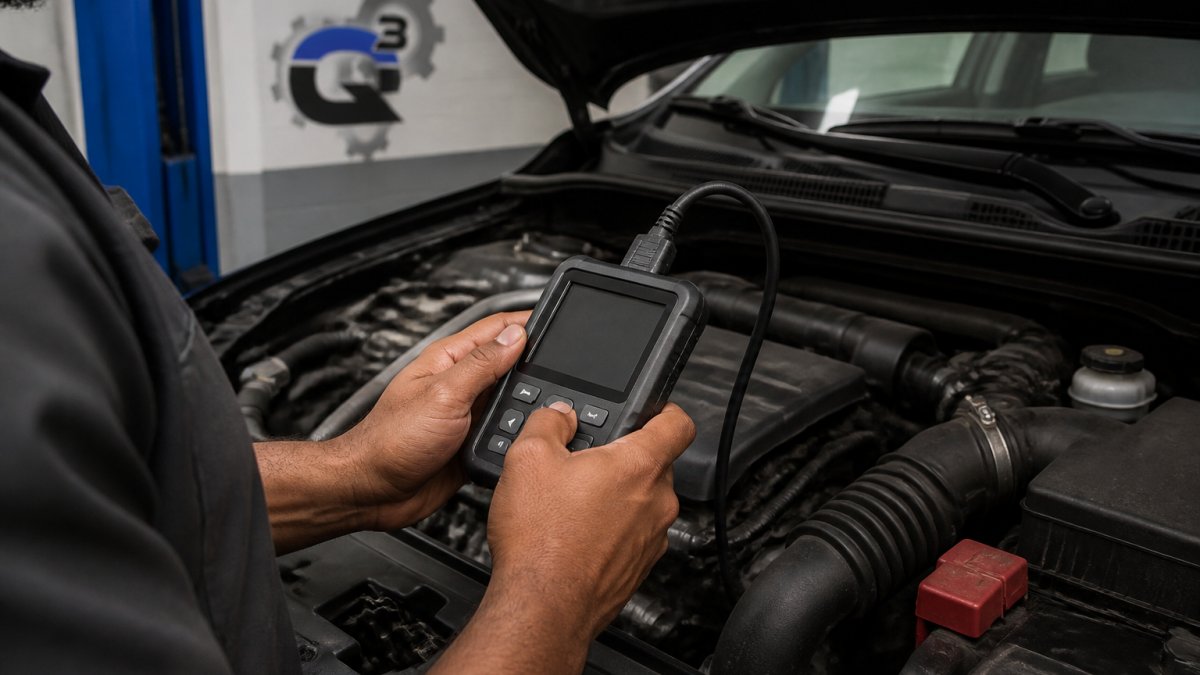
A vacuum leak is mechanical, a hose, gasket, or seal. A MAF problem is electronic or contamination. Replacing a MAF sensor won't fix a cracked intake boot, and sealing a vacuum leak won't fix a sensor reading wrong. Scan tool data tells you which one you're dealing with before you buy parts.
Is It Safe to Drive With Check Engine Light On
Whether it's safe depends on what triggered the light. A steady check engine light usually means you can drive to a repair shop.
Steady check engine light: You can typically drive safely.
Flashing check engine light: This means your engine is misfiring. Stop driving as soon as safely possible. Continued driving can damage your catalytic converter and engine.
Before driving anywhere, consider:
- How far do you need to drive?
- What type of problem triggered the light?
- Is the vehicle running rough or normally?
- Are you hearing unusual noises?
If your vehicle runs smoothly and the light is steady, you can drive to a repair shop.
If you're unsure whether it's safe, get a professional diagnosis. At Q3 Car & Truck Repair, we read your diagnostic codes and tell you exactly what's happening.
Check Engine Light Flashing vs. Steady
The difference between a steady and flashing check engine light is critical.
A steady light indicates a problem that needs attention but isn't causing immediate engine damage, a loose gas cap, failing oxygen sensor, or dirty MAF sensor.
A flashing light means your engine is misfiring right now.
When your check engine light flashes, pull over safely and stop driving.
A flashing light usually indicates:
- Engine misfire (one or more cylinders not firing properly)
- Severe knock or detonation
- Critical emissions system failure
Never ignore a flashing light, repairing a damaged catalytic converter far exceeds the cost of addressing the underlying problem immediately.
| Light Type | Severity | Safe to Drive | Action |
|---|---|---|---|
| Steady | Minor to moderate | Yes, to repair shop | Schedule appointment soon |
| Flashing | Severe | No | Stop and get towed |
When your check engine light comes on, the first step is an accurate diagnosis.
Frequently Asked Questions
What are the most common reasons a check engine light comes on?
The most frequent causes are a loose or faulty gas cap, oxygen sensor failure, catalytic converter problems, spark plug issues, vacuum leaks, and mass airflow sensor faults. A loose gas cap alone triggers roughly 30% of check engine lights and is the easiest fix. Other causes range from minor emissions system faults to engine performance problems that need prompt attention. An OBD-II scanner can pinpoint the exact diagnostic trouble code causing the light.
Is it safe to drive with the check engine light on?
A steady check engine light typically means the vehicle is safe to drive, but you should schedule a diagnostic soon. A flashing check engine light indicates a serious engine misfire or emissions problem and you should stop driving immediately to avoid engine damage. The difference matters: steady means caution, flashing means urgent. Get a diagnostic scan to identify the issue before continuing to drive.
What does a flashing check engine light mean?
A flashing check engine light signals an active engine misfire, severe fuel system problem, or critical emissions system failure. This is different from a steady light and requires immediate attention. Continuing to drive can cause catalyst damage or engine damage. Pull over safely, turn off the engine, and contact a repair shop or tow the vehicle. Do not ignore a flashing light or assume it will resolve on its own.
How much does it cost to diagnose a check engine light?
Diagnostic costs vary based on the repair shop and complexity of the issue. A basic OBD-II scan to read the trouble code is often inexpensive or free at many shops, but a full diagnostic, which includes testing components and confirming the root cause, typically costs more. Q3 Car & Truck Repair provides straightforward estimates so you know exactly what to expect before any work begins. Contact us for a quote tailored to your vehicle's specific situation.