 how-to
Impact of Driving With Low Tire Pressure
Table of Contents
- How Low Tire Pressure Affects Vehicle Safety
- Effects of Underinflated Tires on Handling and Steering
- Braking Distance and Stopping Performance With Low Pressure
- Tire Wear, Blowout Risk, and Internal Damage
- How Long Can You Drive With Low Tire Pressure
- How to Check Tire Pressure and What to Do When the Light Comes On
- Fuel Economy and Rolling Resistance
- Frequently Asked Questions
Last Updated: October 13, 2026
How Low Tire Pressure Affects Vehicle Safety
Driving with low tire pressure creates real dangers. Tires without enough air flex more than they should, generating heat that breaks down the rubber and can lead to sudden failure.
At Q3 Car & Truck Repair, we see the consequences of underinflated tires regularly. Your tire pressure warning light exists for a reason: it tells you when your tires have dropped below the manufacturer's recommended level.
Effects of Underinflated Tires on Handling and Steering
Underinflated tires change how your vehicle responds to steering. Softer sidewalls flex more, so the tire takes longer to respond when you turn the wheel. On a straight road you might not notice this delay, but in an emergency or on a curve the difference becomes critical: your vehicle won't turn as sharply as you intend, and the front end may push wider through a turn than expected, understeer, caused by tires that can't grip the road properly.
Wet roads make this worse. In rain or snow your tires already have less grip; add low air pressure and your vehicle becomes difficult to control, making even gentle turns feel unstable.
Braking Distance and Stopping Performance With Low Pressure
When you press the brake pedal, your tires must grip the road to slow the vehicle. Low tire pressure weakens that grip, lengthening stopping distances.
Braking performance gets worse in wet conditions, where rain already reduces tire grip. Repeated hard braking compounds the problem: each hard stop heats the tires, and if you started with low pressure the tire is already stressed, that extra heat pushes it closer to failure.
Tire Wear, Blowout Risk, and Internal Damage
Low tire pressure causes uneven tire wear. The edges touch the road more than the center, so the shoulders wear faster than the middle, shortening your tire's lifespan.
More importantly, low pressure causes internal damage you can't see.
A blowout happens when that internal damage becomes severe enough and the tire fails suddenly.
The sidewall is especially vulnerable. It's thinner than the tread and carries most of the tire's structural load, so low pressure puts extra stress there, leading to rapid air loss or sudden failure.
How Long Can You Drive With Low Tire Pressure
There is no universally safe distance or speed for driving on an underinflated tire. Anyone who gives you a single number, "10 miles," "50 miles," "you're fine until the light goes off", is guessing. The answer depends on how much pressure is missing, how fast you drive, how hot it is, how heavily the vehicle is loaded, and whether the tire is losing air while you drive.
Why there is no fixed number
An underinflated tire fails through heat, not miles. Every rotation flexes the sidewall and tread, converting motion into heat inside the rubber.
Ambient temperature and load matter too: a tire reading 30 psi on a 100°F afternoon starts from a hotter baseline than one on a 40°F morning, and a fully loaded truck or a vehicle towing a trailer stresses an underinflated tire more than the same vehicle driven empty.
Severity tiers (use these as a rough guide, not a rule)
- Slightly low (a few psi below the placard, tire still holds air, no visible damage): You can typically drive a short distance at moderate speed to reach air, a few miles on surface streets to the nearest gas station or tire shop. Do not take the highway, do not delay, and re-check pressure before driving again.
- Moderately low (roughly 10 psi or more below the placard, or the tire looks visibly soft): Treat this as urgent. Drive only as far as you must to reach air or help, at low speed, on surface streets, every mile adds heat and internal damage. If you can safely add air where you are, do that first.
- Severely low or flat (tire is visibly squashed, sidewall is creased, you can hear air escaping, or the vehicle pulls hard to one side): Do not drive. A tire in this condition can come off the rim, overheat catastrophically, or shred. Call for roadside assistance or change to a spare if you can do it safely.
Conditions that shorten the safe window
- Highway speeds. Heat generation rises sharply with speed. If you must move a moderately low tire, stay off the interstate.
- Hot weather and hot pavement. Summer heat compounds the internal heat the tire already generates.
- Heavy loads or towing. Extra weight means extra sidewall flex.
The practical rule
If you are unsure, stop, check pressure with a gauge, and add air before continuing. If you cannot add air where you are, drive the shortest possible distance at the lowest reasonable speed to reach air or assistance, and if the tire is flat or visibly damaged, do not drive at all.
How to Check Tire Pressure and What to Do When the Light Comes On
Finding the right pressure target
The number you inflate to is not on the tire sidewall. That number is the tire's maximum cold inflation pressure, the most air it's designed to hold, not what your vehicle needs. The correct target is the vehicle manufacturer's recommended cold tire pressure, found in one of these places:
- The tire information placard on the driver's door jamb (most common).
- The owner's manual.
- Sometimes a sticker inside the fuel door or glovebox.
The placard lists pressure for front and rear tires, and may list a separate higher pressure for a fully loaded vehicle or towing, if two figures appear, the higher one is for a full load. "Cold" means the vehicle has been parked at least three hours, or driven less than a mile. Driving heats the tires and raises the reading, so always compare your gauge reading to the cold specification.
Checking pressure accurately
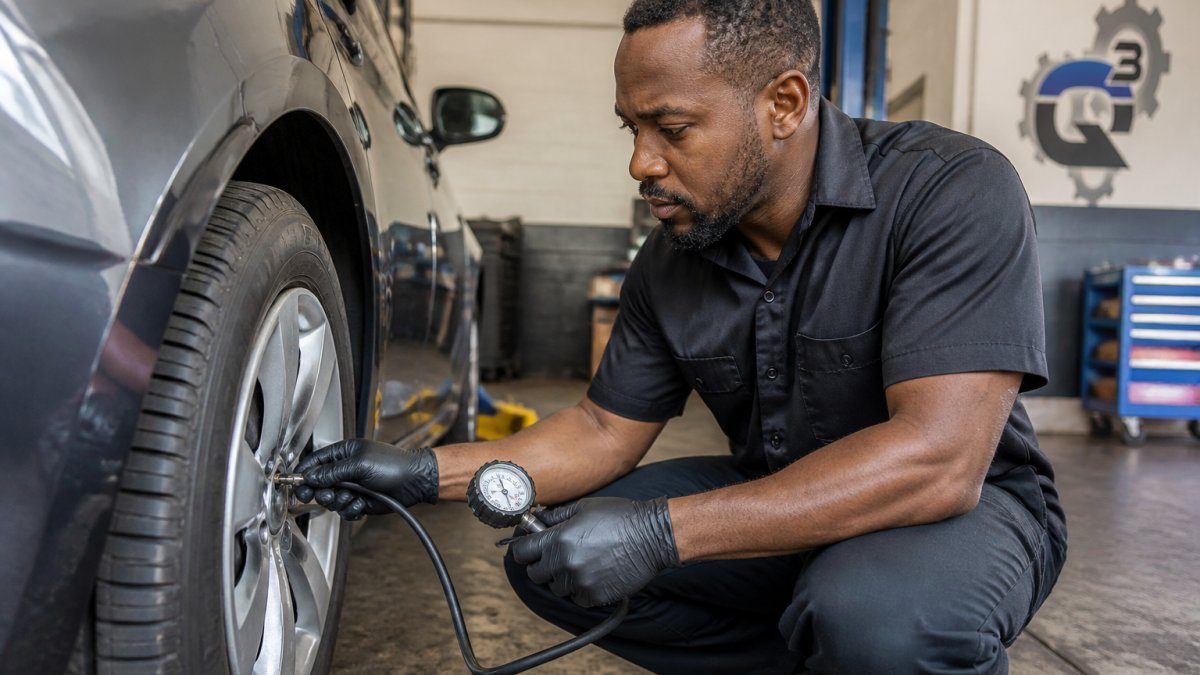
- Use a quality tire pressure gauge, a dial or digital gauge is more accurate and easier to read than a pencil-style gauge.
- Check when the tires are cold. If you must check warm, note the reading will be higher and adjust accordingly.
- Remove the valve stem cap and press the gauge firmly onto the valve stem. You should hear a brief hiss of escaping air.
- Read the pressure and write it down. Repeat for all four tires, and check the spare if you have one.
- Compare each reading to the placard specification and add air to any tire below the target, then re-check and reinstall the valve caps.
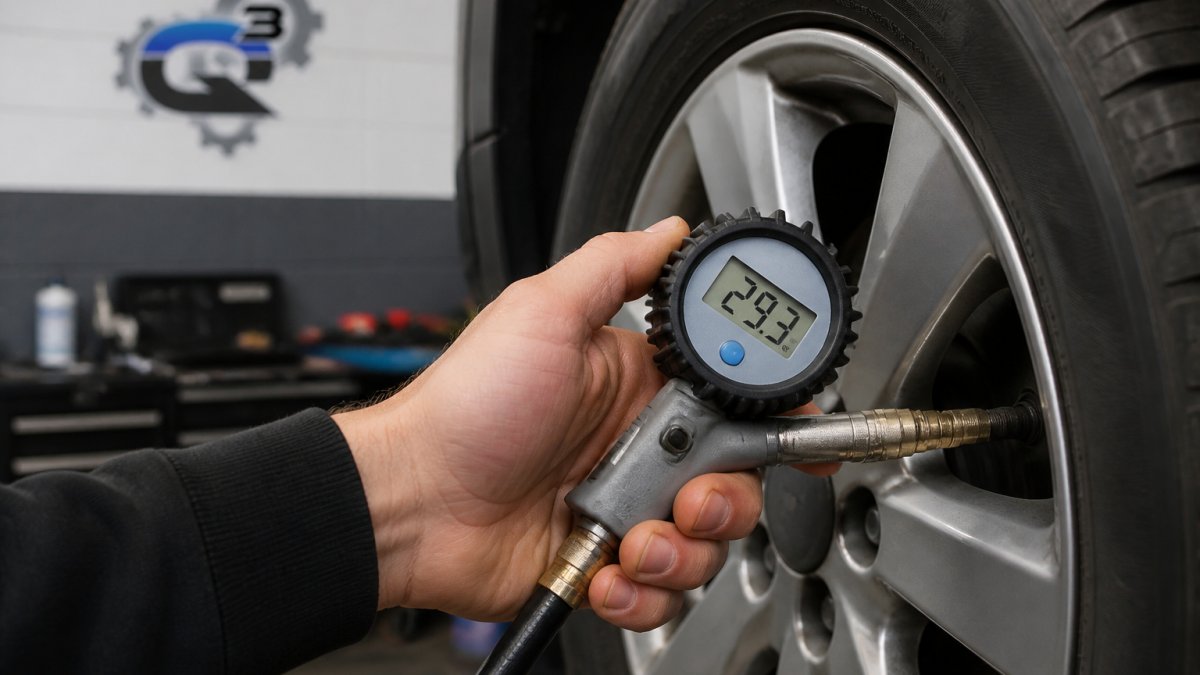
Most gas stations have air pumps; some are free, some charge a small fee.
Check your tire pressure at least once a month and before long trips. Pressure naturally drops over time and faster in cold weather, roughly 1 psi for every 10°F drop in ambient temperature.
When the TPMS light comes on
Your tire pressure monitoring system (TPMS) watches tire pressure and illuminates a dashboard light when one or more drops below a threshold. Some vehicles show which tire is low; others show only a general warning. Here is a step-by-step response:
- Stay calm and assess. A TPMS light usually means low pressure, not an instant flat. But if the vehicle is pulling, vibrating, or handling oddly, treat it as more serious.
- Slow down and find a safe place to stop. Avoid hard braking and sharp steering, and get off the highway if you can do so safely.
- Inspect all four tires visually. Look for a visibly flat tire, a sidewall bulge or bubble, a puncture, a nail or screw, or cords showing through the tread. Check the valve stems for cracks or damage.
- Check pressure with a gauge on all four tires. Write down each reading.
- Add air to the low tire(s) to the placard specification. If you cannot add air where you are, drive slowly and briefly to the nearest air source, but only if the tire is not flat and shows no damage.
- If a tire is flat or damaged, do not drive on it. Call for roadside assistance, or change to a spare if you can do it safely.
- After inflating, drive a short distance. Many TPMS lights reset automatically once pressure is correct; some vehicles require a manual reset described in the owner's manual.
Distinguishing a slow leak from a sensor issue
If the light returns soon after you add air, you likely have a leak rather than a sensor problem. Use this checklist:
- Pressure drops again within hours or days: slow leak, a puncture, damaged valve stem, leaking valve core, or cracked wheel. Have it inspected and repaired.
- Pressure drops rapidly (you can hear or feel air escaping): active leak or puncture, do not drive; get help.
- One tire consistently reads low while the others hold steady: localized leak or damage on that tire.
If the light comes back on after you've inflated to the correct pressure and driven a short distance, or if you find a puncture or sidewall damage, have the tire inspected by a professional. A tire can hold air and still have internal damage only a hands-on inspection will reveal.
Fuel Economy and Rolling Resistance
Low tire pressure increases rolling resistance, the force opposing the tire's motion as it rolls. Higher rolling resistance means your engine has to work harder to move the vehicle, so it burns more fuel and your fuel economy drops noticeably.
Over time this adds up. If you drive 12,000 miles a year with low tire pressure, you'll burn extra fuel that costs real money.
Driving with low tire pressure puts you at risk. Your vehicle doesn't handle the way it should. Stopping takes longer.
The solution is straightforward: check your tire pressure monthly and whenever your warning light comes on.
Frequently Asked Questions
What happens if you keep driving with low tire pressure?
Continued driving on underinflated tires causes accelerated wear on the tire shoulders and sidewalls, increases the risk of a blowout, reduces your vehicle's handling and braking ability, and forces your engine to work harder, wasting fuel. The longer you drive, the greater the risk of internal tire damage that may make the tire unrepairable. Even a short distance on severely underinflated tires can cause permanent structural damage.
How long can you drive with the tire pressure warning light on?
There is no safe distance. A tire pressure warning light indicates your tires are underinflated, which immediately affects handling, braking, and stability. You should check your tire pressure and inflate as soon as possible, ideally before driving further. If you must drive to reach a service station or safe location, do so slowly and carefully, avoiding sudden maneuvers or hard braking.
Does weather affect tire pressure?
Yes. Tire pressure drops in cold weather and rises in hot weather. For every 10-degree Fahrenheit drop in temperature, tire pressure can fall by 1 psi. This is why your warning light may come on during winter months even if your tires were properly inflated in warmer weather. Check your tire pressure regularly, especially when seasons change, and inflate to the pressure listed on your vehicle's door jamb or owner's manual, not the sidewall of the tire.
Can driving on underinflated tires cause permanent damage?
Yes. Underinflated tires flex excessively, generating heat and breaking down the internal structure of the tire. This damage is often invisible from the outside but can make the tire unrepairable and unsafe to use. Even one instance of driving a long distance on very low pressure can cause permanent internal damage. Once damaged, the tire must be replaced, which is why addressing low pressure quickly is important.