 ultimate-guide
How Vehicle Technology Affects Long-Term Ownership Costs
Table of Contents
- The Rising Complexity of Modern Vehicle Repair and Diagnostics
- Modern Vehicle Maintenance Costs and Software-Defined Systems
- Cost of Repairing ADAS Sensors and Advanced Driver-Assistance Systems
- Electric Vehicle Long-Term Ownership Expenses and Battery Degradation
- Insurance Premiums and Technology-Heavy Vehicle Ownership
- Total Cost of Ownership: What Matters Most
- Conclusion
- Frequently Asked Questions
Last Updated: September 28, 2026
How vehicle technology affects long-term ownership costs is now critical for buyers. Modern cars are computers packed with sensors and software that dramatically reshape lifetime ownership expenses. At Q3 Car & Truck Repair, we've watched this transformation reshape what owners actually pay.
Most buyers don't understand how vehicle technology affects long term ownership costs as it compounds year after year. A sensor failure that cost $50 on older vehicles now costs $800. Software updates carry subscription fees. Battery degradation follows unpredictable paths. These are structural shifts in vehicle operation and maintenance costs.
The Rising Complexity of Modern Vehicle Repair and Diagnostics
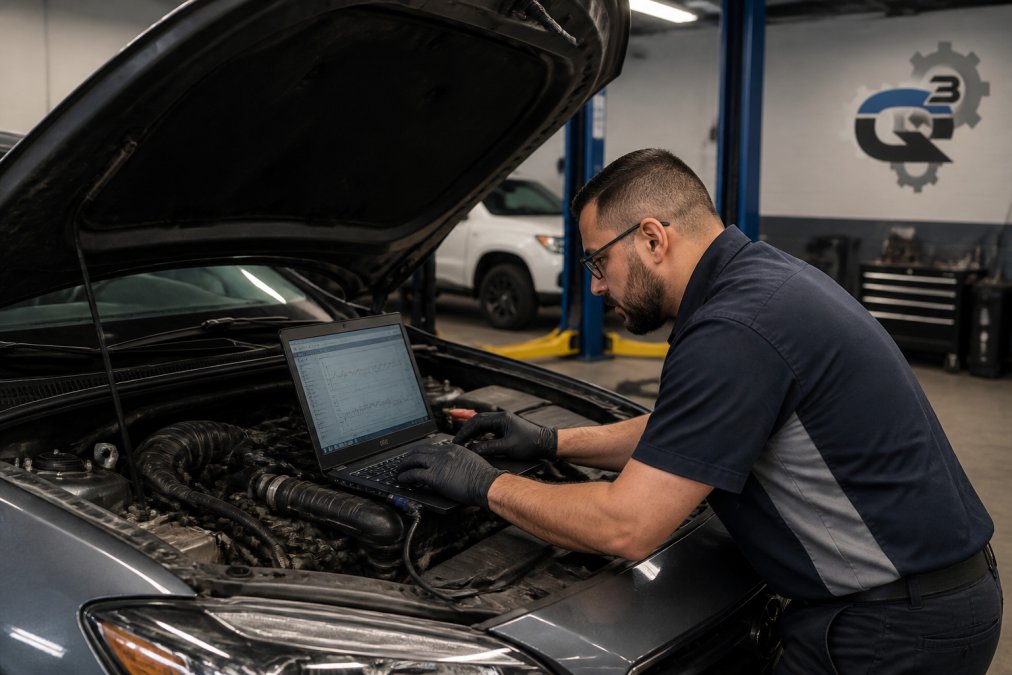
Modern vehicles require specialized diagnostic equipment. A single fault code now requires connecting to multiple electronic control units (ECUs) to trace the source, translating directly to higher labor costs.
Diagnosing a check engine light on a 2010 vehicle takes 30 minutes; on a 2026 vehicle with connectivity systems and sensor fusion networks, it takes 2-3 hours. The systems are fundamentally more complex.
Proprietary repair procedures lock shops into manufacturer-specific protocols. Sensor replacement requires reprogramming, calibration, and verification through manufacturer software. Independent shops face higher diagnostic tool costs, passed to you.
Modern Vehicle Maintenance Costs and Software-Defined Systems
Software-defined systems have changed maintenance fundamentally. You're maintaining code and firmware, not just mechanical components. Over-the-air updates now carry hidden costs beyond traditional service intervals.
Software-as-a-Service features now require subscriptions: BMW charges $18/month for heated seats, GM's OnStar runs $14.99-$34.99 monthly, and Tesla charges $9.99/month for premium connectivity or $199 annually for full self-driving access.
A $15 monthly subscription adds $180 annually or $1,440 over eight years. Multiple subscriptions easily total $3,000-$5,000 over vehicle life, real money most ownership calculators ignore.
Manufacturers now seal transmission fluid, coolant, and brake fluid "for life," eliminating service intervals. When transmission fluid degrades without replacement access, failure at 80,000 miles costs $3,500-$8,000 instead of $150 for routine service.
Manufacturers push updates that change fuel economy, transmission behavior, or suspension tuning without owner choice. If an update causes problems, dealers charge $150-$300 to diagnose software-related issues, even when the manufacturer caused the problem.
Mandatory safety and emissions updates are free, but dealerships charge $75-$150 in labor to facilitate installation if home Wi-Fi is insufficient or calibration is required afterward.
Independent shops pay licensing fees for proprietary diagnostic software or lose service capability, passing costs to you or forcing dealership visits where labor rates run 30-50% higher.
Cost of Repairing ADAS Sensors and Advanced Driver-Assistance Systems
The cost of repairing ADAS sensors represents one of the most significant hidden expenses in modern vehicle ownership. A single ADAS sensor, whether it's a camera, radar, or lidar unit, can cost between $500 and $2,000 depending on the system. But the sensor itself is often the cheapest part of the repair.
After collision, ADAS sensors require recalibration using specialized equipment and manufacturer software, costing $300-$800 before sensor replacement.
A 2026 vehicle carries 6-12 ADAS sensors. One failure can degrade the entire system, requiring system-wide diagnostics to identify the actual failed component.
ADAS sensor failures cascade: a faulty camera can reduce radar capacity and trigger warnings across systems. Repair estimates for one sensor often involve replacing or recalibrating three systems.
Electric Vehicle Long-Term Ownership Expenses and Battery Degradation
EV long-term ownership costs differ from traditional vehicles; battery degradation is the primary driver. Manufacturers warrant 70-80% capacity retention over 8-10 years, but real-world degradation varies by climate and charging habits.
Battery degradation appears gradually: 5-10% range loss by year five, 15-20% by year eight. A 300-mile vehicle delivers 240-255 miles per charge, manageable for commuters but problematic for long-distance driving.
Battery replacement costs $8,000-$15,000. Even with 8-10 year warranties, failure at year nine means out-of-pocket five-figure expenses.
Home charging installation costs $500-$2,500, with panel upgrades adding more. These upfront expenses don't appear in traditional ownership calculations but affect real costs.
Insurance Premiums and Technology-Heavy Vehicle Ownership
Insurance premiums for technology-heavy vehicles run 10-25% higher. Insurers price based on actual diagnostic and repair costs for specific sensor arrays and control modules.
A minor fender bender on a vehicle with ADAS sensors triggers a complete system diagnostic before repair estimates can even be calculated. The insurer knows this will add $500-$1,200 to the repair bill just for diagnostics and recalibration. When you multiply that across thousands of claims annually, insurers build those costs directly into your premium from day one. A vehicle with a basic ADAS package (forward-collision warning, lane-departure warning) costs less to insure than one with a comprehensive suite (adaptive cruise control, automatic parking, 360-degree camera system, blind-spot monitoring).
The specific technologies that drive the highest insurance premiums include:
Adaptive Cruise Control and Radar Systems: Radar sensors mounted in the front bumper cost $800-$1,500 to replace. Recalibration requires specialized equipment and a test drive, adding $400-$800 in labor. A single rear-end collision that damages the radar sensor can trigger a $1,500-$2,500 repair bill. Insurers price this risk into your premium.
Multi-Camera Systems: Vehicles with front, rear, and side-view cameras for parking assistance and 360-degree monitoring have 4-6 camera modules. A single camera costs $300-$600, but damage to one camera often requires recalibration of the entire system. Replacing all cameras in a comprehensive system can exceed $3,000. Insurers charge 15-20% higher premiums for vehicles with these systems.
LiDAR and Advanced Sensor Fusion: High-end ADAS systems using LiDAR (light detection and ranging) or sensor fusion networks that combine camera, radar, and ultrasonic data cost significantly more to repair. A single LiDAR unit can cost $1,500-$3,000. Recalibration of a sensor fusion system requires manufacturer-specific software and can take 4-8 hours of labor. Insurers recognize these vehicles as high-cost claims and price accordingly.
Infotainment and Connectivity Modules: Vehicles with integrated navigation, smartphone integration, and over-the-air update capability have complex control modules that cost $1,200-$2,500 to replace.
Total Cost of Ownership: What Matters Most
Understanding how vehicle technology affects long term ownership costs has made total cost of ownership (TCO) calculations both more important and more complicated simultaneously. Traditional TCO models account for depreciation, fuel costs, maintenance, and insurance. Modern vehicles require adding software subscription costs, diagnostic complexity premiums, and technology-specific maintenance to get an accurate picture.
| TCO Component | Traditional Vehicle | Technology-Heavy Vehicle | Impact |
|---|---|---|---|
| Depreciation (5 years) | 50-55% | 55-65% | Tech obsolescence accelerates loss |
| Maintenance (5 years) | $4,000-6,000 | $6,500-10,000 | Diagnostic and sensor costs higher |
| Insurance (annual) | $1,200-1,500 | $1,400-1,900 | Repair complexity premium |
| Repairs (unexpected) | $1,500-2,500 | $3,000-5,000 | Sensor and software costs |
| Software/Subscriptions | $0 | $300-800/year | Connected vehicle features |
| Fuel/Energy | $8,000-12,000 | $6,000-10,000 | Offset by efficiency gains |
Conclusion
How vehicle technology affects long-term ownership costs ultimately comes down to understanding that modern vehicles are computers first and mechanical systems second. The repair complexity, sensor dependencies, software updates, and battery management systems that make vehicles safer and more efficient also make them more expensive to maintain and repair.
Frequently Asked Questions
How does vehicle technology affect long-term ownership costs?
Modern vehicle technology increases ownership costs through higher diagnostic fees, proprietary repair requirements, and complex sensor replacements. Software-defined systems require specialized equipment and training, raising labor rates. Battery degradation in electric vehicles, ADAS sensor calibration, and over-the-air update subscriptions all add to total cost of ownership. However, preventative maintenance intervals may be longer in some cases, offsetting some expenses.
Are modern vehicles becoming more expensive to repair due to complex electronics?
Yes. Electronic control units, integrated sensors, and proprietary software mean repairs now require specialized diagnostic tools and certified technicians. A single ADAS sensor calibration can cost hundreds of dollars, and component integration means one failure often requires replacing entire systems rather than individual parts. This complexity drives repair labor rates higher and extends diagnostic time compared to older vehicles with simpler mechanical systems.
What is the cost of repairing ADAS sensors and how does it impact ownership?
ADAS sensor repair and calibration costs vary widely depending on the sensor type and vehicle, but can range from several hundred to over a thousand dollars per sensor. Since modern vehicles often have multiple sensors (camera, radar, lidar), a single accident or malfunction can trigger substantial repair bills. These systems require specialized equipment and training, limiting where repairs can be performed and increasing your dependence on dealerships or certified shops.
Do electric vehicles have lower long-term ownership expenses than gas vehicles?
Electric vehicles typically have lower fuel and routine maintenance costs, but battery degradation, replacement, and specialized repair expertise add significant long-term expenses. Battery replacement can cost $5,000 to $15,000 depending on the vehicle and warranty coverage. While preventative maintenance is reduced, the total cost of ownership depends heavily on electricity rates, warranty terms, battery longevity, and whether you keep the vehicle long enough to recoup the higher upfront purchase price.