 Ultimate guide
7 Routine Vehicle Maintenance Costs You Should Budget For
Last Updated: October 24, 2026
Quick Summary
Routine vehicle maintenance costs are predictable expenses for scheduled services like oil changes, tire rotations, inspections, and fluid checks specified in your owner's manual. Most owners can budget by calculating their local service prices against manufacturer intervals, then adding separate reserves for wear items like tires and brakes, and unexpected repairs.
- Oil and filter changes are needed every 5,000 to 10,000 miles depending on oil type and manufacturer recommendation.
- Tire rotations, air filter replacements, and brake inspections typically occur every 5,000 to 30,000 miles.
- Separate routine maintenance costs from wear items like tires and batteries, which are replaced on condition rather than schedule.
- Severe driving conditions such as towing, dusty environments, or mountainous terrain shorten service intervals.
- Keep maintenance records to support warranty claims if a covered component fails.
Table of Contents
- What Counts as Routine Vehicle Maintenance
- Car Maintenance Cost by Service: Breakdown of Common Work
- Annual and Monthly Car Maintenance Budget Estimates
- Oil Change Cost and Frequency by Vehicle Type
- Vehicle Maintenance Schedule: When Each Service is Due
- Factors That Affect Your Routine Vehicle Maintenance Costs
- Schedule Your Maintenance With Q3 Car & Truck Repair
- Frequently Asked Questions
What Counts as Routine Vehicle Maintenance
Routine vehicle maintenance is the set of preventive services you perform on a regular schedule to keep your car or truck running safely and reliably.
The distinction shapes your budget.
Staying on top of routine maintenance can help owners spend far less over the life of their vehicle than those who skip it.
The manufacturer's maintenance schedule and industry guidance on preventive care both emphasize that routine maintenance is the most cost-effective way to extend vehicle life and avoid breakdowns.
Car Maintenance Cost by Service: Breakdown of Common Work
Most routine maintenance falls into a handful of categories, each with its own frequency and cost profile.
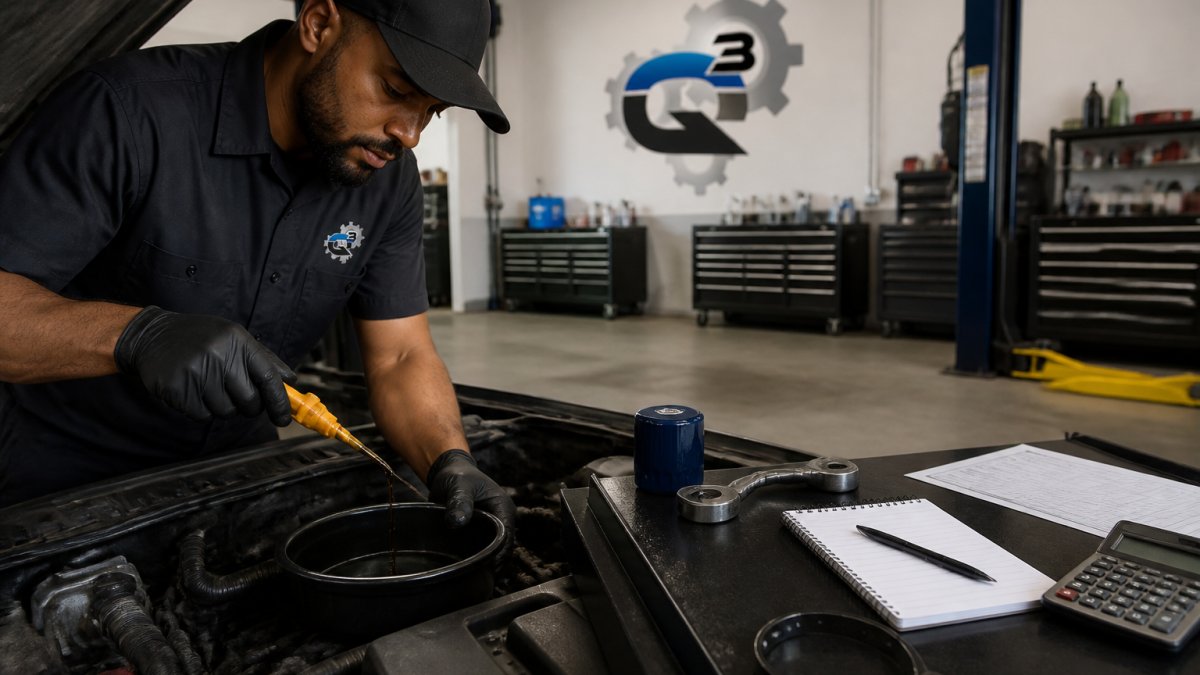
Oil and filter changes are the most frequent maintenance task, needed every 3,000 to 10,000 miles depending on oil type and your manufacturer's recommendation.
Tire rotation keeps wear even across all four tires, extending their life. Most manufacturers recommend it every 5,000 to 8,000 miles or twice yearly, quick and affordable, though tire replacement when tread wears down is a separate, larger expense.
Brake inspections examine pad thickness, rotor condition, and fluid quality.
Fluid checks and top-ups cover engine coolant, transmission fluid, power steering fluid, and windshield washer fluid, quick checks during routine visits.
Battery testing ensures sufficient charge and reliable starting. Most batteries last 3 to 5 years; testing is often free, and replacement is a separate cost when needed.
Annual and Monthly Car Maintenance Budget Estimates
Most published "average cost of routine vehicle maintenance" figures blend three different spending categories. Before you set a monthly number, separate them:
- Routine maintenance, scheduled services your owner's manual specifies: oil and filter changes, tire rotations, inspections, fluid checks, and filter replacements. These are predictable and interval-driven.
- Wear items, tires, brake pads and rotors, wiper blades, and batteries. These are consumed by normal use and replaced on condition rather than on a fixed schedule, so their cost lands in lumps rather than evenly.
- Unexpected repairs, a failed water pump, alternator, or transmission component. These are not maintenance, and folding them into a "maintenance average" overstates what a disciplined owner actually spends on prevention.
How to read any published average
When you see an annual maintenance figure, check four things: the source and publication date, the vehicle sample (makes, model years, whether trucks and luxury vehicles are included), the assumed annual mileage, and which services are counted. An estimate including tires and brakes runs far higher than one limited to fluids, filters, and inspections, and one built on 15,000 miles per year does not transfer to a driver logging 25,000. Treat any headline number as a range midpoint, not a quote for your vehicle.
A transparent worksheet you can fill in
The table below converts the service intervals from the previous section into an annual frequency at a common 12,000-15,000 miles per year, then leaves a column for your own local price. Fill in quotes from your shop or your own receipts, do not rely on a national average for the dollar column.
| Service | Typical interval | Times per year (12k-15k mi) | Your local price | Annual cost |
|---|---|---|---|---|
| Oil and filter change | 5,000-10,000 mi | 1-3 | $ | $ |
| Tire rotation | 5,000-8,000 mi | 2-3 | $ | $ |
| Engine air filter | 15,000-30,000 mi | 0.5-1 | $ | $ |
| Cabin air filter | 15,000-30,000 mi | 0.5-1 | $ | $ |
| Brake inspection | 12 mo / 15,000 mi | 1 | $ | $ |
| Fluid check and top-up | 12 mo | 1-2 | $ | $ |
| Battery test | 12 mo | 1 | $ | $ |
| Routine subtotal | $ |
Then budget separately for the two categories the table excludes:
- Wear-item reserve. Set aside a monthly amount for tires, brakes, and a battery. A common pattern is to divide the expected replacement cost by the number of months you expect the item to last. If a set of tires costs $800 and lasts four years, that is roughly $17 per month, a figure you can plan for instead of absorbing as a surprise.
- Repair reserve. Keep a separate cushion for unexpected failures. A widely used rule of thumb among owners and advisors is to set aside a few hundred dollars a year for an older, higher-mileage vehicle and less for a newer one under warranty.
Why monthly beats annual for planning
Annual totals hide timing. Oil changes, rotations, and inspections cluster around the same visits, so a month with a scheduled service can cost several times a quiet month. Spreading the annual subtotal across twelve months, plus the wear-item reserve, smooths those spikes. Review the worksheet yearly and after any change in mileage, vehicle, or driving conditions.
For how to size the repair reserve alongside routine costs, see our guide to budgeting for unexpected repairs.
Oil Change Cost and Frequency by Vehicle Type
Oil change frequency and cost vary by vehicle type, engine size, and oil grade.
Conventional oil typically requires changes every 3,000 to 5,000 miles; synthetic extends intervals to 7,500 to 10,000 miles or longer. Synthetic costs more per change, but fewer changes per year can offset that.
Small sedans and compact cars have smaller oil capacities and lower labor costs, making oil changes relatively affordable. Midsize SUVs and trucks hold more oil and take longer to service.
The choice isn't just about cost, it affects how often you need service.
Manufacturer guidance on oil specifications varies by engine type and model year, so always check your owner's manual rather than assuming a standard interval applies to your vehicle. Learn more about oil types and their impact on maintenance costs in our detailed comparison.
Vehicle Maintenance Schedule: When Each Service is Due
A maintenance schedule is only useful if it tells you what to do at a specific mileage or date. The intervals below reflect common manufacturer guidance; your owner's manual is the authoritative source for your exact model and model year, and it overrides any general table.
Baseline schedule (normal driving)
| Mileage / time | Services typically due |
|---|---|
| Every 5,000-10,000 mi or 6-12 months | Oil and filter change; tire rotation; multi-point inspection; fluid check and top-up |
| Every 15,000-30,000 mi | Engine air filter; cabin air filter; brake inspection |
| Every 30,000 mi | Transmission fluid service (per manufacturer); coolant inspection; battery test |
| Every 60,000 mi | Spark plugs (many engines); transmission fluid service; brake fluid service |
| Every 90,000-100,000 mi | Timing belt (if equipped and specified); coolant flush; detailed suspension and steering inspection |
Treat the mileage and time columns as "whichever comes first." A low-mileage vehicle still ages: fluids degrade, belts crack, and batteries weaken with time even when the odometer barely moves.
When to shorten the intervals (severe-use conditions)
Most owner's manuals include a separate severe-service schedule. Shorten intervals toward the lower end of each range if your driving regularly includes:
- Mostly short trips under about five miles, especially in cold weather, where the engine and exhaust never fully warm up
- Frequent towing or hauling, or heavy payloads
- Stop-and-go traffic in hot climates
- Dusty, gravel, or construction-site environments
- Mountainous terrain with sustained climbing and braking
Under those conditions, oil changes may move toward the 5,000-mile end, air filters may need annual replacement, and brake and fluid inspections become more frequent. A truck used for construction work is a textbook severe-use vehicle; a commuter on open highways at moderate temperatures is closer to normal.
How to build your own schedule
- Open your owner's manual to the maintenance schedule section and note both the normal and severe-service intervals.
- Pick the schedule that matches your driving, using the conditions above.
- Convert each interval to a date by dividing your annual mileage by the mileage interval, for example, 15,000 miles per year against a 7,500-mile oil interval means two changes a year.
- Put those dates on a calendar or in your phone so the service happens on time rather than when a warning light appears.
- Keep receipts and records; documented service supports warranty claims if a covered component fails.
Driving conditions and vehicle history change the picture, so a personalized review is worth the time. Schedule your maintenance with Q3 Car & Truck Repair and we will map the manufacturer's schedule to how you actually drive.
Factors That Affect Your Routine Vehicle Maintenance Costs
Several factors push maintenance costs up or down.
Vehicle age matters. Newer vehicles under warranty often have lower maintenance costs because many services are covered or deferred.
Mileage drives frequency: a vehicle driven 20,000 miles per year needs service twice as often as one driven 10,000.
Vehicle type and size affect labor and parts.
Driving conditions influence needs.
Regional labor rates vary significantly. Shops in urban areas typically charge more per hour than rural shops. How to budget for unexpected car repairs discusses regional cost variation in more detail.
Parts availability and quality matter.
At Q3 Car & Truck Repair, we help you understand these factors and prioritize which services matter most for your vehicle.
Schedule Your Maintenance With Q3 Car & Truck Repair
Routine vehicle maintenance costs are predictable when you stay on schedule. The real expense comes from skipping maintenance and facing major repairs later.
Managing vehicle maintenance can feel overwhelming, especially if you're unsure whether a recommended service is necessary or a quote is fair.
Our team of highly skilled technicians is dedicated to delivering expert workmanship for cars and trucks. Whether you're managing a single vehicle or a small fleet, we're here to keep your vehicles running reliably and help you avoid the surprise of unexpected breakdowns.
Frequently Asked Questions
What is the average annual cost of routine vehicle maintenance?
Annual routine vehicle maintenance costs depend on your vehicle's age, mileage, and type. Newer vehicles typically cost less than older ones, while larger trucks generally require more investment than compact cars. Budget planning should account for oil changes, filter replacements, tire rotation, and fluid top-ups. Contact Q3 Car & Truck Repair for a personalized estimate based on your specific vehicle and driving habits.
How often should I get an oil change, and what does it cost?
Oil change frequency varies by vehicle and oil type. Most modern vehicles need an oil change every 5,000 to 7,500 miles with conventional oil, or every 7,500 to 10,000 miles with synthetic oil. Your manufacturer's maintenance schedule provides the exact interval for your vehicle. Oil change costs depend on oil type and vehicle size. Q3 Car & Truck Repair provides transparent pricing and can recommend the right service interval during your appointment.
What routine maintenance does a car need, and how often?
Routine maintenance includes oil changes, tire rotation, air filter replacement, cabin air filter changes, fluid checks and top-ups, battery inspection, and brake pad wear assessment. Oil changes occur every 5,000-10,000 miles, tire rotation every 5,000-7,500 miles, air filters annually or per manufacturer guidance, and other services at intervals specified in your owner's manual. Following your vehicle's maintenance schedule prevents costly repairs and keeps your car running reliably.
Is routine maintenance cheaper than waiting for a repair?
Yes. Preventive maintenance catches small issues before they become expensive failures. Neglected routine service leads to worn components, engine damage, and breakdowns that cost significantly more. For example, skipping oil changes can damage your engine; ignoring tire rotation accelerates wear and affects handling. Staying on schedule with Q3 Car & Truck Repair protects your investment and keeps repair bills predictable and lower over your vehicle's lifetime.
Managing routine vehicle maintenance doesn't have to feel like a guessing game. When you understand what services your vehicle needs and why, you can budget confidently and make informed decisions about your care. Q3 Car & Truck Repair is here to guide you through every step, from routine oil changes to complex system inspections, with transparent communication and expert care that you can trust.