 Listicle
7 Warning Signs Your Semi Truck Needs Professional Repair
Last Updated: October 30, 2026
Quick Summary
The main signs your semi truck needs professional repair are unusual engine noises, warning lights, fading brake power, hard or slipping transmission shifts, fluid leaks, exhaust smoke with reduced power, and steering, suspension, or tire clues. Red lights, a spongy pedal, or grinding brakes mean stop driving now, while amber lights and new noises mean schedule service promptly.
- A red warning light means stop, and a flashing amber check-engine light is treated as a stop-driving condition.
- Grinding metal-on-metal when braking means friction material is gone, making it a stop-driving condition.
- A slipping clutch shows up as the engine revving while the truck does not accelerate in step.
- Blue exhaust smoke indicates burning oil and internal engine wear, while black smoke points to too much fuel.
- Do not cover, tape over, or pull the bulb on a warning light, since that can void warranty coverage.
Table of Contents
- Why Ignoring Semi Truck Repair Signs Costs More Than a Shop Visit
- 1. Unusual Engine Noises and Rough Operation
- 2. Semi Truck Warning Lights That Demand Attention
- 3. Semi Truck Brake Problems: When Stopping Power Fades
- 4. Transmission Trouble: Hard Shifting, Grinding, and Slipping Gears
- 5. Semi Truck Fluid Leaks and Low Fluid Levels
- 6. Exhaust Smoke, Reduced Power, and Poor Fuel Economy
- 7. Heavy-Duty Truck Maintenance: Steering, Suspension, and Tire Clues
- What Happens During a Professional Inspection
- Frequently Asked Questions
Why Ignoring Semi Truck Repair Signs Costs More Than a Shop Visit
A semi truck rarely breaks down without warning. Long before a component fails on the highway, it sends signals: a new vibration, a warning light, a brake pedal that feels softer than it did last week, all signs your semi truck needs professional repair. Catching those signs your semi truck needs professional repair early is the difference between a scheduled shop visit and a roadside breakdown with a loaded trailer.
Drivers often wait until a small issue becomes a major one, then pay for towing, downtime, and a bigger repair bill. Below, we walk through the seven warning signs that matter most, which ones mean stop driving now, and what a professional inspection actually uncovers.
A warning sign is any change from your truck's normal behavior, in sound, feel, smell, or dashboard display, that persists beyond a single trip. Some signs demand an immediate stop. Others need prompt professional inspection before they worsen. Knowing the difference protects your equipment, your cargo, and everyone on the road.
1. Unusual Engine Noises and Rough Operation
Engine noise is the most common early indicator of component wear, and it is the one drivers most often dismiss. A healthy diesel engine has a steady, predictable rhythm. Any new knock, ticking, or rattle deserves attention.
Listen for these specific sounds:
- Deep knocking under load, often points to worn bearings or low oil pressure
- Ticking that speeds up with RPM, frequently a valve train or injector issue
- Hissing or whistling, a possible boost leak in the turbo system
- Rough idle or misfire, fuel delivery, injector, or compression problems
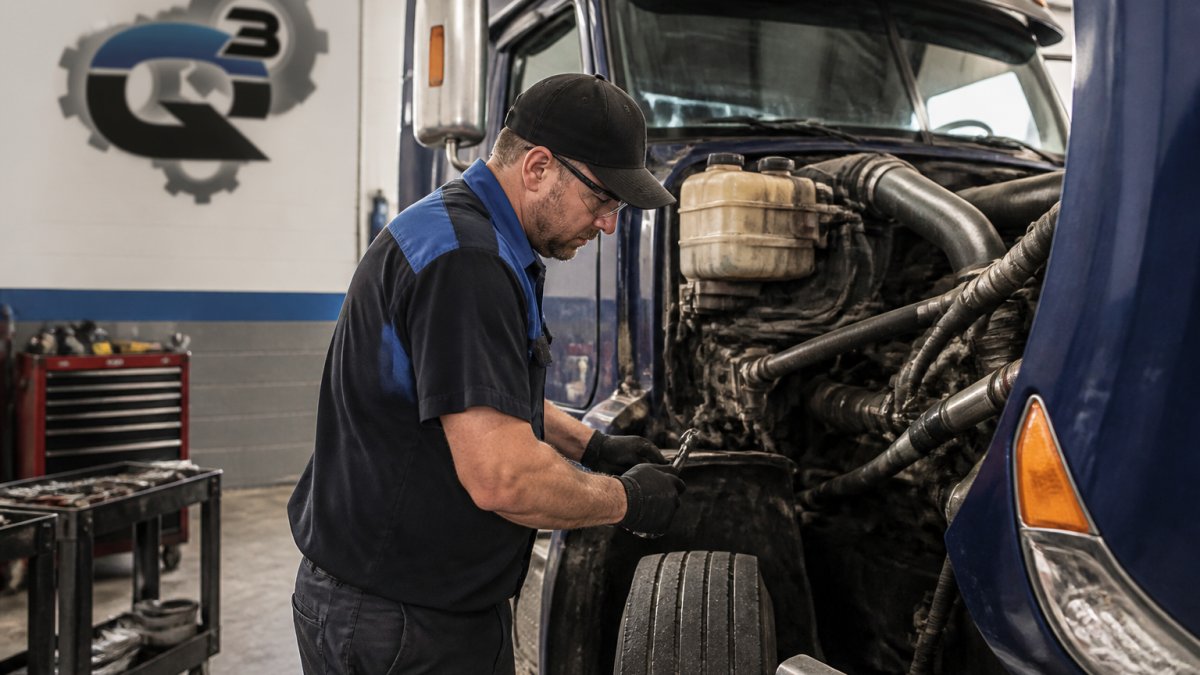
Rough operation often accompanies the noise. If the truck shakes at idle, hesitates under acceleration, or feels down on power, the engine is telling you something. A common mistake is treating a new noise as "just how old trucks sound." In practice, catching it early usually means a smaller repair. If your engine is not running like it used to, a proper diagnosis is the right place to start.
2. Semi Truck Warning Lights That Demand Attention
Dashboard warning lights exist for a reason, and semi truck warning lights deserve more respect than most drivers give them. The color tells you how urgently to act, but the specific symbol and whether the light is steady or flashing tells a technician which system to inspect first. Treat the light as a clue, not a diagnosis.
| Warning Light | Color | What It Typically Indicates | Driver Action |
|---|---|---|---|
| Check-engine light (steady) | Amber | Emissions or engine control fault stored in the ECM | Schedule diagnostic service soon; avoid heavy loads until inspected |
| Check-engine light (flashing) | Amber | Active misfire that can damage the catalytic converter or DPF | Reduce power and stop at the nearest safe location |
| Oil pressure light | Red | Low oil pressure or low oil level | Stop immediately and shut down the engine |
| Brake warning light | Red | Low air pressure or a brake system fault | Stop and inspect before moving |
| Coolant temperature | Red | Overheating | Pull over, shut down, and let the engine cool |
| ABS/traction light | Amber | Anti-lock brake or wheel-speed sensor fault | Schedule service; standard brakes still function but ABS is disabled |
| DPF/regen light | Amber | Exhaust aftertreatment needs attention | Follow the manufacturer's parked-regen procedure; schedule service if it persists |
| DEF low / poor quality | Amber | Diesel exhaust fluid level or quality issue | Refill with certified DEF; if the light stays on, inspect the SCR system |
A red light means stop. An amber light means schedule service before it becomes red. A flashing amber check-engine light is the exception that behaves like a red light: it signals an active misfire dumping unburned fuel into the exhaust, which can overheat and crack expensive aftertreatment components.
The check-engine light is the one drivers ignore most, yet it often flags a fault while it is still cheap to fix. The ECM stores a fault code the moment the light triggers, and that code narrows the diagnosis to a specific circuit or sensor. When your engine light is on, a professional can read the fault codes to narrow down the cause.
3. Semi Truck Brake Problems: When Stopping Power Fades
Semi truck brake problems are the most safety-critical issue on this list. A loaded tractor-trailer needs every bit of its stopping power, and brake faults escalate fast. The key distinction is between a brake fault that means stop driving now and one that means schedule service before the next loaded run.
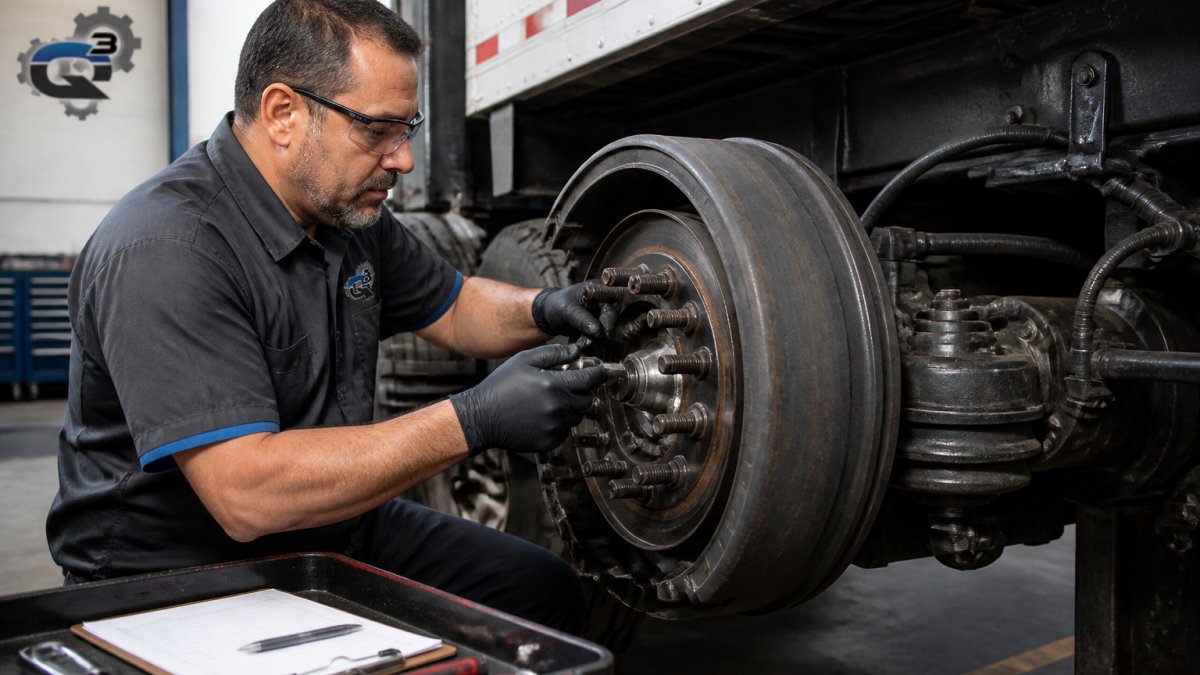
Stop driving and call for service immediately if you notice:
- A brake pedal that sinks to the floor or feels spongy
- Air pressure that will not build to the governor cut-out, or that drops faster than normal with the engine off
- A low-air-pressure buzzer or warning that stays on after the system should be charged
- A pull to one side under braking, or a wheel that locks or drags
- Grinding metal-on-metal noise when braking
- Visible air leaks at chambers, lines, or fittings, or a parking brake that will not hold
Schedule service promptly, before the next loaded run, if you notice:
- Longer stopping distances than the truck used to deliver
- Squealing or chirping from a wheel end
- A soft pedal that firms up after pumping
- Slack adjuster travel that looks longer than the other wheels
- An ABS light that stays on after the bulb check
A soft or spongy pedal on an air-brake truck usually points to an air problem, not a hydraulic one: a leaking chamber, a failed relay valve, or a compressor that is not keeping up.
Do not wait on brakes. If stopping power is fading, have the brakes inspected before the next loaded run, not after. A professional brake inspection typically covers lining and pad thickness, drum and rotor condition, and related brake system components.
4. Transmission Trouble: Hard Shifting, Grinding, and Slipping Gears
Transmission trouble announces itself through feel and sound. Hard shifting, grinding gears, and slipping gears are the classic trio, and each points to a different internal problem.
- Hard shifting, often low fluid, a worn clutch, or a failing synchronizer
- Grinding gears, mechanical wear inside the gearbox
- Slipping gears or a slipping clutch, the transmission loses grip under load
A slipping clutch is especially telling: the engine revs but the truck does not accelerate in step. Left alone, transmission problems move from annoying to expensive quickly. If shifting has become a fight, having the transmission inspected is worth doing before a gearbox rebuild becomes the only option.
5. Semi Truck Fluid Leaks and Low Fluid Levels
Semi truck fluid leaks are easy to overlook because they often start small. A few drops under the truck after a night parked can signal a seal, gasket, or line on its way out.
Check for these fluids and what a leak suggests:
- Oil (dark, slick), engine seals or gaskets
- Coolant (green, orange, or pink), radiator, hoses, or water pump
- Transmission fluid (reddish), seals or lines
- Power steering or hydraulic fluid, steering system wear
Low fluid levels cause overheating, poor lubrication, and premature component wear. A puddle is a warning, not a nuisance. Have the source identified before a slow leak becomes a sudden failure on the road.
6. Exhaust Smoke, Reduced Power, and Poor Fuel Economy
Exhaust color is a diagnostic tool. Each color points to a different system:
- Black smoke, too much fuel, often an injector or air intake issue
- Blue smoke, burning oil, a sign of internal engine wear
- White smoke, coolant entering the combustion chamber or incomplete burn
Reduced power and declining fuel economy usually travel with these symptoms. If your truck is working harder to do the same job and burning more fuel, the engine is running inefficiently. Low fuel efficiency is often the first financial signal that something is wrong. Fixing the root cause restores both power and economy.
7. Heavy-Duty Truck Maintenance: Steering, Suspension, and Tire Clues
Heavy-duty truck maintenance extends well beyond the engine. Steering, suspension, and tires reveal a lot about the health of the whole vehicle.
Signs to watch for:
- Vague or loose steering, worn tie rods or steering components
- Swaying or unstable handling, suspension or axle faults
- Uneven tire wear, alignment or suspension problems
- Vibration at speed, tire, wheel, or driveline issues
Frame integrity and axle faults fall into this category too. These problems affect control and safety, not just comfort. For fleets managing multiple vehicles, consistent maintenance keeps inspections on schedule so small clues get caught before they become breakdowns. Fleet service lets you arrange an inspection for your heavy-duty trucks.
What Happens During a Professional Inspection
A professional inspection is a systematic check of the major systems rather than a quick visual scan. Technicians typically read fault codes, check fluid condition, and inspect brakes and related systems. A clear explanation of what is urgent and what can wait helps you make informed decisions. At Q3 Car & Truck Repair, we aim for transparent communication and straightforward estimates before any repair begins.
Frequently Asked Questions
What warning lights mean a semi truck needs service?
The most urgent semi truck warning lights are the red brake warning light, the oil pressure light, and the engine temperature light. A red brake light can point to low air pressure or a fault in the air brake system, which affects stopping distance. The oil pressure light signals possible lubrication failure that can destroy an engine within minutes. Amber check-engine and ABS lights call for prompt inspection rather than an immediate roadside stop, but they should not be ignored.
Can you drive a semi truck with an air brake problem?
No. If the low air pressure warning buzzer or light comes on, or if you hear air leaking steadily, stop in a safe place and do not continue. Air brakes depend on pressure to stop a loaded truck, and a pressure loss can turn a routine stop into a runaway. Call for mobile service or a tow to a repair shop.
What should you do if your semi truck starts leaking fluid?
Identify the color and location of the leak first. Red fluid is usually transmission fluid, green or orange is coolant, amber is oil, and clear fluid near the wheels may be brake fluid or air line condensate. Do not drive if the leak is brake fluid or if the coolant temperature is climbing. For minor seeps, note the level, top off only with the correct spec fluid, and schedule semi truck repair promptly. A shop can pressure-test the system and find the source.
How often should a semi truck be inspected for maintenance?
Maintenance intervals for heavy-duty trucks depend on the manufacturer's schedule, mileage, and duty cycle, so follow the schedule for your specific truck. Keep inspection records so you can show compliance and catch component wear before it becomes a breakdown.