 Listicle
10 Essential Car Maintenance Checks for Beginners
Quick Summary
A car maintenance checklist for beginners starts with your owner's manual, which lists the service intervals, fluid types and tire pressure for your specific vehicle. Build a simple schedule from those intervals, check fluids and tires monthly, and log every check with the date and mileage.
- Copy the service intervals from your owner's manual, using both mileage and elapsed time.
- Check engine oil, coolant, brake fluid and washer fluid monthly with the engine cool and the car on level ground.
- Use the penny test: if all of Lincoln's head shows in the tread, the tire needs replacing.
- Stop driving and get the car inspected if the brake pedal sinks toward the floor or the brakes grind.
Table of Contents
- 1. Check Your Owner's Manual and Build a Starter Maintenance Schedule
- 2. Check Engine Oil Level and Know When to Change It
- 3. Check Coolant, Brake Fluid, Transmission and Power Steering Fluid
- 4. How to Check Tire Pressure, Tread and Condition
- 5. Inspect Brakes, Battery, Lights and Wipers
- 6. Your Monthly Car Maintenance Checklist and What to Track
- 7. Warning Signs, Safe DIY Limits and Booking Your First Service at Q3 Car & Truck Repair
- Frequently Asked Questions
10 Essential Car Maintenance Checks for Beginners
Last Updated: October 31, 2026
1. Check Your Owner's Manual and Build a Starter Maintenance Schedule
Every car maintenance checklist for beginners should start in the same place: the owner's manual. Treat the manual as the authoritative source for service intervals, fluid types, and tire pressure. Generic advice online is useful, but your vehicle's manufacturer knows its own requirements best.
Start by finding the maintenance section and writing down the intervals listed there. Most manuals list service by mileage and by elapsed time, so note both. Whichever comes first is the one you follow.
| Task | How often | Check sooner if... |
|---|---|---|
| Engine oil level | Monthly | You see a leak, the oil light flickers, or the oil looks milky |
| Tire pressure (including spare) | Monthly | A tire looks low, the TPMS light is on, or the temperature swings 20°F or more |
| Coolant, brake, washer fluid | Monthly | Any level drops between checks, or you smell something sweet or burnt |
| Lights and wipers | Monthly | A bulb is out, blades streak, or you drive at night or in rain often |
| Oil and filter change | Per manual (often 5,000-10,000 miles or 6-12 months) | Oil-life monitor says so, or you do mostly short trips |
| Tire rotation | Per manual (often 5,000-8,000 miles) | You notice uneven wear or a vibration |
| Air filter | Per manual (often 15,000-30,000 miles) | You drive on dusty roads or fuel economy drops |
| Brake inspection | Per manual (often 12,000-15,000 miles) | Squealing, grinding, a soft pedal, or a pull to one side |
| Battery check | Every oil change | Slow cranking, dim lights at idle, or corrosion on terminals |
| Belts and hoses | Every oil change | Cracks, glazing, soft spots, or a squeal on startup |
Mileage, Time and Driving Conditions
Mileage alone does not tell the whole story. A car that sits most of the year still ages through fluid breakdown, dried rubber, and battery drain. A car that makes short trips in stop-and-go traffic wears out faster than the mileage suggests.
Severe conditions include frequent short trips (under about 10 minutes), extreme heat or cold, towing, dusty roads, and heavy stop-and-go driving. If you regularly drive in those conditions, shorten the intervals in your schedule, many manuals publish a separate "severe service" column for exactly this reason. Use that column when it applies rather than guessing.
Track It in a Simple Log
A schedule only works if you record what you actually did. A notebook, a phone note, or a spreadsheet all work, the fields matter more than the format. Log date, odometer reading, task performed, parts or fluid used (brand and spec), and who did the work. Add a "next due" column so the next interval is visible at a glance.
Those records do three things: they reveal patterns (a coolant level that drops every few weeks is a leak, not a topping-off habit), they prove service history if you sell the car, and they let a technician see what has already been ruled out. Bring the log to every service visit and ask the technician to note anything they find that you should watch.
2. Check Engine Oil Level and Know When to Change It
Checking engine oil is the simplest check on this car maintenance checklist for beginners, and it takes about two minutes. Park on level ground, let the engine cool for a few minutes, then pull the dipstick, wipe it clean, reinsert it fully, and pull it again. The oil should sit between the two marks.
Oil changes are a separate question. Many newer vehicles go longer between changes than older ones did, so the manual and any oil-life monitor in your dashboard are the best guides. Watch out: if the oil looks gritty or smells strongly of fuel, have it checked sooner rather than later.
3. Check Coolant, Brake Fluid, Transmission and Power Steering Fluid
Several fluids need regular attention, and most sit in clearly labeled reservoirs under the hood. Check each one with the engine cool and the car on level ground.
| Fluid | How to Check | Warning Sign |
|---|---|---|
| Coolant | Level between the min and max marks on the overflow tank | Level dropping between checks |
| Brake fluid | Level between min and max on the master cylinder | Level falling, spongy pedal |
| Transmission fluid | Dipstick on many cars; some sealed units need a shop | Slipping, delayed engagement |
| Power steering fluid | Reservoir level, often with a dipstick cap | Whining noise when turning |
Never mix fluid types, and never open the coolant cap on a hot engine. If brake fluid drops steadily, a leak is likely, and it needs a professional inspection right away.
4. How to Check Tire Pressure, Tread and Condition
Tires are the most overlooked part of any car maintenance checklist for beginners, yet they affect safety, fuel economy and tire wear. The correct pressure is printed on the driver's door jamb sticker, not on the tire sidewall.
For tread, use the penny test: insert a penny head-first into the groove. If you can see all of Lincoln's head, the tread is worn too low and the tire needs replacing. Look for cracks, bulges, and uneven wear as well.
5. Inspect Brakes, Battery, Lights and Wipers
These four items are quick to inspect, easy to forget, and among the few checks where a missed symptom becomes a safety problem. Treat them as a single walk-around routine you can finish in about ten minutes.
Brakes: What You Can See and What You Cannot
Brakes are the one system where beginners should inspect but not repair. Look at the brake fluid level (engine cool, car level) and note the color, fresh fluid is nearly clear to light amber, and dark, murky fluid is a sign it is due for a flush per the manual.
Symptoms sort by urgency:
- Stop driving and get it inspected: a pedal that sinks toward the floor, a brake warning light that stays on, grinding metal-on-metal, or the car pulling hard to one side when braking.
- Book service soon: squealing that stops when you press the pedal (often a wear indicator), a soft or spongy pedal, or a vibration through the pedal.
- Monitor: light squeaking on the first stop after a rainy night, which is usually surface rust and clears on its own.
Brake pad and rotor replacement, brake line work, and any hydraulic repair belong with a qualified technician. A professional inspection can confirm what needs fixing before a small issue becomes a rotor replacement.
Battery: Connections You Can Check, Tests You Cannot
A battery rarely fails without warning. Slow cranking, dim lights at idle, a clock or radio that resets, and white or green crust on the terminals are the usual early signs.
What you cannot do at home is load-test a battery or check the charging system. Many auto parts stores offer battery and charging-system tests, and that test is worth doing at the first sign of slow cranking rather than waiting for a no-start. If your battery checks poorly, a replacement may be the simplest fix.
Lights: A Two-Person Check in Five Minutes
Walk around the car with the parking lights on, then the headlights on low and high beam, then have someone press the brake pedal while you watch the rear. Check reverse lights with the car in reverse (parking brake set, foot on the brake), and test both turn signals and the hazards. A phone camera propped against a wall works if you are alone. Replace bulbs in pairs when they share a circuit, if one headlight has failed, the other is usually close behind.
Wipers and Visibility
Wiper blades are a consumable, not a permanent part. Most manufacturers recommend replacing them every 6-12 months, and blades that streak, chatter, or leave a film are past due regardless of age. While you are there, top off the washer fluid with a winter-rated formula if temperatures drop below freezing in your area, and check that the washer nozzles spray where you need them.
6. Your Monthly Car Maintenance Checklist and What to Track
Once a month, spend 15 minutes on a short routine. Check engine oil, coolant, brake fluid, and washer fluid levels. Check tire pressure, including the spare. Test every light. Look for leaks under the car by checking the driveway or garage floor for fresh drips.
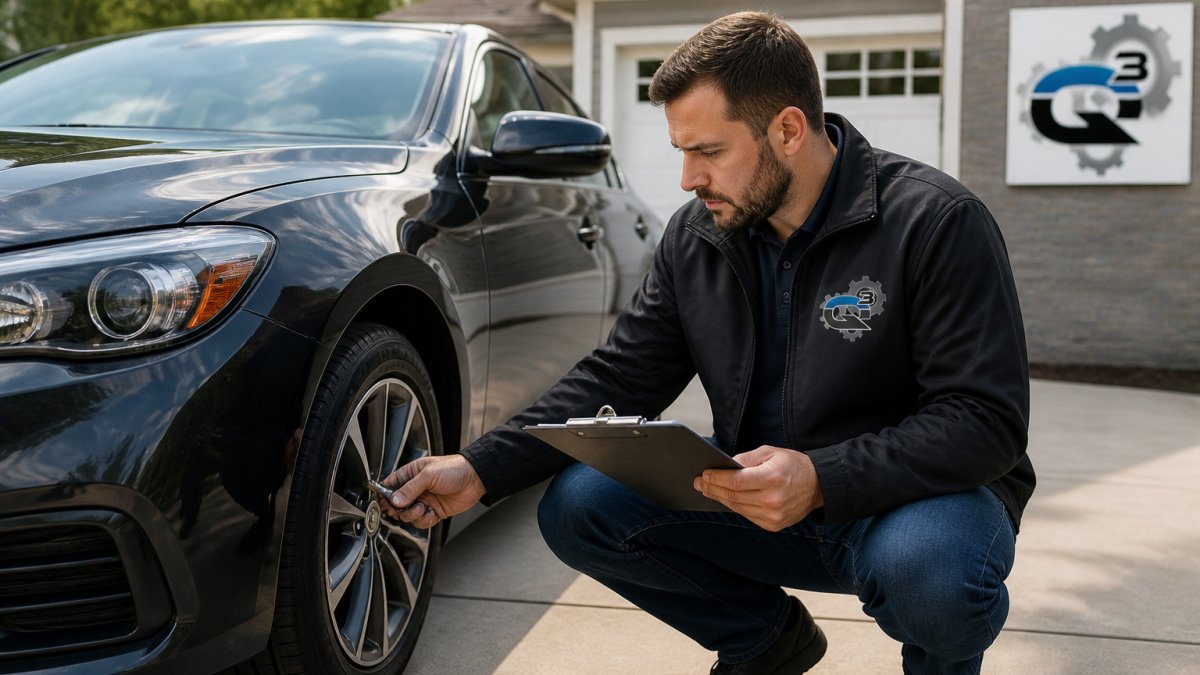
Record what you check and when. A simple notebook or phone note works. Log the date, mileage, what you checked, and anything you topped off or replaced.
7. Warning Signs, Safe DIY Limits and Booking Your First Service at Q3 Car & Truck Repair
Some warning signs need action the same day.
Simple tasks such as checking fluid levels, inflating tires, and replacing wiper blades are safe for beginners. Brake work, fuel system repair, and anything involving high-voltage or structural components belong with a qualified technician.
When you book your first service, bring your maintenance log, describe any symptoms in plain terms, and ask the technician to explain each recommendation before any work begins.
Frequently Asked Questions
What car maintenance should beginners do themselves?
Beginners can safely handle monthly checks that require no tools beyond a tire pressure gauge and a flashlight. These include checking engine oil level on a level surface with the engine off, confirming coolant is between the minimum and maximum marks on the reservoir, checking washer fluid, inspecting tire tread and pressure, and confirming that headlights, brake lights and turn signals work. Oil changes, brake pad replacement, alignments and anything involving a lifted vehicle or disassembly should go to a professional technician.
What should I check on my car every month?
A monthly car maintenance checklist should cover engine oil level, coolant level, brake fluid level, washer fluid, tire pressure (including the spare), tire tread depth, wiper blade condition and all exterior lights. Write each check and its date in a notebook or phone note. Recording the readings makes it easy to spot a fluid that drops faster than normal, which often signals a leak that needs attention.
How often should I change my car's oil?
Most owners should follow the interval in the owner's manual, which for many modern vehicles ranges from 5,000 to 10,000 miles, depending on the oil type and driving conditions. Drivers who make frequent short trips, drive in severe heat or cold, or tow a trailer should change oil more often than the manual's normal-use interval. If you are unsure which interval applies, check the owner's manual first and ask a technician to confirm it at your next visit.
What fluids should I check in my car?
The core fluids to check are engine oil, coolant, brake fluid, power steering fluid, automatic transmission fluid where the vehicle has a dipstick, and windshield washer fluid. Some vehicles have sealed transmissions with no dipstick, so the owner's manual is the authority on what you can check yourself. Note any fluid that is dark, milky, gritty or low, and have it inspected rather than simply topping it off.